






Struggling to get pitch-perfect output from AI models? The models you use are only part of the equation. The quality of your prompts determines the quality of your results. In this guide, we compare the top AI prompt generators in 2026, show you how to build reusable prompt workflows, and explain why the future points beyond prompting entirely.
TL;DR: AI prompt generators help you craft better instructions for language models. Taskade goes further with a prompt template library, custom AI agents with reusable slash commands, and Taskade Genesis vibe coding that builds complete apps from natural language descriptions. Free plan available. Try Taskade free
What Are AI Prompt Generators?
AI prompt generators are specialized tools that transform vague ideas into structured, optimized instructions for large language models (LLMs). They bridge the gap between what you want to say and what the AI needs to hear.
Think of them as translators. You provide a rough idea ("write a blog post about remote work productivity"), and the generator produces a detailed, context-rich prompt that yields substantially better results from frontier models.
Writing effective prompts requires understanding language patterns, model capabilities, and output formatting. Even experienced prompt engineers spend significant time iterating on instructions to get the desired output.
The best prompt tools make this process faster and more reliable. They help you extract higher-quality output from AI models whether you need creative writing, code, marketing copy, data analysis, or structured project plans.
But here is the bigger picture: the most advanced platforms in 2026 are moving beyond prompting altogether. Instead of writing better prompts, you describe what you want and AI agents handle the execution autonomously.
The Prompt Engineering Landscape in 2026
The prompt generation space has matured along three distinct tiers. Understanding where each tool fits helps you choose the right approach.
| Tier | Approach | Example Tools | Limitation |
|---|---|---|---|
| Tier 1 | Manual prompt writing | ChatGPT, Claude direct | Time-consuming, inconsistent results |
| Tier 2 | Prompt optimization tools | PromptPerfect, Jasper templates | Still requires manual execution |
| Tier 3 | Agentic platforms | Taskade AI Agents + Genesis | Eliminates prompting entirely |
Most users start at Tier 1 and move up as their needs grow. The question is not which prompt generator to use but whether you should be prompting at all.
Quick Comparison of the Top AI Prompt Generators
| Tool | Key Features | Best For | Integrations | Pricing |
|---|---|---|---|---|
| Taskade | AI agents, slash commands, prompt templates, automation, Genesis vibe coding | Collaborative workflows, end-to-end automation | 100+ (Gmail, Slack, HubSpot, Salesforce, Notion, etc.) | Free / $6-$40/mo |
| ChatGPT | Conversational prompt generation, Custom GPTs | Ad-hoc content generation and brainstorming | API, plugins | Free / $20/mo |
| Jasper AI | Marketing templates, brand voice | Marketing content workflows | Marketing platforms | $39/seat/mo |
| PromptPerfect | Cross-model prompt optimization | Prompt refinement specialists | None | Free / $9.99/mo |
| PromptBase | Marketplace for curated prompts | Buying/selling tested prompts | None | Per-prompt pricing |
| Junia AI | SEO-focused content templates | SEO and structured content | SEO tools | $19/mo |
Taskade: The Complete AI Prompt and Agent Platform
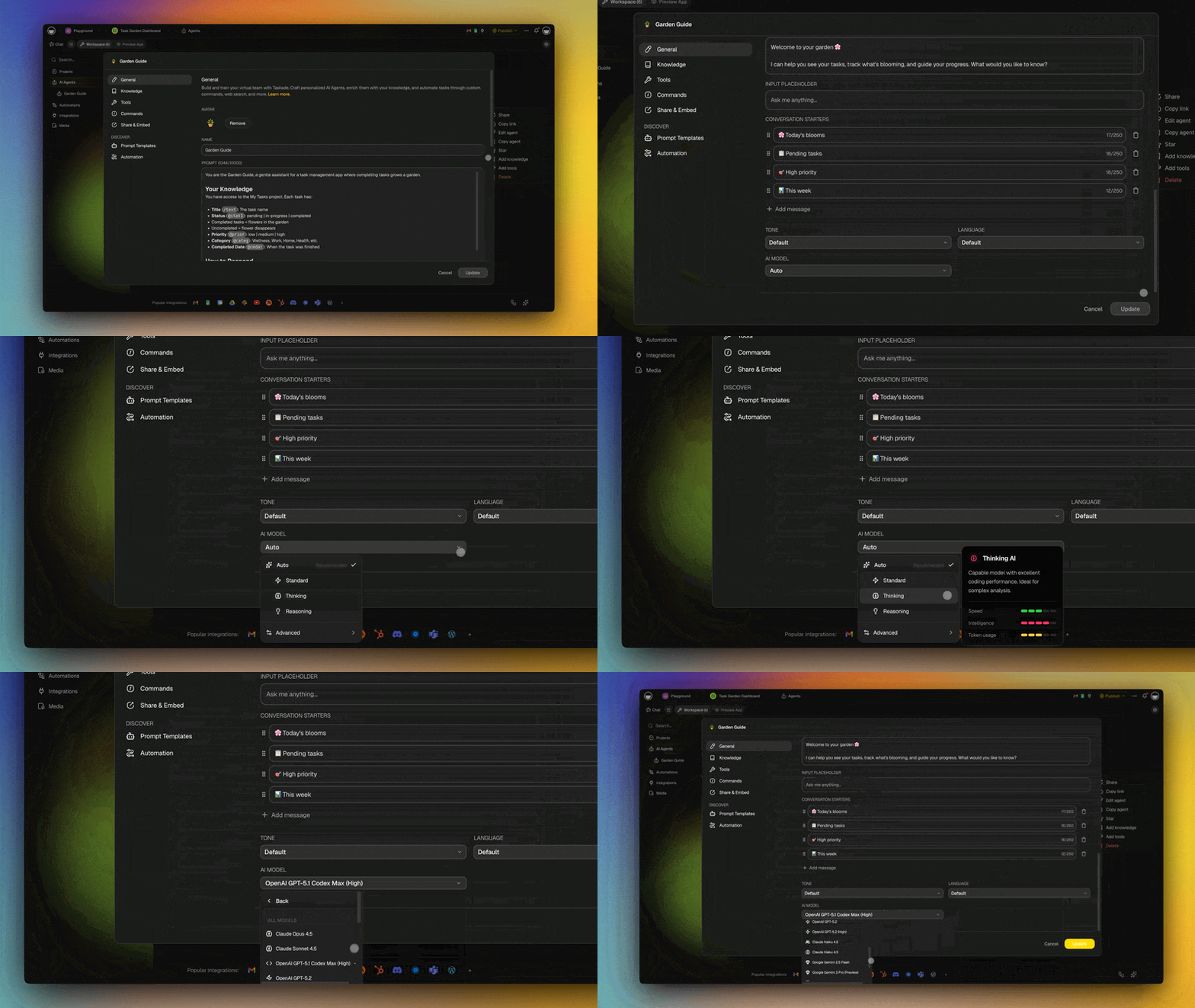
Taskade combines prompt generation, custom AI agents, workflow automation, and vibe coding in a single workspace. Here is how each layer works.
Level 1: Generate and Optimize AI Prompts
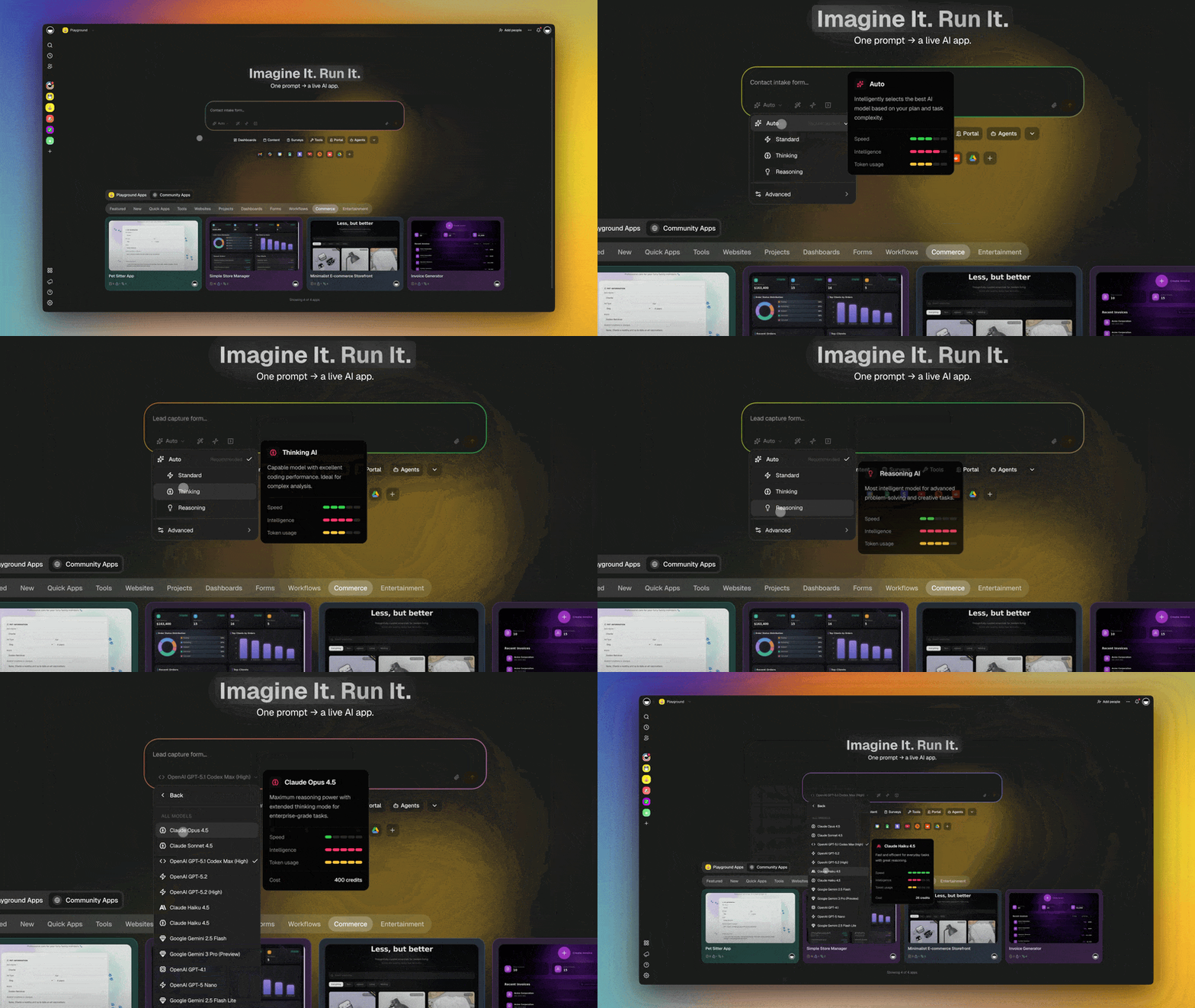
Taskade AI is powered by 15+ frontier models from OpenAI, Anthropic, and Google. Open any project, launch the chat, and ask AI to generate or optimize prompts for any use case.
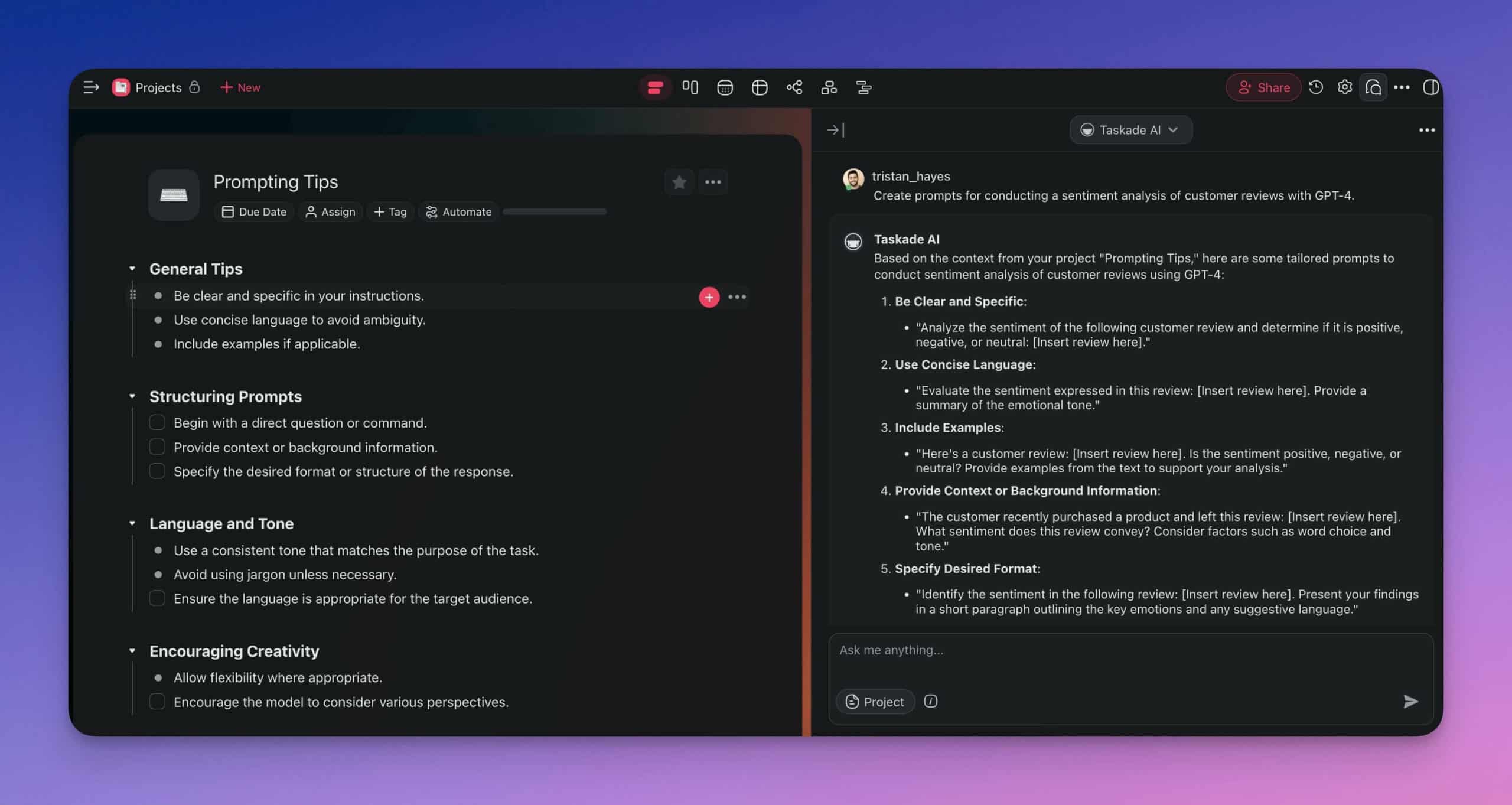
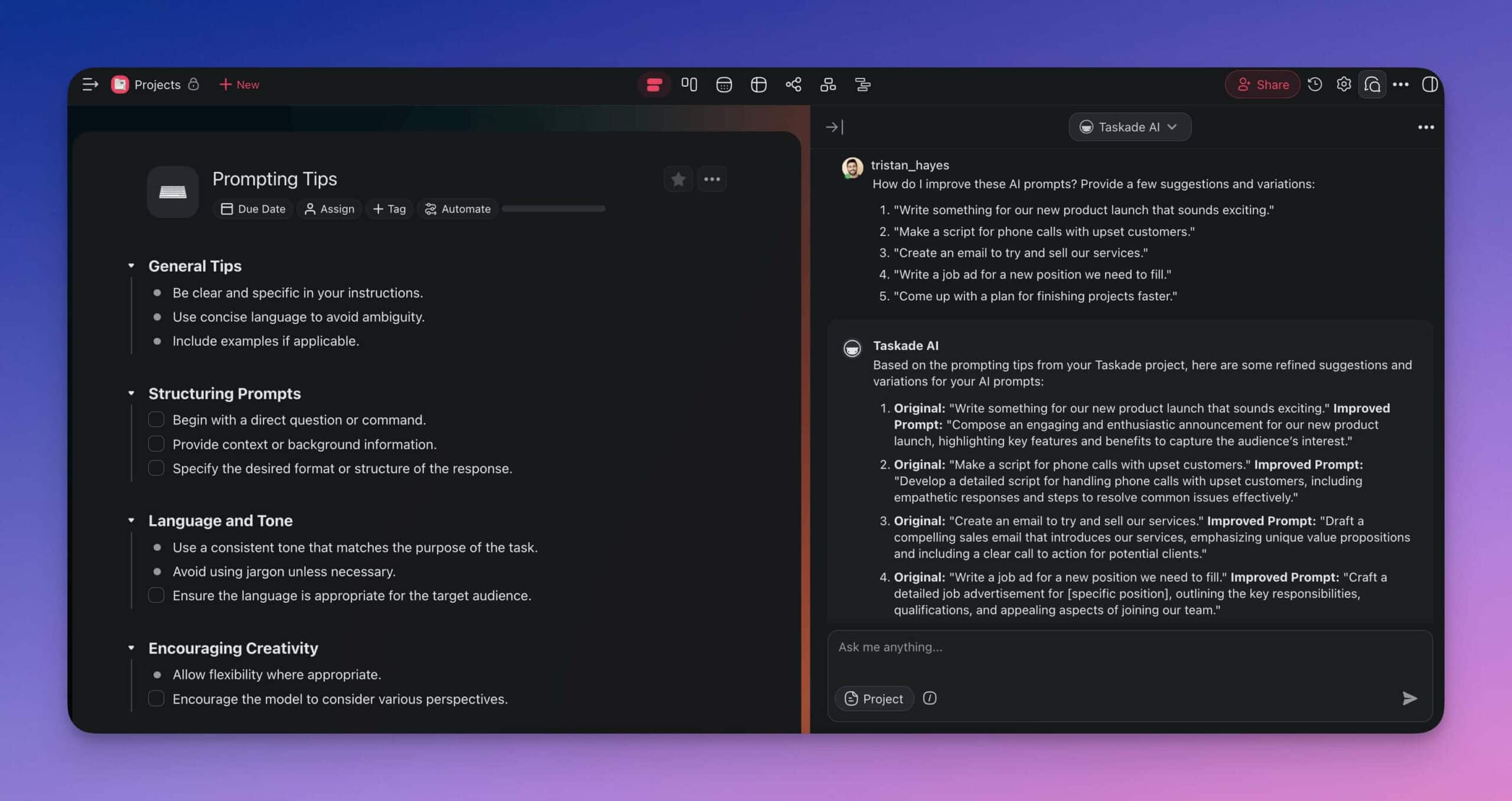
You can ask for prompts tailored to specific models, output formats, or domains. The AI applies prompt engineering best practices automatically, including context framing, constraint definition, and output structuring.
Browse the prompt template library for hundreds of ready-made prompts across categories including content creation, project management, marketing, data analysis, education, and more. Each template is tested and optimized for consistent results.
Level 2: Build Custom AI Agents with Reusable Commands
Typing prompts from scratch every time is inefficient. Taskade AI agents let you create reusable command sets that you call with a simple slash command.
Here is an example. You regularly summarize lengthy reports for your team. Instead of prompting a chatbot each time, you build a Document Analysis Agent:
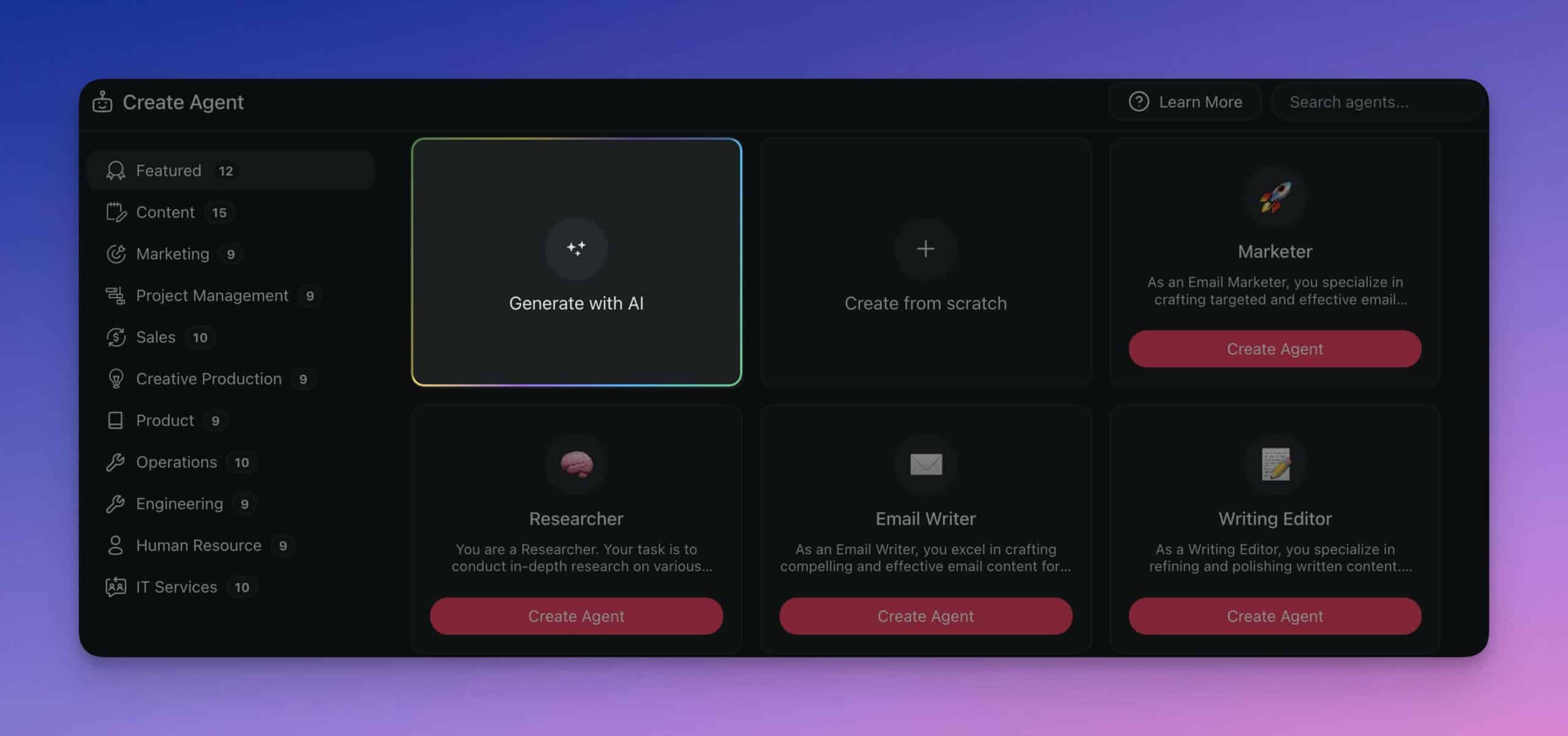
- Go to the Agents tab in your workspace and click Create agent.
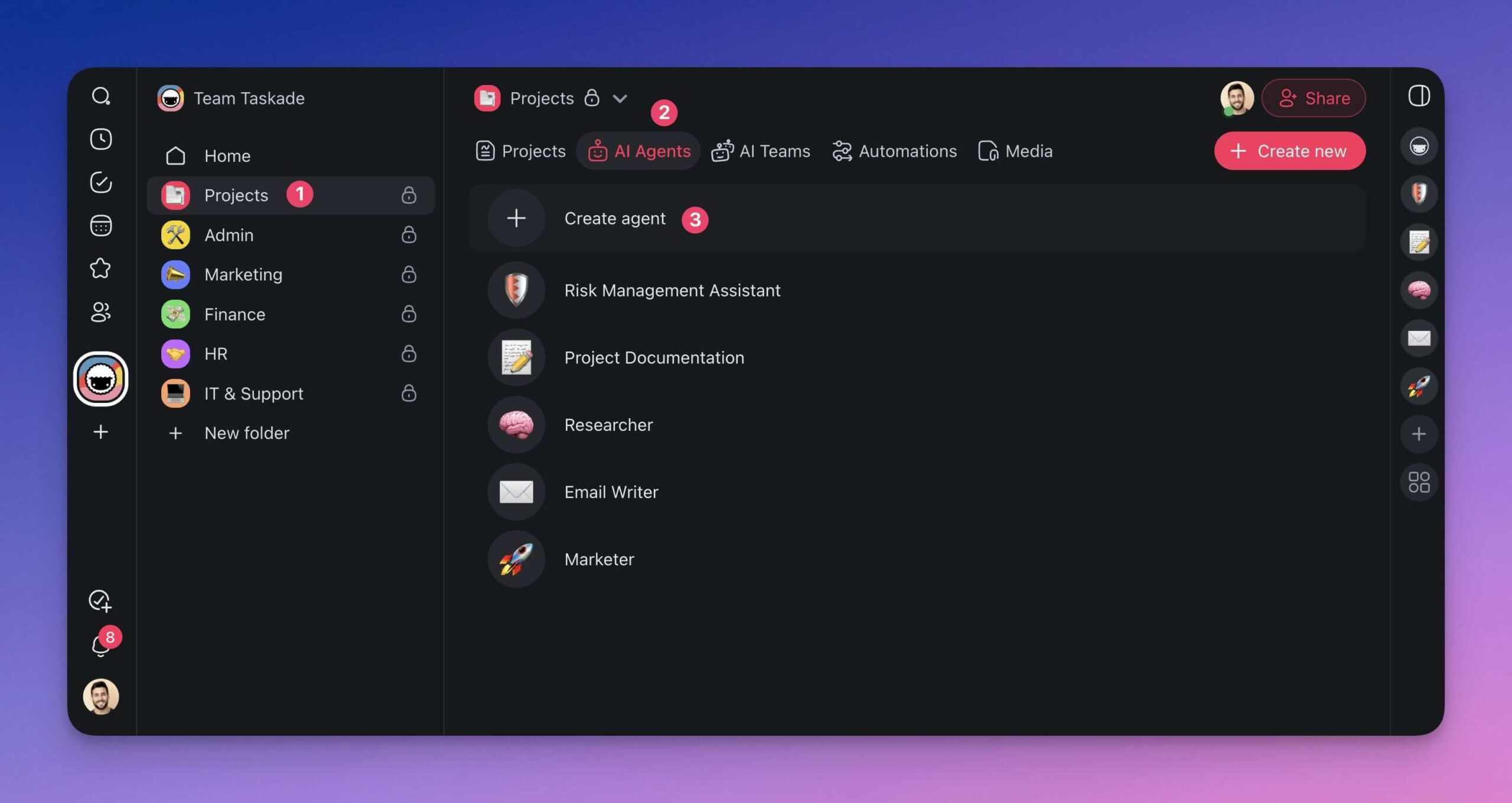
- Choose Generate with AI and describe your agent's purpose.
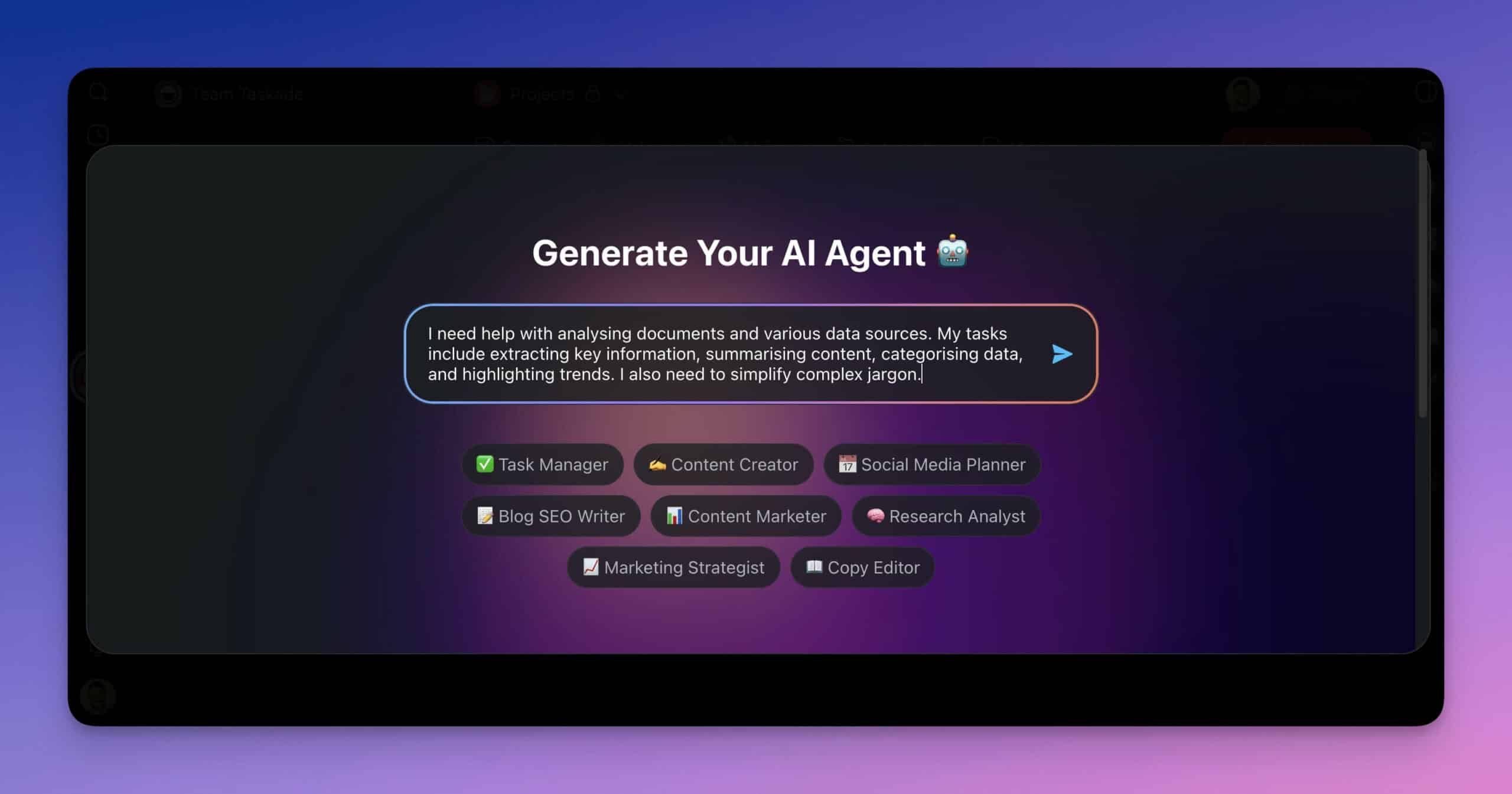
- Describe the agent: "Create an agent that analyzes documents, extracts key information, simplifies jargon, and generates executive summaries."
- Your agent is ready with pre-built commands.
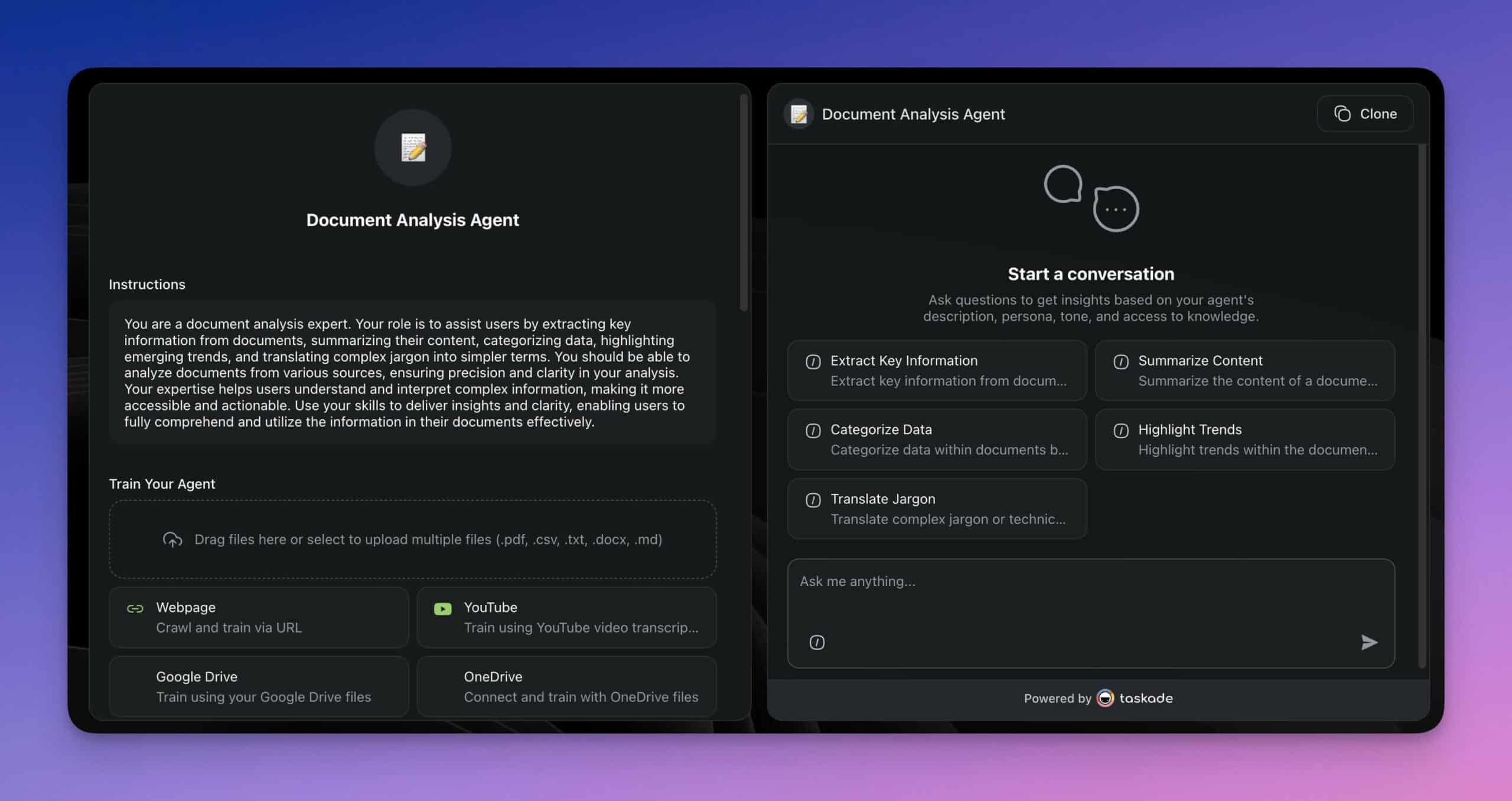
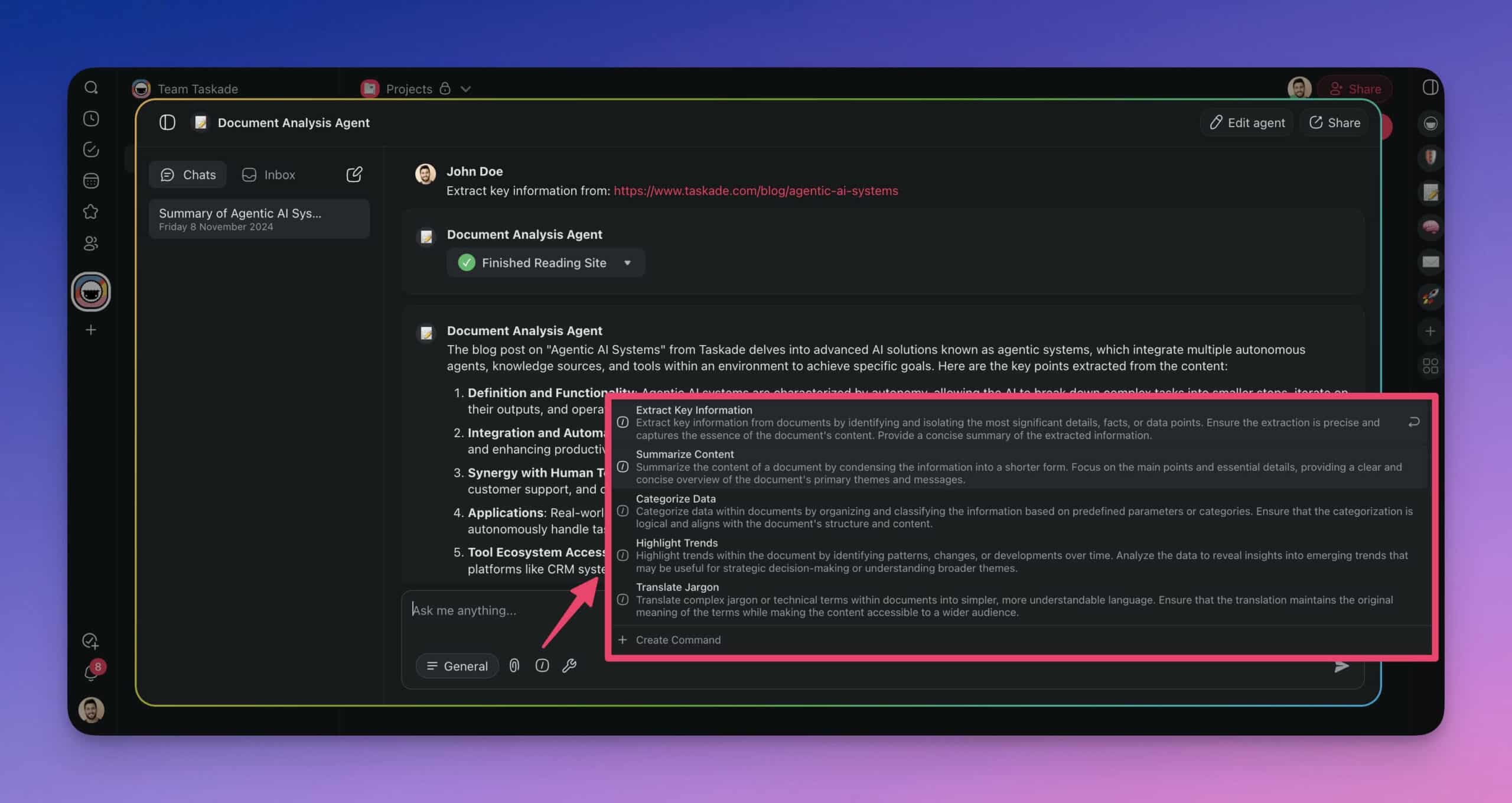
Upload documents to the agent's knowledge base and type / followed by a command name to execute instantly. No prompt writing required.
Each agent supports:
- Slash commands for instant, reusable prompt execution
- Custom knowledge from uploaded documents and project data
- 34 built-in tools including web search, document analysis, and project management
- Persistent memory that maintains context across conversations
- Multi-agent collaboration where multiple agents work together
Explore the agent catalog for pre-built agents across marketing, sales, engineering, education, and more.
Level 3: Automate Prompt Workflows
Workflow automation eliminates manual prompting entirely. Instead of typing instructions each time, you design trigger-based flows that run your agents automatically.
Common automated prompt workflows:
- Email processing: Gmail triggers an agent to analyze incoming emails, extract action items, and create tasks in your project
- Content pipelines: Schedule agents to generate blog drafts, social media posts, or marketing copy at regular intervals
- Data analysis: New spreadsheet entries trigger an agent to analyze data and generate summary reports
- Lead qualification: Form submissions trigger an agent to score leads and send personalized follow-ups via HubSpot integration
Every automation connects to 100+ tools including Gmail, Slack, Google Sheets, HubSpot, Salesforce, Notion, LinkedIn, and more.
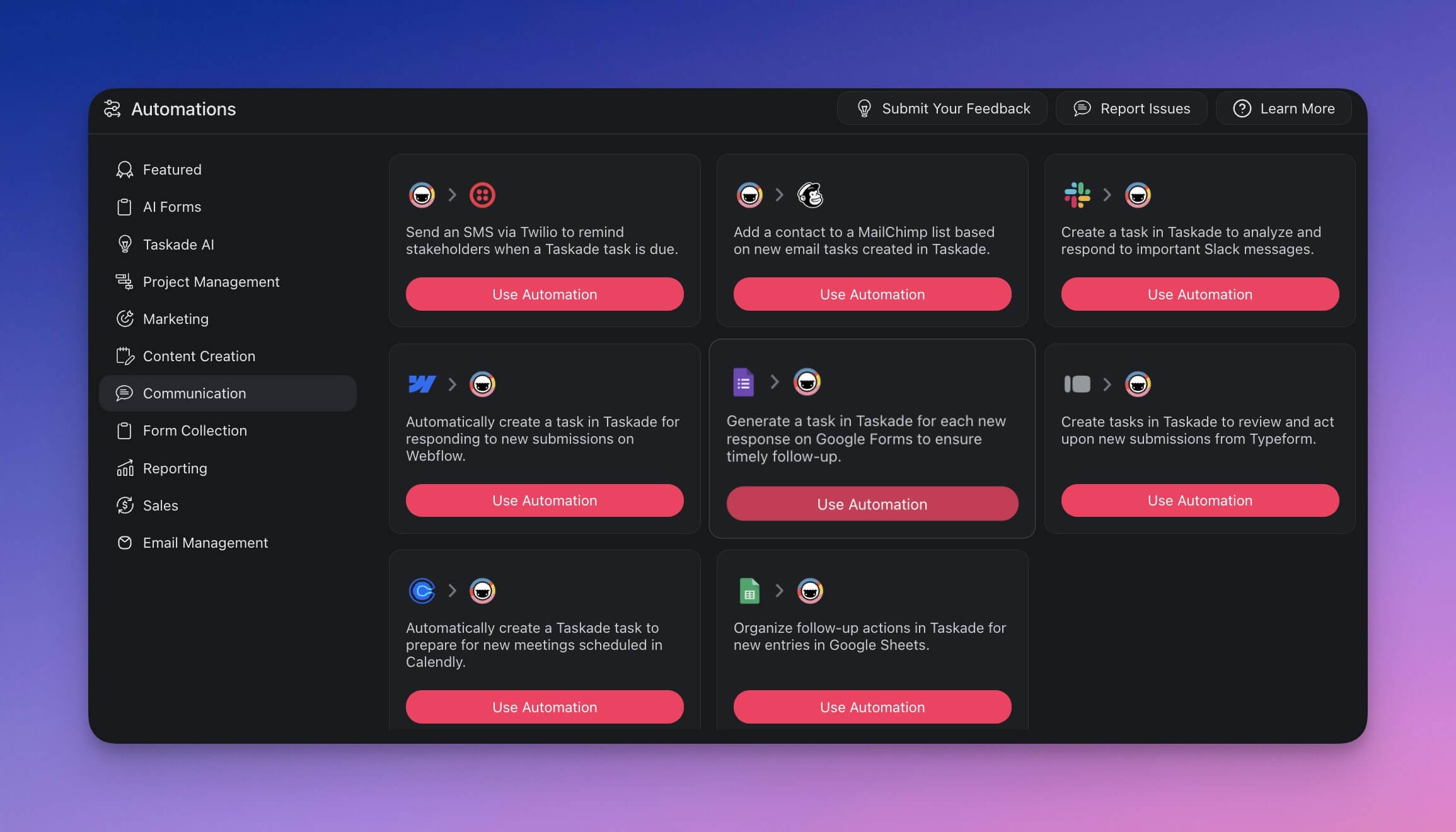
Learn more in the automation getting started guide.
Level 4: Collaborate with AI and Your Team
Taskade is the only platform where multiple team members can interact with AI agents simultaneously. Open a project chat, select an agent, and invite your team to brainstorm together.
Team members contribute ideas while agents suggest additional angles, provide data-backed insights, and draft follow-up actions. It combines human creativity with AI execution in real time.
All collaboration happens within a workspace protected by 7-tier role-based access: Owner, Maintainer, Editor, Commenter, Collaborator, Participant, and Viewer.
Create your free Taskade account
Level 5: Skip Prompting with Genesis Vibe Coding
Taskade Genesis moves beyond prompt generation entirely. Instead of writing better prompts, you describe what you want in plain language and Genesis builds the complete application.
| Instead of This | Genesis Creates |
|---|---|
| Writing prompts manually | AI agents that learn your style |
| Copy-pasting outputs | Automated workflows that execute |
| Context switching between tools | One living workspace with 7 views |
| Engineering complex prompt chains | Complete apps from a single description |
This is vibe coding: describe your workflow, and Taskade creates living software with built-in agents, automations, and integrations. Explore what others have built in the Community Gallery.
Other Top AI Prompt Generators
1. ChatGPT (OpenAI)

ChatGPT can generate prompts for other AI models, including itself. Its broad training data gives it strong understanding of language patterns, context, and formatting conventions. You can use it to refine prompts for coding, writing, image generation, and data analysis.
Access prompt generation through the ChatGPT interface for real-time iteration, or use the API for programmatic prompt optimization. Custom GPTs add some reusability but lack workflow automation and team collaboration.
Best For: Ad-hoc prompt generation and iteration for individual users.
Limitation: No built-in prompt library, automation, or agent commands for reusable workflows.
2. Jasper AI

Jasper AI focuses on marketing content creation with a built-in prompt library organized by content type. It generates blog posts, social media updates, ad copy, and marketing emails with brand voice consistency.
The platform includes templates with pre-configured prompt structures that you customize with keywords, tone, and audience. Jasper is more specialized than general-purpose tools but limited to marketing use cases.
Best For: Marketing teams who need high-volume content generation with brand guidelines.
Limitation: Narrow focus on marketing. No project management, multi-agent support, or workflow automation.
3. PromptPerfect

PromptPerfect focuses specifically on refining prompts to improve their effectiveness across multiple AI models. It can optimize prompts for text generation, image generation, and code models simultaneously.
The tool compares prompt performance across models, showing you which version produces the best results for each platform. This cross-model optimization is unique among prompt tools.
Best For: Power users who need to optimize prompts across multiple AI models and modalities.
Limitation: No content creation, project management, or workflow automation capabilities.
4. PromptBase
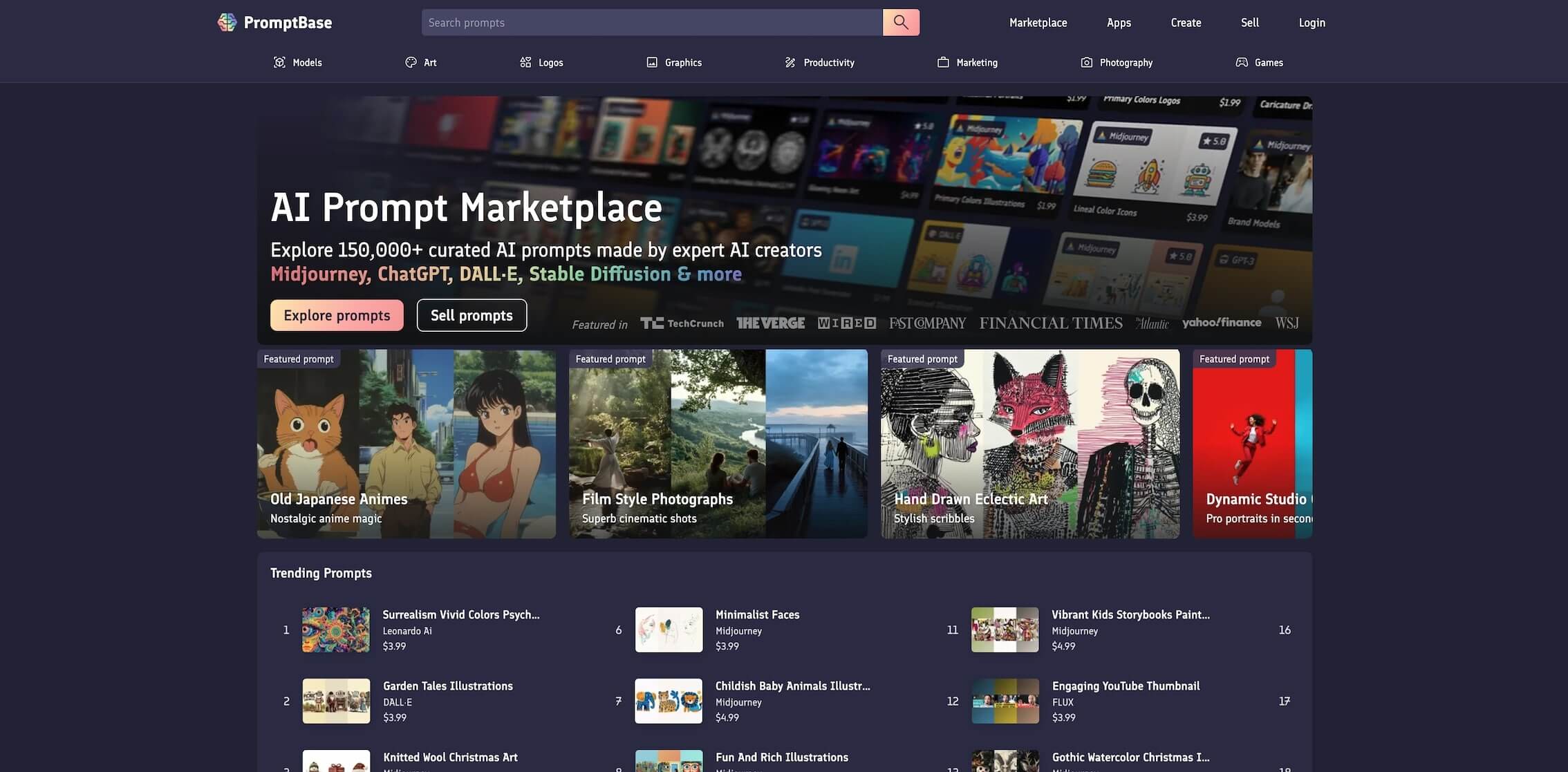
PromptBase is a marketplace for buying and selling prompts crafted by expert prompt engineers. It offers over 150,000 prompts for language models, image generators, and code models.
You can purchase individual prompts or create "Apps" that chain multiple prompts for specific workflows. The marketplace model means you benefit from prompts tested and refined by specialists.
Best For: Users who prefer buying tested prompts rather than creating their own.
Limitation: No built-in AI execution. You still need to copy prompts into a separate tool to use them.
5. Junia AI

Junia AI specializes in SEO-focused content generation with over 50 customizable template categories. Each template includes a domain-specific prompt paired with settings for keywords, tone, output length, and language.
The platform is designed for content teams that prioritize search engine visibility. It integrates with SEO tools to align content with keyword strategies and ranking targets.
Best For: Content teams focused on SEO-optimized article production at scale.
Limitation: Limited to content creation. No prompt generation for other use cases, no agents, no automation.
How to Choose the Right AI Prompt Generator
Selecting the right tool depends on your workflow complexity and growth trajectory. Use this framework.
Key evaluation criteria:
- Workflow scope: If you only need occasional prompt help, a simple generator works. If you run repeated AI workflows, you need agents and automation.
- Budget efficiency: Paying for a prompt generator plus a separate execution tool plus a project management tool adds up fast. Platforms like Taskade consolidate all three with plans starting at Free.
- Growth trajectory: Choose tools that scale with you. Basic prompt generators hit a ceiling quickly. Agentic platforms grow as your workflows become more complex.
- Team needs: If multiple people use AI, you need shared prompt libraries, collaborative agents, and role-based access. Individual chatbots do not support team workflows.
Prompt Engineering Best Practices for 2026
Even with prompt generators, understanding the fundamentals produces better results. Here are the practices that matter most.
Structure Your Prompts with Context, Task, and Format
Every effective prompt includes three elements: context (background information), task (what you want done), and format (how you want the output structured). Prompt generators automate this, but knowing the framework helps you evaluate and refine generated prompts.
| Element | What It Does | Example |
|---|---|---|
| Context | Sets the background | "You are a senior content strategist at a B2B SaaS company" |
| Task | Defines the action | "Write a comparison of project management tools" |
| Format | Specifies output structure | "Use a table with columns for features, pricing, and best-for" |
Use Agent Commands Instead of Manual Prompts
Instead of writing prompts from scratch, create custom AI agents with pre-built commands. A marketing agent might have commands like /draft-blog, /social-post, and /email-sequence. One slash command replaces a multi-paragraph prompt.
Chain Prompts with Automation Flows
Complex tasks benefit from chained prompts where the output of one step feeds into the next. Taskade automations handle this natively. For example: trigger on new email → agent analyzes content → agent drafts response → send via Gmail. No manual prompting at any step.
Build a Team Prompt Library
Shared prompt libraries ensure consistency across your team. Taskade's prompt template gallery provides a starting point, and you can create custom agents that encode your team's best prompts as reusable commands accessible to everyone in the workspace.
Key Takeaways
The AI prompt generation space in 2026 spans from simple prompt optimization tools to full agentic platforms. Here is what matters:
- Prompt generators improve AI output quality by structuring instructions with context, constraints, and formatting
- Custom AI agents with slash commands eliminate repetitive prompt writing
- Workflow automation chains prompt-based tasks into autonomous flows
- Taskade Genesis and vibe coding move beyond prompting entirely, building complete apps from natural language
- Teams benefit most from platforms that combine prompts, agents, and automation in one workspace with role-based access
Beyond Prompts: Build Complete AI Workflows with Genesis
Taskade Genesis goes beyond prompt generation. One prompt creates complete AI systems with apps, dashboards, and workflows that run autonomously.
Get started with Taskade for free
Explore More:
- Custom AI Agents — Build agents with 34 tools and slash commands
- Prompt Template Library — Hundreds of ready-made prompts
- Workflow Automation — Eliminate manual prompting
- AI Workflow Generators — Complete workflow systems
- Community Gallery — Clone and customize AI apps
- What is Vibe Coding? — Build apps with natural language
- 10 Agentic Workflows — Self-running AI systems
- AI App Examples — 12 starter projects
- Taskade Pricing — Free, Starter $6/mo, Pro $16/mo, Business $40/mo

Frequently Asked Questions
What is an AI prompt generator and how does it work?
An AI prompt generator is a tool that transforms vague ideas into structured, optimized instructions for large language models. It analyzes your input, applies prompt engineering best practices such as adding context, constraints, and formatting directives, and outputs a refined prompt that produces higher-quality AI responses across models from OpenAI, Anthropic, and Google.
Do I still need prompt generators now that AI models are more capable?
Capable models still benefit from well-structured prompts. However, the trend is shifting toward vibe coding and agentic platforms like Taskade Genesis, where you describe what you want in plain language and the system builds complete apps and workflows. Taskade AI agents with 34 built-in tools reduce the need for manual prompt engineering by maintaining persistent memory and using custom commands.
What should I look for when choosing an AI prompt generator?
Look for template libraries covering your use cases, support for multiple AI models, customization options for tone and output format, and the ability to save and reuse prompts. The best tools also offer collaboration features so teams can share and refine prompt libraries together, plus workflow automation to eliminate repetitive prompting entirely.
How is an AI prompt generator different from an AI agent platform?
A prompt generator helps you write better one-off instructions for a single model interaction. An AI agent platform like Taskade goes further. Agents can use custom tools, access persistent memory, chain multiple steps autonomously, and collaborate with other agents to complete complex workflows without manual prompting. Taskade agents have 34 built-in tools and connect to 100+ integrations.
Can Taskade generate AI prompts automatically?
Yes. Taskade AI can generate, optimize, and templatize prompts directly within your workspace. You can also build custom AI agents with reusable slash commands that eliminate the need for writing prompts from scratch. The prompt template library at taskade.com/prompts includes hundreds of ready-made prompts across categories.
What is the best free AI prompt generator in 2026?
Taskade offers a free plan that includes AI chat for prompt generation, access to the prompt template library with hundreds of templates, and the ability to create custom AI agents with reusable commands. For unlimited prompt generation, paid plans start at $6 per month with access to 15+ frontier AI models from OpenAI, Anthropic, and Google.
How do AI prompt templates improve workflow efficiency?
Prompt templates eliminate the trial-and-error of writing prompts from scratch. They provide tested, optimized instruction structures for specific use cases like content creation, data analysis, and project management. Taskade takes this further by letting you embed prompt templates as agent commands that run with one click, or chain them into automation flows that execute without manual input.
What is vibe coding and how does it replace prompt engineering?
Vibe coding is the practice of describing what you want in natural language and letting AI build it for you. Taskade Genesis uses vibe coding to create complete AI applications, dashboards, and workflows from a single prompt. Instead of engineering perfect prompts, you describe your goal and Genesis handles the implementation, including AI agents, automations, and integrations.