




The Upload Trap: Why Static Training Fails
The ritual of “AI training” today looks like this:
- Upload 50 PDFs to a “custom GPT.”
- Ask it questions.
- Marvel as it spits your words back at you.
- A week later, it’s stale, irrelevant, and dumb again.
This isn’t training. It’s document dumping. Like pouring water into sand. It soaks for a moment, then vanishes. It feels clever in a demo, but it collapses when real work begins.
Real training doesn’t happen in a dump. It happens in a loop.
| Aspect | Static Upload | Living Knowledge |
|---|---|---|
| Data freshness | Snapshot that degrades within days | Updates automatically as work happens |
| Agent context | Limited to uploaded documents | Draws from live projects, workflows, and interactions |
| Maintenance | Manual re-uploads on a schedule | Zero maintenance - knowledge stays current by design |
| Scaling | More files = slower retrieval, more noise | More activity = deeper intelligence, stronger connections |
| Intelligence growth | Flat - agent never improves after upload | Compounding - every cycle makes the agent sharper |
The Genesis Way: Living Knowledge Systems
Taskade Genesis cultivates living knowledge systems that grow as your work grows. Think of it less like uploading a book into a chatbot, and more like planting a tree in a garden.
- Every form submission is sunlight.
- Every workflow is soil.
- Every interaction is rain.
Agents don’t sit on a static archive. They live in your workspace, absorbing every drop and carrying it forward. That’s the difference between chatbots and Genesis: one forgets, the other evolves.
How Biological Learning Actually Works
The distinction between document dumping and living knowledge has a deep scientific basis.
In 1949, psychologist Donald Hebb proposed a rule that became the foundation of biological learning: neurons that fire together wire together. When two neurons are active simultaneously during an experience, the connection between them strengthens. This Hebbian learning is how the brain forms associations - not by storing files, but by strengthening pathways through repeated use.
Neuroscience has since confirmed that memories are stored as engrams - small ensembles of neurons selected through an excitability competition. The neurons that are most ready to fire at the moment of learning win the competition and get recruited into the memory trace. Crucially, this excitability fluctuates over time in windows of several hours.
This has a profound implication: timing matters. When two experiences happen within the same excitability window, they recruit overlapping neurons and become automatically linked. Separate them by more than 24 hours, and they form independent, non-overlapping traces.
Living knowledge systems mirror this biology:
- Hebbian learning = connections strengthen through use, not through manual uploads. The more your agents interact with specific workflows, the stronger those knowledge pathways become.
- Excitability windows = timing matters for knowledge connection. Information that flows through the system together gets linked together - just as neurons that fire together wire together.
- Continuous encoding = the brain doesn’t batch-process memories in weekly uploads. It encodes continuously, in real time, as experiences happen. Living knowledge does the same.
This is why static document dumps fail. They bypass the compounding mechanism entirely. Real learning requires continuous exposure, association through use, and the time to let connections strengthen.
Knowledge That Compounds
Growth doesn’t come from throwing more files at a chatbot.
Growth comes from knowledge that compounds.
- A Sales Agent learns which deals close, which stall, and why.
- A Support Agent evolves with every resolved ticket, every customer conversation.
- A Growth Agent experiments, learns what worked, and adjusts the next run.
This is how intelligence compounds, every cycle sharper than the last.
Architecture of Living Memory
So, what's the recipe for effective agent training?
The secret is structural.
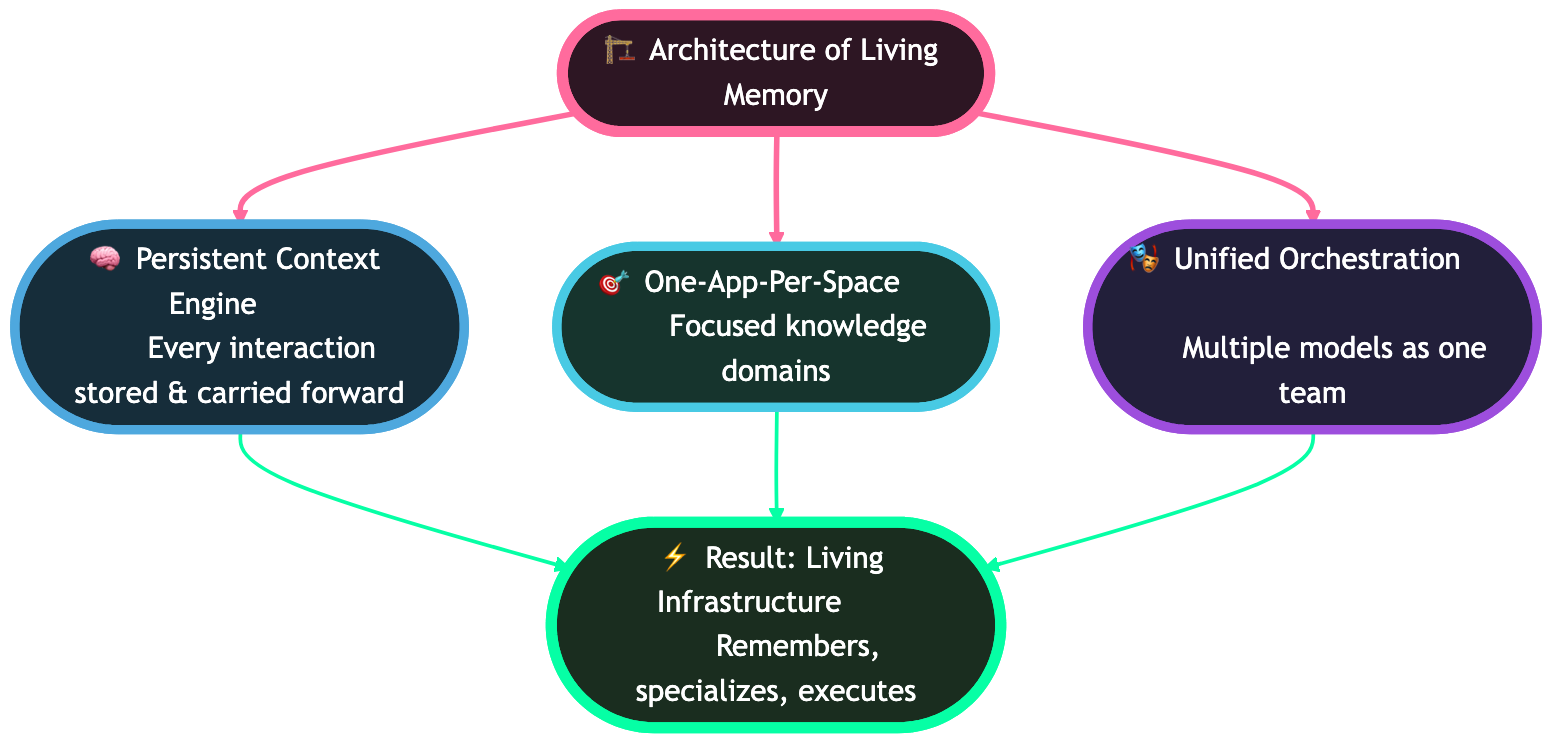
- Persistent Context Engine → Every interaction is stored and carried forward, not forgotten.
- One-App-Per-Space → Each Space is a focused knowledge domain.
- Unified Orchestration → Multiple models and tools coordinate as a single team of agents.
The result is not a parlor trick. It’s infrastructure. A system that remembers, specializes, and executes.
Two recent capabilities make this architecture dramatically more powerful:
Custom agent tools. Any automation workflow can be exposed as a tool that your agent invokes during conversations. Your Sales Agent doesn’t just know about leads. It can check their Shopify order history, update their HubSpot record, and trigger a Slack notification, all from a single conversational exchange. The automation is the agent’s hands.
Background agents. On Pro plans and above, agents run autonomously. They process new form submissions, monitor project changes, and execute workflows while you sleep. Knowledge doesn’t just compound when you’re using it. It compounds around the clock.
Workflows, Not Demos
The difference between chatbots and Taskade Genesis lies in how knowledge flows through the system.
- A Customer Portal App collects tickets and feedback that directly strengthen your Support Agent.
- An Investor Dashboard feeds live metrics and Q&A into your Fundraising Agent.
- A CRM Dashboard teaches your Sales Agent which pitches convert.
- A Growth Command Center runs experiments, tracks outcomes, and passes the lessons forward.
We call this work engineering.
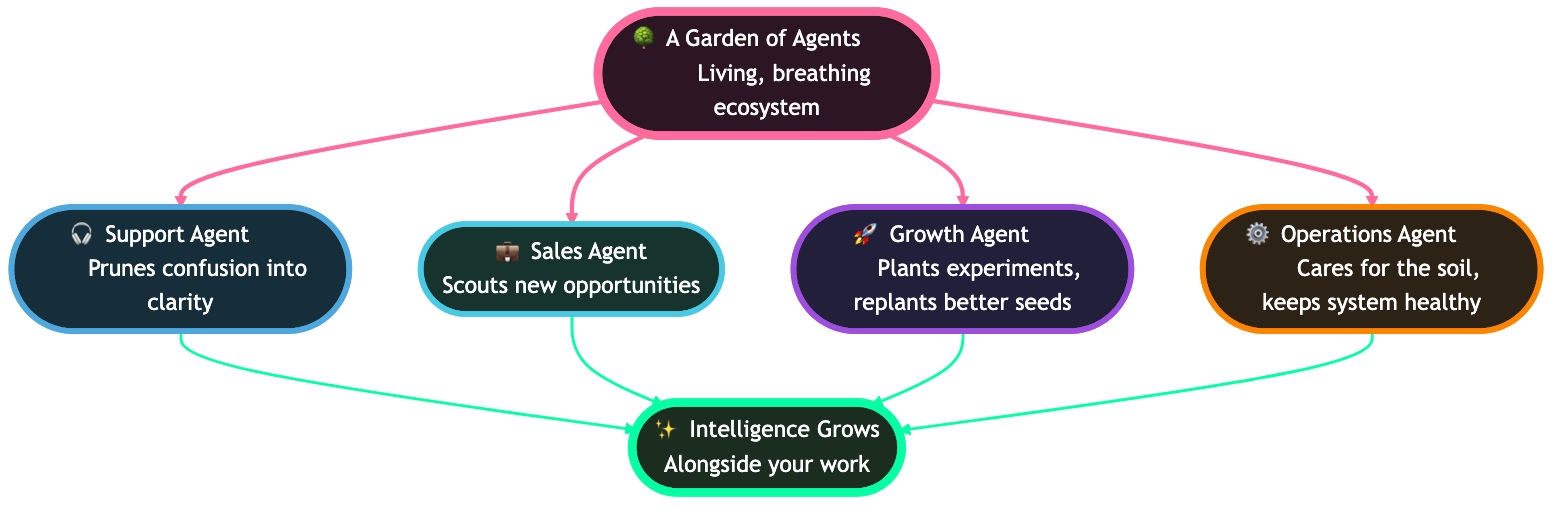
A Garden of Agents
Imagine your workspace as a garden, and your agents as its caretakers.
- The Support Agent prunes confusion into clarity.
- The Sales Agent scouts new paths and brings back opportunities.
- The Growth Agent plants experiments, measures what grows, and replants with better seeds.
- The Operations Agent cares for the soil, keeping the system healthy.
This is a living, breathing ecosystem where intelligence grows alongside your work.
From Knowledge to Execution
Knowledge without execution is trivia. Execution without knowledge is chaos.
Genesis closes the loop:
- Collect knowledge through Genesis Apps.
- Feed it into persistent agent memory.
- Let agents execute with living context.
- Watch the system grow stronger with every cycle.
Each loop compounds. Each loop creates deeper intelligence.
Step-by-Step: Train Your First Agent
Here's how to build a living knowledge system in 10 minutes:
1. Create a Knowledge Project
Start with a Taskade project containing your core documents, SOPs, or past work. This becomes your agent's foundational memory.
2. Build a Custom Agent
Navigate to AI Agents → Create Agent. Connect it to your knowledge project. Your agent now has context about your work.
3. Deploy a Genesis App
Use a prompt like: "Build a customer FAQ portal powered by my knowledge base." Genesis creates the interface while your agent handles the intelligence. Need more prompt ideas? Browse our prompt templates for dozens of agent-ready starting points.
4. Connect Workflows
Add automations that feed new data back into your agent:
- Form submissions → Agent learns from customer questions
- Resolved tickets → Agent learns successful answers
- Meeting notes → Agent learns team decisions
5. Watch It Compound
Every interaction makes your agent smarter. What starts as a simple FAQ becomes an expert system that knows your business better each week.
| Week | Agent Capability |
|---|---|
| Week 1 | Answers basic questions from uploaded docs |
| Week 4 | Handles edge cases from customer interactions |
| Week 8 | Proactively suggests improvements based on patterns |
| Week 12 | Operates as a domain expert trained on your specific context |
This is how you build AI agents that actually work.
Why This Matters
The AI industry is obsessed with the wrong metrics.
Every few months, we're told the next model will be "10x smarter" and "unlock" capabilities we couldn't access before. Companies debate which frontier model has the best reasoning scores.
But here's what no one wants to admit:
The next leap in AI isn't bigger models or flashier prompts.
It's systems that think, learn, and execute with humans.
That’s what Genesis delivers: execution intelligence that grows with your company.
Stop Uploading PDFs. Start Building Systems.
The future of AI training isn’t about dumping documents into a chatbot.
It’s about cultivating living systems that learn with you, grow with you, and execute for you.
That’s how you stop worshipping prompts, and start building workflows.
Read more: Stop Worshipping Prompts. Start Building Workflows | What Are AI Agents?
Explore Taskade AI:
- AI App Builder - Build complete apps from one prompt
- AI Dashboard Builder - Generate dashboards instantly
- AI Workflow Automation - Automate any business process
Build with Genesis:
- Browse All Generator Templates - Apps, dashboards, websites, and more
- Browse Agent Templates - AI agents for every use case
- Explore Community Apps - Clone and customize

Frequently Asked Questions
Why does uploading PDFs to a custom GPT stop working after a few days?
Static document uploads create a snapshot of knowledge that degrades over time. The information becomes stale as your business evolves, the AI lacks context about recent changes, and the retrieval system can't distinguish between outdated and current information. This is the 'upload trap' - document dumping feels productive but produces agents that are perpetually behind.
What is a living knowledge system for AI agents?
A living knowledge system connects AI agents to dynamic data sources - project databases, form submissions, workflow outputs, real-time collaboration - so the agent's knowledge updates automatically as work happens. Instead of periodic manual uploads, the agent learns continuously from the same workspace where your team operates. The knowledge is alive because it grows with your business.
How do I keep AI agent knowledge fresh without constant retraining?
Connect agents to live data sources rather than static uploads. When your agents draw knowledge from the same projects and databases your team actively uses, every update, comment, or workflow output automatically becomes part of the agent's context. This eliminates the retraining cycle entirely - the agent stays current because it reads from the same source of truth your team writes to.
How does biological learning explain why living knowledge systems work?
Biological learning follows Hebbian principles: neurons that fire together wire together, meaning connections strengthen through repeated co-activation, not through bulk uploads. Memories are stored as engrams - sparse neuron ensembles selected through excitability competition. Timing matters: experiences within the same excitability window (several hours) recruit overlapping neurons and become automatically linked. Living knowledge systems mirror this biology - connections strengthen through use, information that flows together gets linked together, and encoding happens continuously in real time rather than in periodic batch uploads.
What is the difference between document dumping and knowledge gardening for AI?
Document dumping is uploading everything you have and hoping the AI figures it out. Knowledge gardening is intentionally cultivating what the agent knows: organizing information by topic, connecting it to live data flows, pruning outdated content, and designing feedback loops where agent interactions generate new knowledge. Gardening compounds over time; dumping degrades.