

See the alternative working — clone in 60 seconds
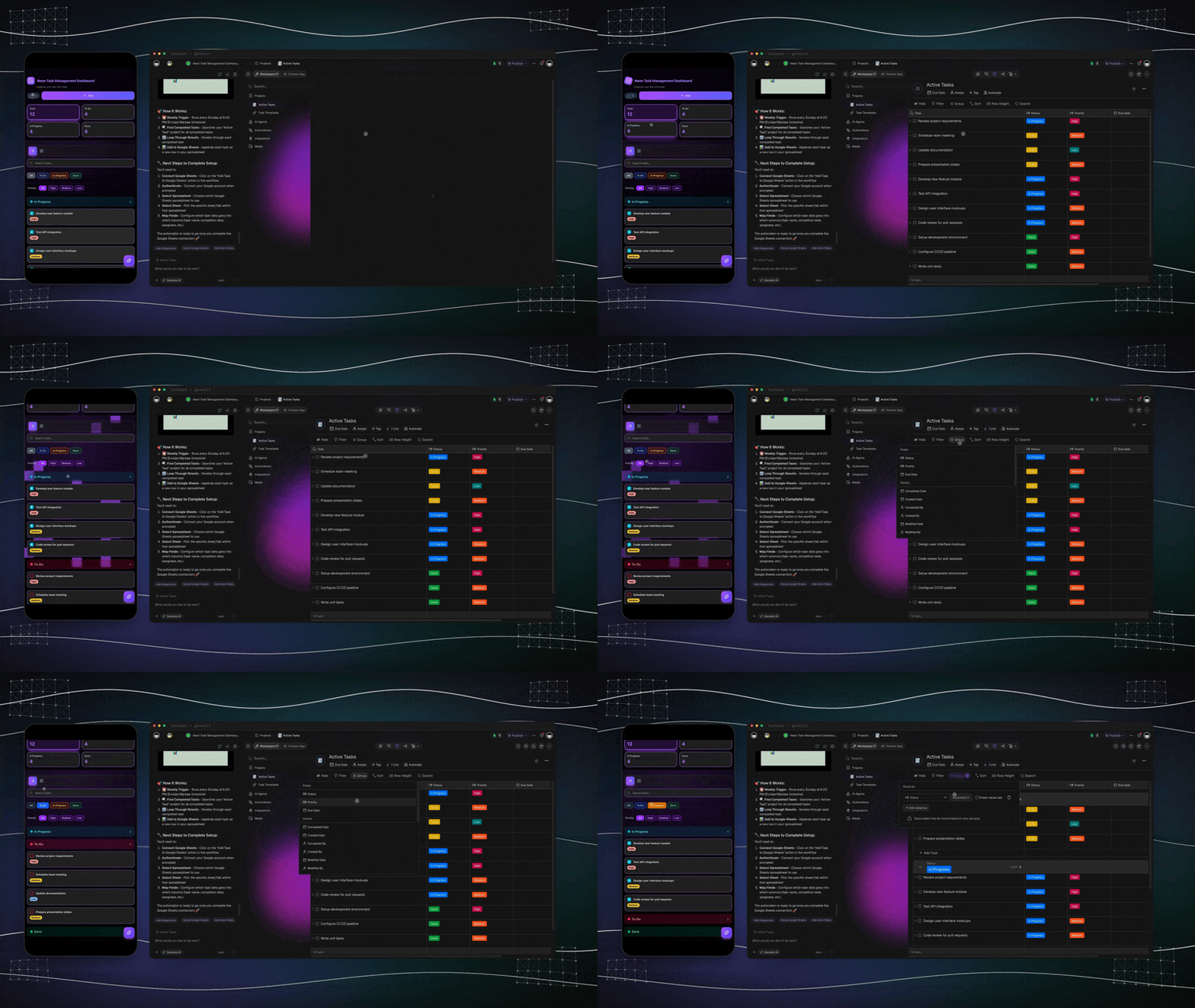
No signup, no credit card. Open the live neon task manager → (opens in new tab)
| Capability | TickTick | Taskade Genesis |
|---|---|---|
| Pricing (starting) | Free, with TickTick Premium around $36/year | $0 Free · $16/mo Pro (10 seats) |
| Cloneable live demo | ❌ | ✅ |
| Built-in AI agents | None | ✅ 33 built-in tools |
| Automation engine | Reminder rules only | ✅ Temporal-backed, 100+ integrations |
| Workspace DNA loop | ❌ | ✅ ▲ Memory · ■ Intelligence · ● Execution |
Overall winner: ✅ Taskade Genesis — for anyone who wants tasks to be the starting point of an AI-driven workspace, not the end product. TickTick remains the right pick if your bar is "the cleanest dedicated to-do app on every platform."
Table of Contents
- Quick Comparison Table
- The fundamental difference
- What is Taskade Genesis?
- What is TickTick?
- Feature-by-feature deep dive
- The Workspace DNA advantage
- Pricing and total cost of ownership
- Where TickTick has the edge
- What users say
- When to choose each
- Frequently asked questions
- Build without permission
The fundamental difference
TickTick and Taskade Genesis are aimed at the same input — your task list — from very different ends of the product stack. TickTick is a focused, beautifully crafted to-do app: native clients on every platform you can name (web, iOS, Android, macOS, Windows, Linux, Apple Watch, browser extensions), a polished Pomodoro timer, a native habit tracker, and one of the best Google Calendar integrations in the category. The artifact is a clean, completable task list.
Genesis treats the task list as the starting point of a workspace, not the end product. The same tasks are reachable by AI agents that take action on them, automations that trigger from them, and Genesis Apps you can build on top of them. From the same data, you can produce a deployed dashboard, a customer portal, an internal tool, or a CRM.
TickTick asks: "What's the cleanest way to track and complete a task?" Genesis asks: "What can the workspace do once the task exists?"
What is Taskade Genesis?
Taskade Genesis is the AI app builder inside the Taskade workspace. It is built on Workspace DNA — Memory (Projects), Intelligence (AI Agents), and Execution (Automations) — a self-reinforcing loop where what you and your team do becomes the substrate the agents reason over. Founded by John Xie, Dionis Loire, and Stan Chang in 2017, Taskade is a Y Combinator-backed platform with over a million users and a public Community Gallery of apps anyone can clone.
A single prompt to Genesis can produce a personal task dashboard, a team operations hub, a CRM, a project portal, an intake form, or any tool whose foundation is a structured task list — with built-in AI agents, automations, custom domains, password protection, and the option to embed publicly with GenesisAuth. No DevOps. No infrastructure to maintain.
Genesis is for everyone — solo users running their personal life, small teams shipping internal tools, and founders who want the workspace itself to do work, not just hold it.
What is TickTick?
TickTick is a long-running cross-platform to-do app from Appest Inc., first released in 2013. It runs natively on web, iOS, Android, macOS, Windows, Linux, Apple Watch, and as browser extensions for Chrome and Firefox.
TickTick at a glance: Free tier covers core task management — lists, subtasks, due dates, reminders, and basic recurring tasks. TickTick Premium is roughly $36/year and unlocks calendar view, custom filters, advanced subtasks, more lists, more reminders, the full habit tracker, the Pomodoro timer with statistics, and collaboration upgrades. Two-way Google Calendar sync, Outlook integration, Siri shortcuts, and IFTTT/Zapier hooks are baked in.
The headline features TickTick users love are the polish and the platform breadth: a beautifully calm calendar view, a native Pomodoro with focus statistics and white-noise tracks, a habit tracker with streak goals, smart date parsing in natural language, location-based reminders, and one of the cleanest cross-platform sync stories in the category. TickTick is consistently a top pick on r/productivity, r/todoist (often as a Todoist comparison), and Apple/Android app store productivity charts.
TickTick is, for very good reasons, the gold standard if your only goal is "a beautiful task app that lives everywhere." It is also unapologetically a focused tool: AI agents, automations, app generation, and broad team collaboration are not its core domain.
Feature-by-feature deep dive
Task management depth
- Taskade Genesis has full task management with subtasks, due dates, recurring tasks, reminders, assignees, file attachments, and seven project views (List, Board, Calendar, Table, Mind Map, Gantt, Org Chart). The same tasks are reachable by AI agents and automations.
- TickTick has the cleanest pure-task UX on the market — natural-language date parsing, location reminders, multiple sub-task levels, smart lists. The depth of the task model itself is hard to beat.
AI agents that take action
- Taskade ships AI Agents v2 — first-class digital teammates with persistent memory, 33 built-in tools (web search, file analysis, project management, image generation, code execution, and more), custom tools you define, and the ability to be embedded publicly inside Genesis Apps. An agent can review your task list, propose reorganizations, and trigger automations.
- TickTick has no AI layer. The intelligence is the polish.
Workflow automations and integrations
- Taskade includes production-grade durable Automations with branching, looping, and filtering across 100+ bidirectional integrations. Triggers pull external events in (Calendar events, Slack messages, Gmail, Sheets rows, webhooks). Actions push data out (Notion syncs, Stripe checkouts, Salesforce updates, GitHub PRs).
- TickTick has solid native integrations with Google Calendar, Outlook, Siri, IFTTT, and Zapier — but no first-party automation builder and no broad ecosystem of native triggers and actions.
Calendar, Pomodoro, and habits
- TickTick wins outright here. The native calendar view, Pomodoro timer with focus statistics, and habit tracker are some of the most polished implementations in any productivity app.
- Taskade has a Calendar view across the workspace and can build Pomodoro and habit-tracking apps via Genesis prompt, but it does not ship native first-party Pomodoro/habit modules of TickTick's polish.
Team collaboration
- Taskade is workspace-native: real-time multiplayer editing, comments, chat, video calls, and granular 7-tier role-based access (Owner, Maintainer, Editor, Commenter, Collaborator, Participant, Viewer).
- TickTick has shared lists with basic permissions and comments. It is a single-user app that supports light sharing, not a team workspace.
App generation
- Taskade Genesis can take your task list and generate a deployed app on top of it — a CRM, a dashboard, a portal, a form-driven intake system — all with custom domains, AI agents, and automations.
- TickTick does not generate applications. The list is the deliverable.
The Workspace DNA advantage
TickTick's mental model is "the user logs, the app polishes." Genesis's mental model is Workspace DNA: a self-reinforcing loop between three pillars.
- Memory (Projects) — Your tasks, files, notes, and structured data become the substrate every agent reasons over. The longer you work, the smarter the workspace gets.
- Intelligence (Agents) — Custom AI Agents with persistent memory, 33 built-in tools, and the ability to call out to MCP servers or your own custom tools. An agent can review your task list and act on it.
- Execution (Automations) — Durable workflows triggered by external events (Calendar, Slack, Gmail, schedules) that read from Memory and act through Intelligence — then write the results back into Memory. The loop closes.
TickTick is brilliant at one slice of that loop — the clean, polished log of what needs to happen. Genesis runs the entire loop continuously, so the longer you use it, the more your workspace itself becomes the thing that does the work.
Pricing and total cost of ownership
| Plan | Taskade Genesis | TickTick |
|---|---|---|
| Free | Free Forever — limited AI credits, full app builder access | Generous free tier covers core tasks |
| Paid (entry) | Pro $16 / month (annual) — unlimited apps, 10 seats | TickTick Premium ~$36/year — calendar, habits, Pomodoro stats |
| Business | $40 / month — unlimited seats, higher AI capacity | Not applicable |
| Max | $200 / month — maximum AI generation capacity | Not applicable |
| Enterprise | $400 / month with custom SLA | Not applicable |
TickTick's pricing is one of the gentlest in the productivity-app market — under $3/month annualized for the full Premium experience. If your need is exclusively "a polished task app on every device," TickTick Premium is excellent value.
Genesis flips the model: a flat subscription includes AI credits, hosting, deployment, agents, integrations, automations, and team collaboration. There is no separate model bill, no DevOps line item, no infra cost. For users whose tasks are supposed to become running systems and team workflows, the math reframes itself.
Where TickTick has the edge
In the spirit of an honest comparison, TickTick clearly wins on a few axes:
- Native client breadth. Web, iOS, Android, macOS, Windows, Linux, Apple Watch, browser extensions. Hard to match.
- Pomodoro timer. Polished, native, with focus statistics and white-noise — one of the best in the category.
- Habit tracker. Native module with streaks and goals (Premium tier).
- Calendar polish. The TickTick calendar view with two-way Google Calendar sync is consistently called out as best-in-class.
- Single-purpose simplicity. Open the app, log a task, finish it. No workspace to set up, no agents to configure.
Genesis does not try to compete on Pomodoro polish or platform breadth. It is a different product with different priorities.
What users say
TickTick's longtime fans on r/productivity and r/getdisciplined consistently call out the same things:
- "The native Pomodoro is the only one I have stuck with for more than a month."
- "Two-way Google Calendar sync that actually works."
- "Same app on Mac, Windows, iPhone, and Apple Watch — no compromises."
The honest critique that surfaces just as often: "I wish my tasks could trigger automations across Slack and Gmail," "no AI agent that can reason over my workload," and "team features feel bolted on, not native."
Genesis users tend to show up because they want one workspace that holds their tasks, their projects, their agents, and the automations that connect everything. Browse the Community Gallery to see CRMs, dashboards, intake forms, and operations hubs built and shipped by other users.
When to choose each
Choose TickTick if:
- You want the cleanest pure task app on every platform you own.
- The native Pomodoro timer and focus statistics matter to you.
- The native habit tracker is a feature you will actually use.
- You want best-in-class two-way Google Calendar sync.
- You don't need AI agents, automations, or team-style collaboration.
Choose Taskade Genesis if:
- You want tasks to be the starting point of a workspace, not the end product.
- You want AI agents that reason over your task list and trigger actions.
- You need 100+ integrations with Slack, Gmail, Notion, Sheets, Stripe, GitHub.
- You collaborate in real time with a team and need 7-tier role-based access.
- You want one flat subscription that includes hosting, agents, automations, and team collaboration.
Use both if: Many users keep TickTick for personal daily tasks, Pomodoro, and habits and use Taskade for team projects, AI agents, and automations across business workflows. The two complement each other naturally.
Frequently asked questions
Is Taskade Genesis a good TickTick alternative?
Yes, especially if you want your tasks to do more than sit on a list. TickTick is the gold standard for cross-platform pure task apps. Genesis is the workspace where the same tasks live alongside AI agents and automations.
Is TickTick really free?
Yes — generous free tier covers core task management. TickTick Premium is roughly $36/year for calendar view, habits, Pomodoro statistics, and collaboration upgrades.
Does TickTick have AI agents or workflow automations?
No. TickTick is a focused task manager. Genesis includes AI Agents v2 and durable automations across 100+ integrations.
Can Genesis replace TickTick for daily task management?
Yes. Taskade has full task management with subtasks, due dates, recurring tasks, reminders, assignees, and 7 project views. The difference is that the same tasks are reachable by AI agents and automations.
Does Genesis have a Pomodoro timer like TickTick?
Not as a polished native module. TickTick's native Pomodoro with statistics is best-in-class. You can build a Pomodoro app in Genesis from a prompt.
What does Taskade Genesis cost?
Free Forever for the entry tier, $16/month on Pro (annual) for unlimited apps and 10 seats, $40/month on Business for unlimited seats.
Build without permission
TickTick is the best at what it does — a clean, polished task app on every platform. Genesis is the workspace where the same tasks become the substrate AI agents and automations work on.
- Build with Genesis → — One prompt, one deployed app
- Browse the Community Gallery — Clone CRMs, dashboards, and operations hubs shipped by other Genesis builders
- Read the Workspace DNA explainer — How Memory, Intelligence, and Execution work together
Explore Taskade Genesis
- AI App Builder — Build complete apps from one prompt
- Vibe Coding — Natural-language app creation
- AI Agent Platform — Digital teammates that work 24/7
- AI Website Builder — Sites in seconds
- Workflow Automation — AI-powered business automation
Learn the Genesis architecture
Your living workspace includes:
- Create Your First App — 5-minute tutorial
- Custom AI Agents — The Intelligence pillar
- Projects & Databases — The Memory pillar
- Automations & Workflows — The Execution pillar
Build without code
- AI App Generator — Full apps from prompts
- AI Dashboard Generator — Business dashboards
- AI Form Generator — Smart intake forms
- Browse Community Apps — Clone and customize
Related reading
- Build Without Permission — Our manifesto
- How Workspace DNA Works — The architecture
- Origin of Living Software — The future of apps
- Agentic Workflows That Replace Your Startup's Busywork — Automate the routine
- Stop Worshipping Prompts, Start Building Workflows — Why workflows beat prompts
- AI Tools for Knowledge Management — Organize what you know
- Vibe Coding for Non-Developers — Build apps without code
- Vibe Coding for Teams — Ship 10x faster