

See the alternative working — clone in 60 seconds
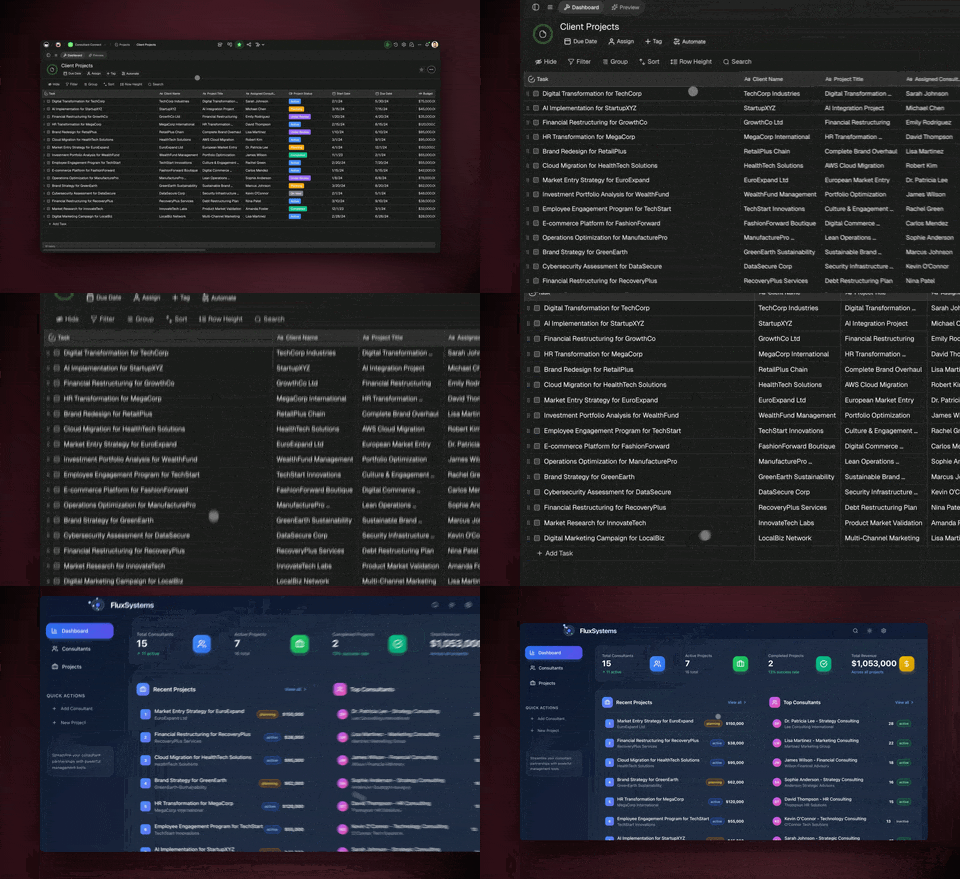
No signup, no credit card. Open the live automation workspace → (opens in new tab)
| Capability | Zapier | Taskade Genesis |
|---|---|---|
| Pricing (starting) | Free; Starter $29.99/mo; Professional $73.50/mo; Team $103/mo (annual) | $0 Free · $16/mo Pro (10 seats) |
| Cloneable live demo | ❌ | ✅ |
| Built-in AI agents | None (just a runner) | ✅ 33 built-in tools |
| Automation engine | Yes (scenarios only) | ✅ Temporal-backed, 100+ integrations |
| Workspace DNA loop | ❌ | ✅ ▲ Memory · ■ Intelligence · ● Execution |
Table of Contents
- Quick Comparison Table
- The fundamental difference
- What is Taskade Genesis?
- What is Zapier?
- Feature-by-feature deep dive
- The Workspace DNA advantage
- Pricing and total cost of ownership
- When to choose each
- Frequently asked questions
- Build without permission
The fundamental difference
Zapier earned its position as the market leader in workflow automation by patiently building partner integrations for more than a decade. If your goal is "when X happens in app A, do Y in app B," Zapier likely supports both apps and a third one you have not thought of yet.
Taskade Genesis takes a different starting point. The workspace is the backend, AI agents reason inside every workflow step, and Genesis ships the front-end app the automation feeds. You get durable workflows across 100+ bidirectional integrations plus the agents and the app — in one platform.
Zapier asks: "Which two apps should I connect?" Genesis asks: "What system should exist, and what should it do automatically?"
What is Taskade Genesis?
Taskade Genesis is the AI app builder inside the Taskade workspace. It is built on Workspace DNA — Memory (Projects), Intelligence (AI Agents), and Execution (Automations) — a self-reinforcing loop where what your team does becomes the substrate the agents reason over. Founded by John Xie, Dionis Loire, and Stan Chang in 2017, Taskade is a Y Combinator-backed platform with a public Community Gallery of apps anyone can clone.
Automations run on a durable execution runtime: retries are automatic, long-running workflows survive provider outages, and branching, looping, and filtering are first-class. Triggers pull events in (Slack messages, Gmail, Sheets rows, Calendly events, webhooks). Actions push data out (Stripe checkouts, Shopify orders, Notion syncs, Salesforce updates, GitHub PRs). And every workflow step can call an AI agent with persistent memory and 33 built-in tools.
What is Zapier?
Zapier was founded in 2011 by Wade Foster, Bryan Helmig, and Mike Knoop and bootstrapped to profitability as the dominant no-code automation platform. Zapier's signature is breadth: 7,000+ app integrations built and maintained over more than a decade. Zaps trigger on events in one app and run actions in others. Paths, Filters, and Sub-Zaps add conditional logic and reuse.
Zapier at a glance: 7,000+ app integrations, mature trigger catalog, multi-step Zaps with Paths and Filters, Tables for lightweight data storage, Interfaces for basic forms and dashboards, and AI add-on actions. Pricing is metered per task: Free 100 tasks per month, Starter $29.99 per month for 750 tasks (annual), Professional $73.50 per month for 2,000 tasks, Team $103 per month for multi-user collaboration.
Zapier's strengths are real and worth naming: the largest integration library on the market, mature and reliable triggers, a deep template ecosystem, and a brand teams trust for production workflows. The trade-off is that Zapier is fundamentally a connector layer — it assumes the apps it connects already exist, and AI is bolted on as add-on actions rather than first-class agents with memory.
Feature-by-feature deep dive
Bidirectional integrations
- Taskade ships 100+ first-party bidirectional integrations across 10 categories: Communication, Email and CRM, Payments, Development, Productivity, Content, Data and Analytics, Storage, Calendar, and E-commerce. Triggers pull external events in. Actions push data out. Recent additions include Salesforce automation pieces, Notion sync, Google Calendar listEvents and getFreeBusy, Stripe checkout sessions, GitHub repo export and import.
- Zapier ships 7,000+ integrations after more than a decade of partner work. Trigger and action coverage is bidirectional and broad. For raw catalog size, Zapier wins outright. For the integrations most teams use every day, Genesis is comparable and adds the AI layer.
AI agents inside the workflow
- Taskade ships AI Agents v2 — first-class teammates with persistent memory, 33 built-in tools (web search, file analysis, project management, image generation, code execution, more), custom tools you define, and the option to embed agents publicly inside Genesis Apps. Any automation step can call an agent to classify, summarize, route, or draft.
- Zapier offers AI add-on actions (ChatGPT for Zapier, AI by Zapier) that call models inside a Zap step. They work, but they are stateless — no persistent memory, no built-in tool catalog, no agent identity that survives across runs.
Durable execution and reliability
- Taskade automations run on durable infrastructure with automatic retries, branching, looping, filtering, and a Runs tab for inspection. Long-running workflows survive deploys and provider outages without dropping work.
- Zapier uses retry logic, error handling, and Sub-Zaps for reuse. Reliability is a Zapier strength — production teams have run mission-critical Zaps for years.
App builder
- Taskade Genesis turns a prompt into a deployed application — dashboard, portal, CRM, intake form, internal tool — with the automation already wired in. Custom domains, password protection, and public embedding via GenesisAuth are built in.
- Zapier offers Tables for lightweight data storage and Interfaces for basic forms and dashboards. They cover the simple cases. They do not replace a real app builder.
Workspace memory and context
- Taskade's Workspace DNA gives every agent persistent context across projects, files, integrations, and the live state of your business. Memory feeds Intelligence; Intelligence triggers Execution; Execution writes back into Memory.
- Zapier stores data per-Zap or inside Tables. There is no concept of a workspace-wide memory layer that automations and AI agents share.
Team collaboration and access control
- Taskade is workspace-native: real-time multiplayer editing, comments, chat, video calls, and 7-tier role-based access (Owner, Maintainer, Editor, Commenter, Collaborator, Participant, Viewer).
- Zapier is single-user by default, with multi-user collaboration on the Team plan ($103 per month and up).
The Workspace DNA advantage
Zapier's mental model is "an event in app A triggers an action in app B." Genesis's mental model is Workspace DNA: a self-reinforcing loop between three pillars.
- Memory (Projects) — Your team's docs, tasks, files, and structured data become the substrate every agent reasons over.
- Intelligence (Agents) — Custom AI Agents with persistent memory, 33 built-in tools, and the ability to call out to MCP servers or your own tools.
- Execution (Automations) — Durable workflows triggered by external events that read from Memory, act through Intelligence, and write the results back into Memory. The loop closes.
Zapier is excellent at one slice of this loop — moving an event from one app into an action in another. Genesis runs the entire loop continuously, so the longer you use it, the more your workspace itself becomes the thing that builds and runs the next workflow.
Pricing and total cost of ownership
| Plan | Taskade Genesis | Zapier |
|---|---|---|
| Free | Free Forever — limited AI credits, full app builder access | Free — 100 tasks per month, single-step Zaps |
| Starter / Pro | Pro $16 / month annual — unlimited apps, 10 seats | Starter $29.99 / month annual — 750 tasks, multi-step |
| Business / Professional | Business $40 / month — unlimited seats, higher AI capacity | Professional $73.50 / month — 2,000 tasks, Paths, custom logic |
| Max / Team | Max $200 / month — maximum AI generation capacity | Team $103 / month — unlimited users, shared apps |
| Enterprise | $400 / month with custom SLA | Custom — contact sales |
Zapier's pricing is per-task metered. Heavy automation users routinely hit overage charges, and the cost scales with workflow volume rather than seats. Taskade's pricing is flat per seat with included AI credits — predictable monthly spend regardless of how many workflows run.
When to choose each
Choose Zapier if:
- You need a niche integration only Zapier supports out of 7,000+ partners.
- Your workflows are simple if-then triggers with no AI reasoning required.
- You already have all your front-end apps built and only need a connector layer.
- You prefer per-task metering over flat seat-based pricing.
Choose Taskade Genesis if:
- You want AI agents inside every automation step, not bolted-on AI actions.
- You want to build the app and the automation in one place.
- You want a flat subscription with included AI credits and no overage charges.
- You want workflow automation, an AI agent platform, and an app builder unified by a workspace memory layer.
- You want to ship apps your team can clone, embed, and extend over time.
Use both if: Many teams keep Zapier for legacy or niche integrations and use Taskade Genesis for AI-powered workflows, agent automation, and the apps the team builds and ships.
The Workspace DNA advantage
Aider's mental model is "the LLM edits files." Genesis's model is the workspace itself becomes the engine that builds, automates, and runs the next thing.
Build without permission
Zapier is the safe pick for connecting apps you already use. Genesis is the pick for teams who want AI agents, durable automations, and the app the automation feeds — all in one workspace.
- Build with Genesis → — One prompt, one deployed app
- Browse the Community Gallery — Clone apps shipped by other Genesis builders
- Read the Workspace DNA explainer — How Memory, Intelligence, and Execution work together
Explore Taskade Genesis
- Workflow Automation — AI-powered business automation
- AI Agent Platform — Digital teammates that work 24/7
- AI App Builder — Build complete apps from one prompt
- AI Website Builder — Sites in seconds
- AI Knowledge Base — Searchable AI-powered docs
Build without code
- AI App Generator — Full apps from prompts
- AI Dashboard Generator — Business dashboards
- AI Form Generator — Smart intake forms
- Browse Community Apps — Clone and customize
Related reading
- Build Without Permission — Our manifesto
- How Workspace DNA Works — The architecture
- Origin of Living Software — The future of apps
- Agentic Workflows That Replace Your Startup's Busywork
- Stop Worshipping Prompts, Start Building Workflows
- AI Tools Built with Taskade Genesis