

See the alternative working — clone in 60 seconds
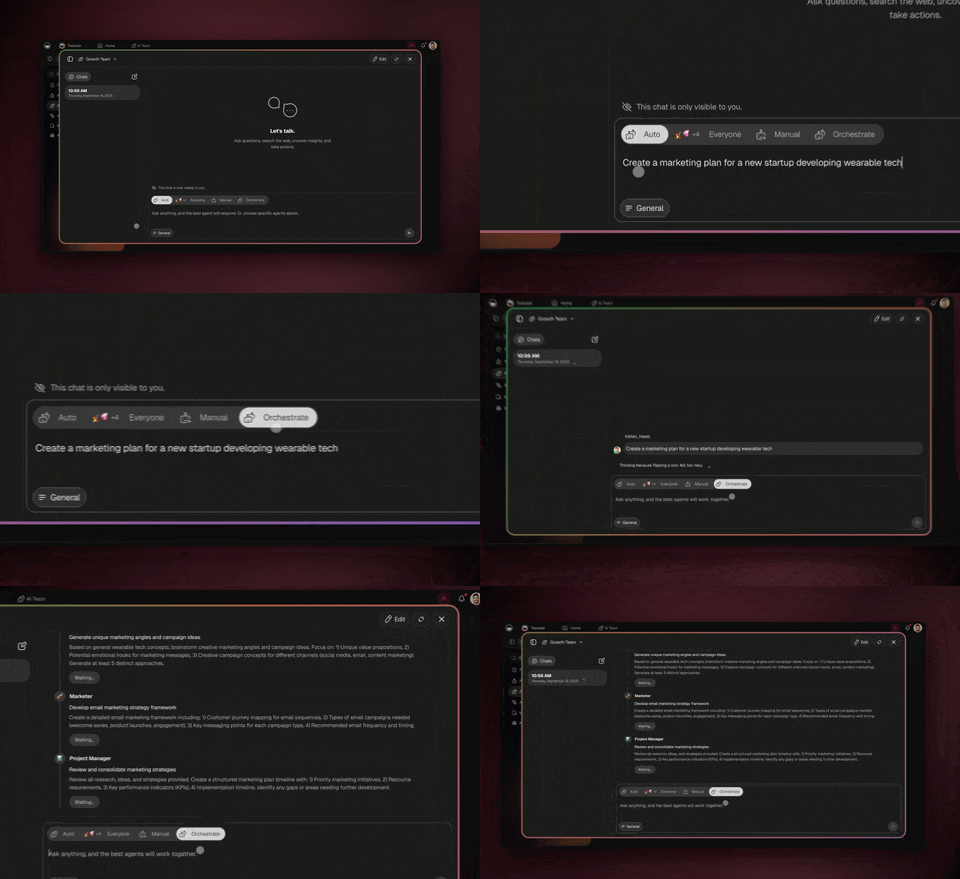
No signup, no credit card. Open the live multi-agent workspace → (opens in new tab)
| Capability | Relevance AI | Taskade Genesis |
|---|---|---|
| Pricing (starting) | $19/month Pro, $199/month Team (annual) | $0 Free · $16/mo Pro (10 seats) |
| Cloneable live demo | ❌ | ✅ |
| Built-in AI agents | Yes, custom agents | ✅ 33 built-in tools |
| Automation engine | Limited / no native integrations | ✅ Temporal-backed, 100+ integrations |
| Workspace DNA loop | ❌ | ✅ ▲ Memory · ■ Intelligence · ● Execution |
Overall winner: ✅ Taskade Genesis — for teams who want AI agents that live inside a workspace with their humans, powered by native memory, integrations, and automations. Relevance AI remains an excellent pick for agents-as-API workloads and BYOK-first teams.
Table of Contents
- Quick Comparison Table
- The fundamental difference
- What is Taskade Genesis?
- What is Relevance AI?
- Feature-by-feature deep dive
- The Workspace DNA advantage
- Pricing and total cost of ownership
- Where Relevance AI has the edge
- What users say
- When to choose each
- Frequently asked questions
- Build without permission
The fundamental difference
Relevance AI is the no-code AI agent platform built on the agents-as-API premise: define an agent, give it tools and memory, deploy it as an endpoint, and let it serve external systems. Multi-agent teams, custom Python and JavaScript tools, BYOK across providers, and a strong agents-as-widgets story have made it a favorite of indie builders and AI-first startups.
Taskade Genesis takes a different position on what an AI agent is. In Genesis, an AI agent is a first-class workspace teammate. The agent's memory IS the workspace's projects. The agent's tools include the workspace's automations and 100+ bidirectional integrations. The agent ships embedded inside a deployed Genesis App where humans and agents collaborate on the same surface. Memory, intelligence, and execution are infrastructure, not features bolted on later.
Relevance AI asks: "How do we deploy an agent as a service?" Genesis asks: "How do we make an agent a teammate?"
What is Taskade Genesis?
Taskade Genesis is the AI app builder inside the Taskade workspace. It is built on Workspace DNA — Memory (Projects), Intelligence (AI Agents), and Execution (Automations) — a self-reinforcing loop where what your team does becomes the substrate every agent reasons over. Founded by John Xie, Dionis Loire, and Stan Chang in 2017, Taskade is a Y Combinator-backed platform with over a million users and a public Community Gallery of apps anyone can clone.
AI Agents v2 are first-class workspace teammates with custom tools, slash commands, 33 built-in tools, persistent memory, multi-model routing across 15+ frontier models, multi-agent collaboration, and public embedding inside Genesis Apps. A single prompt to Genesis can produce a customer support portal, an ops dashboard, a CRM, or any other deployed application — with the AI agents already wired in, the automations already running, and the integrations already connected.
Taskade is for founders, ops teams, marketing, customer success, product managers, and engineers who want their AI agents to be teammates inside a workspace, not microservices behind an endpoint.
What is Relevance AI?
Relevance AI is a no-code AI agent platform founded in Sydney by Daniel Vassilev and Jacky Koh in 2020. The product lets users build, deploy, and manage AI agents through a visual builder, with strong support for multi-agent teams, custom Python and JavaScript tools, and bring-your-own-key access to OpenAI, Anthropic, and other providers.
Relevance AI at a glance: Free tier with limited credits. Pro at $19/month annual for individual builders. Team at $199/month annual for collaboration features and higher limits. Business and Enterprise are custom-priced. Native support for multi-agent teams (orchestrator agent plus specialized sub-agents), BYOK across providers, agents deployable as APIs, embeddable widgets, and Slack bots. Strong tool ecosystem with Python and JavaScript code tools.
Relevance AI's beloved features are agent-platform primitives done well: a clean visual agent builder, the multi-agent teams pattern (one of the cleanest implementations on the market), agents-as-API for any external integration, custom tools written in Python or JavaScript, and BYOK across providers for cost-conscious builders.
Relevance AI is, deservedly, popular with indie builders, AI-first agencies, and lean startups shipping agent-driven products. It is also unapologetically an agent platform: you build agents, you deploy agents, you manage agents — the workspace surface around them is intentionally minimal.
Feature-by-feature deep dive
Agent definition and customization
- Taskade AI Agents v2 are configured visually inside the workspace: name, persona, system prompt, tools (built-in or custom), slash commands, knowledge sources (workspace projects), and model routing. Agents can be private or embedded publicly inside a Genesis App.
- Relevance AI offers a visual agent builder with deep tool customization. Custom tools can be Python or JavaScript code, API calls, or other agents. The agent definition surface is more developer-leaning, the workspace surface around it is lighter.
Built-in and custom tools
- Taskade ships 33 built-in tools (web search, file analysis, project management, image generation, code execution, and more) plus user-defined custom tools, slash commands, and the ability to call out to external MCP servers like Notion and Linear.
- Relevance AI ships a strong built-in tool catalog plus a code-tool builder where users write Python or JavaScript directly. The custom-tool surface is one of Relevance AI's strongest differentiators.
Persistent memory
- Taskade stores agent memory as Workspace DNA — the agent's memory IS the workspace's projects, files, and structured data. Memory persists across sessions and across agents in the same workspace. The longer the workspace runs, the smarter the agents get.
- Relevance AI offers per-agent memory stores. Each agent maintains its own context. The pattern works well for agents-as-API where each endpoint owns its memory.
Multi-agent teams
- Both support multi-agent collaboration. Relevance AI's multi-agent teams pattern (an orchestrator agent plus specialized sub-agents) is one of the cleanest on the market and a frequent showcase. Taskade Agents v2 supports agent-to-agent handoff and shared workspace memory across agents.
Workflow automations
- Taskade includes production-grade durable Automations with branching, looping, and filtering across 100+ bidirectional integrations. Triggers pull external events in (Slack messages, Gmail, Sheets rows, Calendly events, webhooks). Actions push data out (Stripe checkouts, Shopify orders, Notion syncs, Salesforce updates, GitHub PRs).
- Relevance AI has native automation flows with triggers, scheduled runs, and the ability to chain agents into workflows. It is excellent for agent-driven pipelines. The integration breadth is closer to a tool catalog than a 100+ piece library.
Building deployed apps around agents
- Taskade Genesis turns a single prompt into a deployed application — UI, data model, agents, and automations connected — accessible at a shareable URL with custom domains, password protection, and built-in OIDC auth via GenesisAuth.
- Relevance AI is focused on the agent layer. The deployment surfaces are agent endpoints, widgets, and Slack bots — not full apps with custom UIs and databases.
Team collaboration
- Taskade is workspace-native: real-time multiplayer editing, comments, chat, video calls, and granular 7-tier role-based access (Owner, Maintainer, Editor, Commenter, Collaborator, Participant, Viewer).
- Relevance AI offers team collaboration on its Team and Business tiers — shared agents, shared tools, and role-based permissions. Lighter-weight than a full workspace.
The Workspace DNA advantage
Relevance AI's mental model is "the agent is a service." Genesis's mental model is Workspace DNA: a self-reinforcing loop between three pillars where the agent is a teammate.
- Memory (Projects) — Your team's docs, tasks, files, and structured data become the substrate every agent reasons over. The agent's memory is not a separate vector store you maintain. It is the workspace itself.
- Intelligence (Agents) — Custom AI Agents with persistent memory, 33 built-in tools, and the ability to call out to MCP servers or your own custom tools. Agents are first-class teammates that live in the workspace alongside humans.
- Execution (Automations) — Durable workflows triggered by external events (Slack, Gmail, Stripe, GitHub, Calendly, webhooks, schedules) that read from Memory and act through Intelligence — then write the results back into Memory. The loop closes.
Relevance AI is brilliant at one slice of this loop — building, deploying, and operating AI agents as standalone services. Genesis runs the entire loop continuously, so the agent you spin up on Monday inherits everything the workspace has learned by Friday.
Pricing and total cost of ownership
| Plan | Taskade Genesis | Relevance AI |
|---|---|---|
| Free | Free Forever — unlimited projects, limited AI credits | Free — limited credits |
| Entry paid | Starter $6/month annual (3 seats) | Pro $19/month annual (single user) |
| Pro | $16/month annual — 10 seats, unlimited apps | Pro $19/month annual |
| Team | Business $40/month — unlimited seats | Team $199/month annual |
| Max / Business | Max $200/month — maximum AI generation capacity | Business custom-priced |
| Enterprise | $400/month with custom SLA | Custom-priced |
Both platforms include AI credits in the subscription, so total cost of ownership is mostly the subscription tier. Taskade Pro at $16/month for 10 seats is dramatically cheaper than Relevance AI Pro at $19/month per user — though the products are not identical, since Taskade includes a full workspace, 7 project views, and Genesis App builder on top of agents.
Relevance AI's BYOK model is a real cost lever for builders who want to optimize per-token spend by routing to cheaper providers. Taskade's bundled model routing is simpler operationally — no API keys to manage, no rate limits to babysit — at the cost of less granular spend control.
Where Relevance AI has the edge
Honesty matters. Relevance AI beats Taskade on three things:
- Agents-as-API focus. If your goal is to deploy an agent as an endpoint that an external system calls, Relevance AI is purpose-built for that shape. Taskade can embed agents publicly via Genesis Apps but the agents-as-API pattern is Relevance AI's home turf.
- Custom code tools. The Python and JavaScript tool builder lets developers write tools as code, with full control over inputs, outputs, and execution. Taskade supports custom tools but the code-tool surface in Relevance AI is more mature.
- BYOK model control. Relevance AI is BYOK-first across providers. For builders who want to control per-token spend at the model-provider level, this is a real advantage. Taskade's model routing is automatic and unified — simpler, less granular.
If your single, highest-priority need is "deploy AI agents as APIs with custom code tools and full BYOK control," Relevance AI is the right answer. Taskade does not pretend otherwise.
What users say
Relevance AI has earned a reputation as one of the cleanest no-code agent platforms on the market. Recurring themes across r/AI_Agents, Hacker News, and Indie Hackers:
- "The multi-agent teams pattern is the cleanest I've used." — appears in nearly every Relevance AI thread.
- "BYOK with full control over model spend." — cost-conscious builders love this.
- "Agents-as-API just works." — indie devs shipping AI products.
- "Workspace surface is intentionally minimal." — said as both praise and critique depending on the team.
Genesis users are usually builders who want the inverse: agents that live inside a workspace alongside humans, with the workspace itself as the agent's memory and the integrations and automations as its tools. Browse the Community Gallery to see Genesis Apps shipped with embedded agents.
When to choose each
Choose Relevance AI if:
- Your primary deployment shape is agents-as-API serving an external system.
- You want to write custom tools as Python or JavaScript code.
- BYOK across providers and granular per-token cost control matter.
- The multi-agent teams pattern (orchestrator + sub-agents) is central to your design.
- The workspace surface around the agent should be minimal.
Choose Taskade Genesis if:
- You want AI agents to be first-class teammates inside a workspace alongside humans.
- The agent's memory should be the workspace's projects, not a separate vector store.
- You need durable workflow automations across 100+ bidirectional integrations.
- You want to ship deployed apps with embedded agents — UI, data, agents, and automations all wired together.
- You collaborate with a team and want granular 7-tier permissions and real-time multiplayer.
Use both if: Some teams keep Relevance AI for high-volume agents-as-API workloads serving external systems, and use Taskade for internal-facing agents that live alongside humans on a shared workspace. The two deployment shapes are complementary.
Frequently asked questions
Is Taskade Genesis a good alternative to Relevance AI?
Yes — if you want AI agents that live inside a workspace with humans, with native memory (projects), native integrations (100+), and native durable automations. If you want agents-as-API with BYOK and custom code tools, Relevance AI is purpose-built.
What are AI Agents v2?
First-class workspace teammates with 33 built-in tools, custom tools, slash commands, persistent memory, multi-model routing across 15+ frontier models, multi-agent collaboration, and public embedding inside Genesis Apps.
Can Taskade agents use my own custom tools?
Yes. Custom tools, slash commands, and external MCP server calls (Notion, Linear, any MCP-compliant service). Taskade is also itself an MCP server that Claude Desktop, Cursor, and VS Code can connect to.
Does Taskade include workflow automations?
Yes — production-grade durable automations across 100+ bidirectional integrations.
Which is cheaper?
Taskade Pro at $16/month for 10 seats is dramatically cheaper than Relevance AI Pro at $19/month per user. Both include AI credits in the subscription.
Build without permission
Relevance AI gave the world clean agents-as-API. Genesis gives the world a workspace where the agents are teammates, the memory is the work, and the integrations are infrastructure.
- Build with Genesis → — One prompt, one deployed app
- Browse the Community Gallery — Clone apps shipped by other Genesis builders
- Read the Workspace DNA explainer — How Memory, Intelligence, and Execution work together
Explore Taskade Genesis
- AI App Builder — Build complete apps from one prompt
- Vibe Coding — Natural-language app creation
- AI Agent Platform — Digital teammates that work 24/7
- AI Website Builder — Sites in seconds
- Workflow Automation — AI-powered business automation
Learn the Genesis architecture
Your living workspace includes:
- Create Your First App — 5-minute tutorial
- Custom AI Agents — The Intelligence pillar
- Projects & Databases — The Memory pillar
- Automations & Workflows — The Execution pillar
Build without code
- AI App Generator — Full apps from prompts
- AI Dashboard Generator — Business dashboards
- AI Website Generator — Sites in seconds
- AI Form Generator — Smart intake forms
- Browse Community Apps — Clone and customize
Related reading
- Build Without Permission — Our manifesto
- How Workspace DNA Works — The architecture
- Origin of Living Software — The future of apps
- Host Your First AI Agent — Shipping agents to production
- What Is an Agent Hosting Platform — Where agents live
- How to Train AI Agents With Your Knowledge — Memory as substrate
- Agentic Workflows That Replace Your Startup's Busywork — Multi-agent execution
- Stop Worshipping Prompts, Start Building Workflows — Why workflows beat one-shot prompts