

See the alternative working — clone in 60 seconds
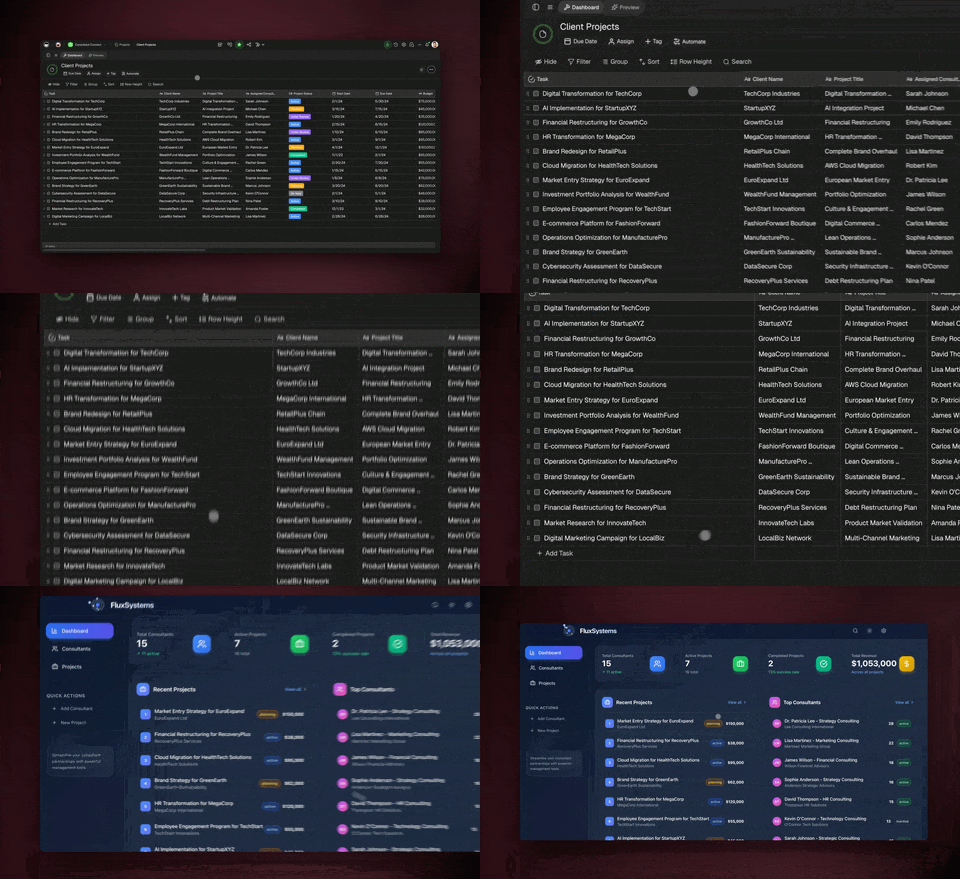
No signup, no credit card. Open the live sales pipeline → (opens in new tab)
| Capability | ClickUp | Taskade Genesis |
|---|---|---|
| Pricing (starting) | $7–$19/user/month + $7/user/month for ClickUp Brain AI | $0 Free · $16/mo Pro (10 seats) |
| Cloneable live demo | ❌ | ✅ |
| Built-in AI agents | AI add-ons only | ✅ 34 built-in tools |
| Automation engine | Limited workflow rules | ✅ Temporal-backed, 100+ integrations |
| Workspace DNA loop | ❌ | ✅ ▲ Memory · ■ Intelligence · ● Execution |
Table of Contents
- Quick Comparison Table
- The fundamental difference
- What is Taskade?
- What is ClickUp?
- Feature-by-feature deep dive
- The Workspace DNA advantage
- Pricing and total cost of ownership
- When to choose each
- Frequently asked questions
The fundamental difference
ClickUp markets itself as the "everything app for work" — one tool that bundles tasks, docs, chat, whiteboards, goals, dashboards, time tracking, and more across a 5-level hierarchy (Workspaces → Spaces → Folders → Lists → Tasks). ClickUp 4.0 (December 2025) shipped a full redesign with Teams Hub, Subfolders, AI Planner auto-scheduling, and ~40% faster loads. Super Agents (December 23, 2025) added autonomous "coworker" agents you @mention with 500+ fine-tuned skills. Brain MAX (2026) added a standalone desktop app with cross-tool universal search and multi-model access. If your team wants one product to cover every category, ClickUp 4.0 does the bundling — deeply.
Taskade starts from a different premise. Bundling everything into one surface creates configuration overhead and makes AI feel bolted on. Taskade is AI-native and focused — 7 canonical project views, AI Agents v2 included on every plan, Temporal-backed automations across 100+ bidirectional integrations, and Genesis to turn a prompt into a full deployed app. The result is less surface area and more leverage.
ClickUp asks: "Where in the hierarchy does this task belong?" Taskade asks: "What should this team actually ship next, and can the agents help?"
What is Taskade?
Taskade is the AI-native workspace where teams plan, build, and ship together. Founded by John Xie, Dionis Loire, and Stan Chang in 2017 (Y Combinator-backed), Taskade combines 7 project views, AI Agents v2 with 34 built-in tools, Temporal-backed Automations across 100+ bidirectional integrations, and Genesis — the AI app builder that turns a prompt into a deployed application.
What is Taskade Genesis?
Genesis is Taskade's AI app builder. Describe what you want and Genesis returns a live, working application — UI, data, agents, and automations connected. Your workspace is the backend. Your projects are the database. Your agents are the runtime.
One prompt = one deployed app. Focused, AI-native, no bundle.
Create your first app in 5 minutes →
What is ClickUp?
ClickUp is an all-in-one productivity platform founded by Zeb Evans in 2017. It positions itself as "the everything app for work," combining tasks, docs, chat, whiteboards, goals, time tracking, and dashboards in a single workspace.
ClickUp at a Glance: Free Forever (limited), Unlimited $7/user/month, Business $12/user/month, Business Plus $19/user/month, Enterprise on quote. ClickUp Brain AI is a separate add-on at $7/user/month that must be enabled across the entire workspace.
ClickUp excels at being a single configurable container for many use cases. The honest critique surfaced in nearly every review thread: feature density creates onboarding overhead, the 5-level hierarchy demands setup time, and the AI add-on must be purchased for every seat in the workspace. None of these are bugs — they are consequences of the all-in-one bundling.
Feature-by-feature deep dive
AI included on every plan vs. per-seat add-on
- Taskade includes AI Agents v2 on every plan, including Free Forever. AI capacity scales with the tier (more credits on higher plans), but there is no separate per-seat AI fee.
- ClickUp Brain is a separate $7 per seat per month add-on that must be enabled workspace-wide. A 25-person team with 5 power users still pays $175/month for Brain.
7 canonical views vs. 15+ marketed views
- Taskade ships seven project views — List, Board, Calendar, Table, Mind Map, Gantt, and Org Chart — and the same data renders in all of them. The Timeline scrolling component lives inside the Gantt view.
- ClickUp markets 15+ view types. In practice, most teams use a small handful (List, Board, Gantt, Calendar) and the rest add UI complexity without adding leverage.
Workflow automations and integrations
- Taskade includes Temporal-backed durable Automations with branching, looping, and filtering across 100+ bidirectional integrations. Triggers pull external events in (Slack messages, Gmail, Sheets rows, Calendly events, webhooks). Actions push data out (Stripe checkouts, Shopify orders, Notion syncs, Salesforce updates, GitHub PRs).
- ClickUp includes native automation with monthly run caps that scale by tier. Cross-system workflows often rely on Zapier-style middleware.
Genesis: full apps from a prompt
- Taskade Genesis turns one prompt into a deployed application — a CRM, support portal, ops dashboard, intake form, internal tool, or customer-facing app — with AI agents, automations, custom domains, password protection, and the option to embed publicly with GenesisAuth.
- ClickUp organizes tasks. There is no app generation, no deployed surface, no public embedding.
Team collaboration
- Taskade is workspace-native: real-time multiplayer editing, comments, chat, video calls, and granular 7-tier role-based access (Owner, Maintainer, Editor, Commenter, Collaborator, Participant, Viewer).
- ClickUp offers a separate Chat view and task comments. Native video conferencing is limited; most teams pair ClickUp with Zoom or Slack.
The Workspace DNA advantage
ClickUp's mental model is "bundle every productivity tool into one workspace." Taskade's mental model is Workspace DNA — a self-reinforcing loop between three pillars.
- Memory (Projects) — Your team's tasks, docs, files, and structured data become the substrate every agent reasons over. The longer you work, the smarter the workspace gets.
- Intelligence (Agents) — AI Agents v2 with persistent memory, 34 built-in tools, custom tools, and the ability to call out to MCP servers. Agents triage incoming work, draft updates, and execute follow-ups alongside your team — included on every plan.
- Execution (Automations) — Durable Temporal-backed workflows triggered by external events (Slack, Gmail, Stripe, GitHub, Calendly, webhooks, schedules) that read from Memory and act through Intelligence — then write the results back into Memory. The loop closes.
ClickUp Brain assists across the bundle. Taskade runs the entire loop continuously across the workspace, so the longer you use it, the more your workspace itself becomes the thing that builds the next app.
Pricing and total cost of ownership
| Plan | Taskade | ClickUp |
|---|---|---|
| Free | Free Forever — unlimited collaborators, all 7 views, Genesis access, AI agents | Free Forever (limited storage and AI) |
| Entry paid | Pro $16/month annual (10 seats, unlimited apps) | Unlimited $7/user/month |
| Mid tier | Business $40/month (unlimited seats) | Business $12/user/month |
| AI add-on | Included on every plan | ClickUp Brain $7/user/month workspace-wide |
| Top tier | Max $200/month (max AI capacity), Enterprise $400/month | Business Plus $19/user/month, Enterprise on quote |
| 20-person team with AI, 1 year | $192 (Pro) or $480 (Business) | $3,360 (Unlimited + Brain) to $6,240 (Business + Brain) |
ClickUp's per-seat math compounds quickly once Brain is added across the workspace. Taskade's flat workspace pricing keeps a 20-person team with AI under $500 per year on Pro or Business.
When to choose each
Choose ClickUp if — honest acknowledgments where ClickUp genuinely wins:
- ✅ You're a services org or agency that needs billable time tracking, capacity planning, and workload dashboards as first-class primitives — ClickUp's time tracking is meaningfully ahead of Taskade
- ✅ You want one tool to bundle tasks, docs, chat, goals, time tracking, and whiteboards in a single workspace — ClickUp 4.0 is the deepest all-in-one bundle in the category
- ✅ You need 15+ view types including Box, Workload, and Activity (broader than Taskade's 7 canonical views)
- ✅ Your team has the budget and appetite for Super Agents at $28/seat/month and the operational depth to wire 500+ agent skills
- ✅ You're willing to invest setup time configuring the 5-level hierarchy (Workspaces → Spaces → Folders → Lists → Tasks) for granular control
Choose Taskade if:
- You want AI-native PM that is focused, not bundled.
- You want AI Agents v2 included on every plan, even Free Forever.
- You want 7 canonical views instead of 15+ marketed view types.
- You want Temporal-backed automations across 100+ bidirectional integrations.
- You want flat workspace pricing rather than per-seat math plus an AI add-on.
- You want Genesis to build full deployed apps from a prompt.
Frequently asked questions
Is Taskade a good ClickUp alternative?
Yes. Taskade is AI-native, focused, and includes AI agents on every plan — 7 views, Temporal-backed automations, and Genesis. Free Forever for unlimited collaborators.
How does ClickUp pricing compare?
ClickUp is per-seat ($7–$19/user/month) plus ClickUp Brain ($7/user/month workspace-wide). Taskade is Free Forever, Pro is $16/month annual, and Business is $40/month for unlimited seats — AI included.
Are AI features included in Taskade plans?
Yes. AI Agents v2 and Genesis are on every plan, including Free.
Does Taskade have all the views ClickUp does?
Taskade ships 7 canonical views and the same data renders in all of them.
What can Genesis do that ClickUp cannot?
Genesis turns a prompt into a deployed app — CRM, dashboard, portal, intake form. ClickUp organizes tasks.
Can I migrate from ClickUp?
Yes. Export ClickUp tasks as CSV and import into Taskade. The same data renders in any of the 7 views.
Build without permission
ClickUp gives bundlers an everything app. Taskade gives every team an AI-native workspace where the apps come out finished, hosted, and ready for users.
- Build with Genesis → — One prompt, one deployed app
- Browse the Community Gallery — Clone apps shipped by other Genesis builders
- Read the Workspace DNA explainer — How Memory, Intelligence, and Execution work together
Explore Taskade Genesis
- AI App Builder — Build complete apps from one prompt
- AI Agent Platform — Digital teammates that work 24/7
- Workflow Automation — AI-powered business automation
- AI Coding — Natural-language app creation
- AI Knowledge Base — Searchable team memory
Build without code
- AI App Generator — Full apps from prompts
- AI Dashboard Generator — Business dashboards
- AI Website Generator — Sites in seconds
- AI Form Generator — Smart intake forms
- Browse Community Apps — Clone and customize
Compare Taskade to other platforms
- Taskade vs Asana
- Taskade vs Monday
- Taskade vs Trello
- Taskade vs Wrike
- Taskade vs Smartsheet
- Taskade vs Jira
Related reading
- Build Without Permission — Our manifesto
- How Workspace DNA Works — The architecture
- Origin of Living Software — The future of apps
- Agentic Workflows That Replace Your Startup's Busywork
- AI Tools Built With Taskade Genesis