

See the alternative working — clone in 60 seconds
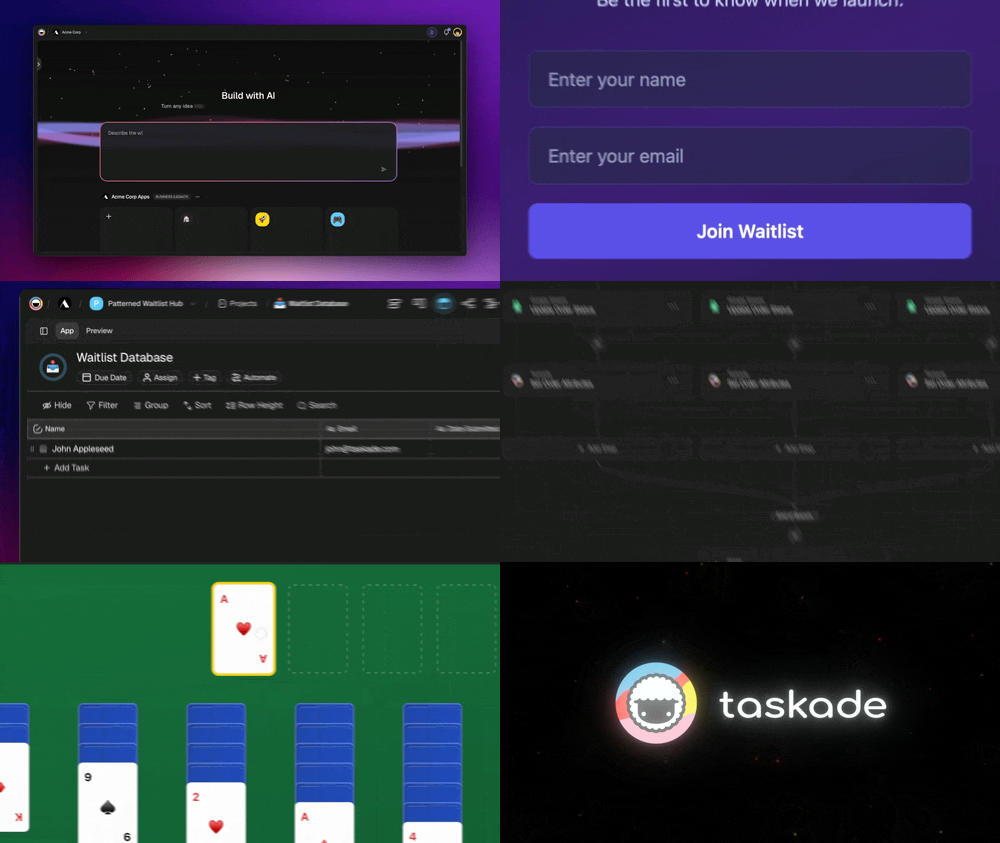
No signup, no credit card. Open the live Shopify-style storefront → (opens in new tab)
| Capability | Emergent | Taskade Genesis |
|---|---|---|
| Pricing (starting) | $20/month + cloud infrastructure costs | $0 Free · $16/mo Pro (10 seats) |
| Cloneable live demo | ❌ | ✅ |
| Built-in AI agents | Code generation, no live agents | ✅ 33 built-in tools |
| Automation engine | No automation engine | ✅ Temporal-backed, 100+ integrations |
| Workspace DNA loop | ❌ | ✅ ▲ Memory · ■ Intelligence · ● Execution |
What is Taskade Genesis?
Taskade Genesis is the AI app builder inside the Taskade workspace. Founded in 2017 by John Xie, Dionis Loire, and Stan Chang, Taskade is a Y Combinator-backed platform serving over a million users. Genesis is built on Workspace DNA — Memory (Projects), Intelligence (AI Agents), and Execution (Automations) — a self-reinforcing loop where the workspace gets smarter the more your team uses it.
A single prompt can produce a customer portal, an ops dashboard, a CRM, a knowledge base, a form-driven intake tool, or an internal app — with custom domains, password protection, built-in OIDC/SSO via GenesisAuth, and one-click publishing to the Community Gallery. No DevOps. No CI/CD. No infrastructure to maintain.
What is Emergent?
Emergent is an AI full-stack app generator that turns natural language prompts into frontend, backend, and database code, plus the cloud infrastructure to run them. It targets developers who want AI-accelerated coding and full ownership of the resulting stack.
Emergent at a glance: Generates a complete codebase from a prompt, provisions cloud infrastructure, gives developers ownership of the source. Best fit for engineering teams who want to ship faster while keeping the code they can deploy anywhere.
Where each tool wins
Generated full-stack code you own — Emergent
If the goal is owned source code that the team can host, modify, and deploy on its own infrastructure, Emergent is purpose-built for that workflow.
Working app right now — Taskade Genesis
If the goal is a deployed app that runs immediately with backend, AI agents, automations, and integrations connected, Genesis ships the working application from the first prompt — no deploy step, no infrastructure to provision.
The Workspace DNA advantage
Emergent's mental model is "AI generates a codebase, the team deploys it." Genesis's mental model is Workspace DNA: a self-reinforcing loop between three pillars.
- Memory (Projects) — Your team's docs, tasks, files, and structured data become the substrate every agent reasons over. Read How Workspace DNA Works.
- Intelligence (Agents) — AI Agents v2 with persistent memory, 33 built-in tools, custom tools, and the option to embed publicly inside any Genesis App.
- Execution (Automations) — Durable workflows triggered by external events (Slack, Gmail, Stripe, GitHub, Calendly, webhooks, schedules) that read from Memory and act through Intelligence — then write the results back into Memory. The loop closes.
Emergent is brilliant at one slice — generating a codebase. Genesis runs the entire loop continuously, so every action a team takes makes the workspace smarter and the next app faster to build.
Pricing comparison
| Plan | Taskade Genesis | Emergent |
|---|---|---|
| Free | Free Forever — full app builder access | Limited trial credits |
| Entry | Starter $6/mo annual (3 seats) | $20/mo + cloud infrastructure |
| Most popular | Pro $16/mo annual (10 seats, unlimited apps) | Pro tier + cloud infrastructure |
| Team | Business $40/mo (unlimited seats) | Team tier + cloud infrastructure |
| High capacity | Max $200/mo | Custom |
Choose Taskade Genesis if
- You want a deployed app running today, not source code to deploy
- You need AI agents that persist, have tools, and can be embedded for customers
- You need workflow automations across Slack, Gmail, Stripe, HubSpot, Salesforce, Notion, Shopify, and 100+ other tools
- You want one flat subscription that includes hosting, agents, automations, and team collaboration
- Your team includes non-engineers who need to build alongside engineers
Choose Emergent if
- You want owned source code and full deployment control
- Your team has the DevOps capacity to manage cloud infrastructure
- You prefer a code-first editing model
- You are building applications that will live outside any single platform
Frequently asked questions
Is Taskade Genesis a good Emergent alternative?
When the job is a deployed app you can ship today — yes. When the job is owned source code with full deployment control, Emergent remains the better fit.
Does Taskade Genesis include AI agents and automations?
Yes — AI Agents v2 with 33 built-in tools, plus durable workflows across 100+ bidirectional integrations.
Which AI models power Taskade Genesis?
Taskade routes work across 15+ frontier models from OpenAI, Anthropic, and Google. Routing is automatic by plan tier.
Can I publish a Genesis app to a custom domain?
Yes — custom domains are available on Business+ plans; password protection and OIDC/SSO via GenesisAuth are available on Pro and above.
Build without permission
Emergent gives engineering teams a sharper code generator. Genesis gives every team — engineers and non-engineers alike — a workshop where apps come out finished, hosted, and ready for users.
- Build with Genesis → — One prompt, one deployed app
- Browse the Community Gallery — Clone apps shipped by other Genesis builders
- Read the Workspace DNA explainer — How Memory, Intelligence, and Execution work together
Explore Taskade Genesis
- AI App Builder — Build complete apps from one prompt
- Vibe Coding — Natural language app creation
- AI Agent Platform — Digital teammates that work 24/7
- AI Website Builder — Sites in seconds
- Workflow Automation — AI-powered business automation
Build without code
- AI App Generator — Full apps from prompts
- AI Dashboard Generator — Business dashboards
- AI Website Generator — Sites in seconds
- AI Form Generator — Smart intake forms
- Browse Community Apps — Clone and customize
Related reading
- Build Without Permission — Our manifesto
- How Workspace DNA Works — The architecture
- Origin of Living Software — The future of apps
- Best Vibe Coding Tools in 2026 — AI coding tools compared
- Best Cursor Alternatives in 2026 — AI code editors compared
- Best Claude Code Alternatives in 2026 — AI coding agents compared
- Vibe Coding for Teams — Ship 10x faster
- AI Tools Built With Taskade Genesis — Real apps from the gallery