





It is the 1950s, and a group of brilliant minds are huddled together at Dartmouth College. They are laying the groundwork for what we now call artificial intelligence. People like that may have been under the radar back then, but today they are top AI influencers shaping every industry on the planet.
This list puts together the 12 brightest minds shaping the future of AI in 2026. You will learn who to follow, why they matter, and how their work connects to the AI tools you can use today.
TL;DR: The 12 AI influencers on this list lead the labs (OpenAI, Anthropic, DeepMind, Meta), set the research agenda, and define terms like "vibe coding" and "Constitutional AI." Following them gives you early signals on breakthroughs that affect productivity, careers, and business. Taskade Genesis lets you apply their vision today with custom AI agents and app building from prompts. Try Taskade Genesis free -->

Why Follow AI Influencers in 2026?
AI is no longer an academic curiosity. It is reshaping work, education, healthcare, and governance in real time. The people on this list are not just commentators. They are the ones deciding which models get built, which capabilities get released, and how safety guardrails are implemented.
| Reason | What You Get | How It Helps |
|---|---|---|
| Early signal detection | Breakthroughs announced weeks before mainstream media | Adapt strategy before competitors |
| Technical understanding | Complex concepts explained accessibly | Make informed tool and career decisions |
| Career positioning | See which skills and industries AI impacts next | Upskill before disruption hits |
| Safety awareness | Understand alignment, regulation, and ethical debates | Form informed opinions on AI governance |
The AI Influence Landscape
AI Influencers You Must Follow in 2026
1. Sam Altman -- OpenAI
Sam Altman leads OpenAI and is the driving force behind ChatGPT, GPT-4, and the push toward artificial general intelligence. Under his leadership, OpenAI has become the most recognized AI company in the world, with ChatGPT reaching over 200 million weekly active users by early 2025.
Altman's vision extends beyond language models. OpenAI's agent strategy, multimodal models, and enterprise offerings under his direction are reshaping how businesses adopt AI. As a co-founder of Y Combinator, he also brings a startup and venture capital perspective that makes his commentary on AI business models especially valuable.
| Expertise | Key Achievements | Follow On |
|---|---|---|
| AI research, AGI strategy, entrepreneurship | CEO of OpenAI, co-founder of Y Combinator and Loopt, drove ChatGPT to 200M+ weekly users | X, LinkedIn, personal blog |
2. Dario Amodei -- Anthropic
Dario Amodei co-founded Anthropic in 2021 after leaving his role as VP of Research at OpenAI. Anthropic builds the Claude model family and pioneered Constitutional AI, a training technique that makes models helpful, harmless, and honest without relying solely on human feedback.
His 2024 essay Machines of Loving Grace outlined a detailed vision for how AI could accelerate progress in health, science, freedom, and governance while maintaining safety. Anthropic has raised over $7 billion and Claude competes directly with GPT-4 on enterprise and developer benchmarks.
| Expertise | Key Achievements | Follow On |
|---|---|---|
| AI safety, Constitutional AI, ML research | CEO and co-founder of Anthropic, former VP of Research at OpenAI, author of Machines of Loving Grace | X, Anthropic blog |
3. Andrej Karpathy -- Educator and Vibe Coding Pioneer
Andrej Karpathy is the former Director of AI at Tesla and a co-founder of OpenAI. He coined the term "vibe coding" in early 2025, describing a new programming paradigm where developers describe what they want in natural language and AI generates the code.
Beyond coining terms, Karpathy is one of the most effective AI educators alive. His YouTube lectures on neural networks, tokenization, and GPT internals have millions of views. His nanoGPT and minbpe projects taught an entire generation of developers how large language models work from the ground up.
His AutoResearch project (2025) demonstrated autonomous AI-driven experimentation, where agents iteratively propose, run, and evaluate ML experiments with minimal human intervention.
| Expertise | Key Achievements | Follow On |
|---|---|---|
| Deep learning, computer vision, AI education | Former Director of AI at Tesla, co-founder of OpenAI, coined "vibe coding," author of nanoGPT, Stanford's first deep learning course | X, YouTube, personal website |
Why Karpathy matters for productivity: The vibe coding concept he popularized is exactly what Taskade Genesis delivers. Describe what you want, and AI builds a complete app. No coding required.
4. Ilya Sutskever -- Safe Superintelligence Inc.
Ilya Sutskever co-founded OpenAI and served as its chief scientist for nearly a decade. He co-authored the foundational GPT research and the sequence-to-sequence learning papers that underpin modern language models. In 2024, he departed OpenAI and co-founded Safe Superintelligence Inc. (SSI), a company focused exclusively on building safe superintelligent AI.
SSI raised over $1 billion in 2024, signaling deep investor confidence in Sutskever's safety-first approach. His departure from OpenAI and the founding of SSI marked a defining moment in the AI safety debate.
| Expertise | Key Achievements | Follow On |
|---|---|---|
| Deep learning theory, AI alignment, neural network optimization | Co-founder of OpenAI and SSI, co-author of GPT research, former chief scientist at OpenAI, raised $1B+ for SSI | X, academic publications |
5. Demis Hassabis -- Google DeepMind
Demis Hassabis co-founded DeepMind and Isomorphic Labs. His team built AlphaGo (the first AI to beat a world champion at Go), AlphaFold (which predicted protein structures for nearly all known proteins), and AlphaFold 3 (which predicts drug-molecule interactions).
In 2024, Hassabis won the Nobel Prize in Chemistry for AlphaFold's contributions to computational biology, making him one of the few AI researchers to receive a Nobel. Under his leadership, DeepMind is now integrated into Google as Google DeepMind, driving Gemini models and multimodal AI research.
| Expertise | Key Achievements | Follow On |
|---|---|---|
| AI research, neuroscience, computational biology | Co-founder of DeepMind and Isomorphic Labs, created AlphaGo and AlphaFold, 2024 Nobel Prize in Chemistry | X, DeepMind blog |
6. Yann LeCun -- Meta AI
Yann LeCun is the Chief AI Scientist at Meta and one of the three "Godfathers of AI" (alongside Geoffrey Hinton and Yoshua Bengio) who received the 2018 Turing Award. He pioneered convolutional neural networks (CNNs) and is a vocal advocate for open-source AI.
Under his influence, Meta released the LLaMA model family as open-source, challenging the closed-source approach of OpenAI and Anthropic. LeCun's public debates with other AI leaders on the nature of intelligence, consciousness, and AI risk are essential reading for anyone following the field.
| Expertise | Key Achievements | Follow On |
|---|---|---|
| Computer vision, convolutional neural networks, open-source AI | Chief AI Scientist at Meta, 2018 Turing Award, pioneer of CNNs, champion of open-source LLaMA models | X, LinkedIn, Meta AI blog |
7. Andrew Ng -- DeepLearning.AI and Coursera
Andrew Ng co-founded Google Brain and Coursera, making AI education accessible to millions. His online courses have enrolled over 8 million students globally. He is also the founder of Landing AI (computer vision for manufacturing) and DeepLearning.AI.
Ng continues to influence through educational initiatives and his advocacy for AI adoption in traditional industries. His weekly newsletter "The Batch" is one of the most-read AI publications, covering breakthroughs, industry trends, and practical applications.
| Expertise | Key Achievements | Follow On |
|---|---|---|
| Machine learning, AI education, computer vision, NLP | Co-founder of Google Brain and Coursera, founder of DeepLearning.AI and Landing AI, 8M+ students enrolled | LinkedIn, X, The Batch newsletter, personal website |
8. Fei-Fei Li -- Stanford and World Labs
Fei-Fei Li is a professor at Stanford University, creator of ImageNet (the dataset that catalyzed the deep learning revolution), and co-founder of World Labs. World Labs, founded in 2024, builds large world models (LWMs) that understand 3D physical environments, bridging AI perception and spatial reasoning.
Her work extends beyond academia into healthcare, environmental science, and AI ethics. She is a member of the National Academy of Engineering, the National Academy of Medicine, and the American Academy of Arts and Sciences.
| Expertise | Key Achievements | Follow On |
|---|---|---|
| Computer vision, spatial AI, AI ethics | Creator of ImageNet, co-founder of World Labs, Stanford professor, member of three national academies | X, LinkedIn, Stanford HAI |
9. Ian Goodfellow -- DeepMind
Ian Goodfellow invented Generative Adversarial Networks (GANs), the architecture that revolutionized AI image generation, style transfer, and data augmentation. GANs laid the groundwork for the generative AI boom that led to DALL-E, Midjourney, and Stable Diffusion.
Before joining DeepMind, Goodfellow held positions at Apple and OpenAI. His contributions span machine learning, AI security (adversarial examples), and privacy-preserving AI.
| Expertise | Key Achievements | Follow On |
|---|---|---|
| Machine learning, AI security, generative models | Inventor of GANs, former director of ML at Apple, Foreign Policy's 100 Global Thinkers | LinkedIn, Google Scholar, X |
10. Rachel Thomas -- Fast.ai
Rachel Thomas co-founded Fast.ai with Jeremy Howard, creating one of the most accessible deep learning courses in the world. She is also a professor at the University of San Francisco and the founding Director of the Center for Applied Data Ethics.
Thomas focuses on making AI education equitable and challenging biases in AI models. Her work on data ethics, AI fairness, and diversity in tech makes her an essential voice in the responsible AI movement.
| Expertise | Key Achievements | Follow On |
|---|---|---|
| AI ethics, deep learning education, data ethics | Co-founder of Fast.ai, professor at USF, founding Director of the Center for Applied Data Ethics | X, Fast.ai blog |
11. Kate Crawford -- AI Ethics Researcher
Kate Crawford is a principal researcher at Microsoft Research and co-founder of the AI Now Institute at NYU. Her book Atlas of AI examines the social, political, and environmental impacts of AI systems, from the labor of data annotation to the environmental cost of training large models.
Crawford's work influences policymakers, regulators, and technologists who are shaping AI governance frameworks worldwide.
| Expertise | Key Achievements | Follow On |
|---|---|---|
| AI ethics, social implications of AI, AI governance | Principal researcher at Microsoft Research, co-founder of AI Now Institute, author of Atlas of AI, WEF Global Agenda Council member | X, personal website |
12. Allie K. Miller -- AI Business Leader
Allie Miller is an AI business leader and former U.S. Head of AI Business Development for Startups and Venture Capital at Amazon. She focuses on the commercial applications of AI, making her especially valuable for founders, entrepreneurs, and business leaders looking to adopt AI strategically.
Miller is also recognized for her advocacy for women in tech and has authored 10 guidebooks on building and scaling AI solutions.
| Expertise | Key Achievements | Follow On |
|---|---|---|
| AI in business, entrepreneurship, AI strategy | Youngest woman to build an AI product at IBM, former Head of AI BD at Amazon, author of 10 AI guidebooks | LinkedIn, X |
AI Influencer Impact Matrix
Here is how each influencer's work connects to the broader AI landscape and the tools you can use today:
| Influencer | Primary Focus | AI Concept They Champion | How You Can Apply It |
|---|---|---|---|
| Sam Altman | AGI, products | "AI for everyone" -- accessible, powerful models | Use AI agents that leverage frontier models |
| Dario Amodei | Safety, alignment | Constitutional AI, responsible deployment | Choose platforms with safety-first architecture |
| Andrej Karpathy | Education, vibe coding | "Forget the code exists" -- natural-language programming | Build apps from prompts with Taskade Genesis |
| Ilya Sutskever | Superintelligence safety | Safety before capability scaling | Support safety-focused companies and policies |
| Demis Hassabis | Scientific discovery | AI for science -- protein folding, drug discovery | Apply AI to domain-specific problems |
| Yann LeCun | Open-source AI | "AI should be open" -- democratized access | Use open models and contribute to open-source |
| Andrew Ng | AI education | "AI is the new electricity" -- universal adoption | Take courses, upskill your team |
| Fei-Fei Li | Spatial AI | World models that understand 3D environments | Watch for spatial AI in AR/robotics |
Key AI Trends From Influencers in 2026
1. Agentic AI
The shift from chatbots to autonomous agents is the defining trend of 2026. All major labs (OpenAI, Anthropic, DeepMind, Meta) are investing heavily in agent capabilities. AI agents that can plan, use tools, and execute multi-step workflows are replacing single-turn chat interactions.
What you can do now: Build your own AI agent team in Taskade with 22+ built-in tools and automation workflows.
2. AI Safety and Alignment
Sutskever's SSI, Amodei's Anthropic, and Hassabis's DeepMind are all investing in alignment research. The debate between "move fast" (Altman, LeCun) and "move carefully" (Amodei, Sutskever) directly affects which AI capabilities you can access and how they are regulated.
3. Multimodal AI
Models that process text, images, video, and audio together are becoming standard. Google's Gemini, OpenAI's GPT-4o, and Anthropic's Claude all support multimodal inputs. This unlocks new use cases from document analysis to video understanding.
4. Open-Source vs. Closed-Source
Meta's open-source LLaMA models challenge the closed-source approach of OpenAI and Anthropic. This debate affects pricing, accessibility, and who can build with frontier AI. Taskade supports 11+ frontier models from OpenAI, Anthropic, and Google, giving you flexibility regardless of how the debate resolves.
5. Vibe Coding and AI-Generated Software
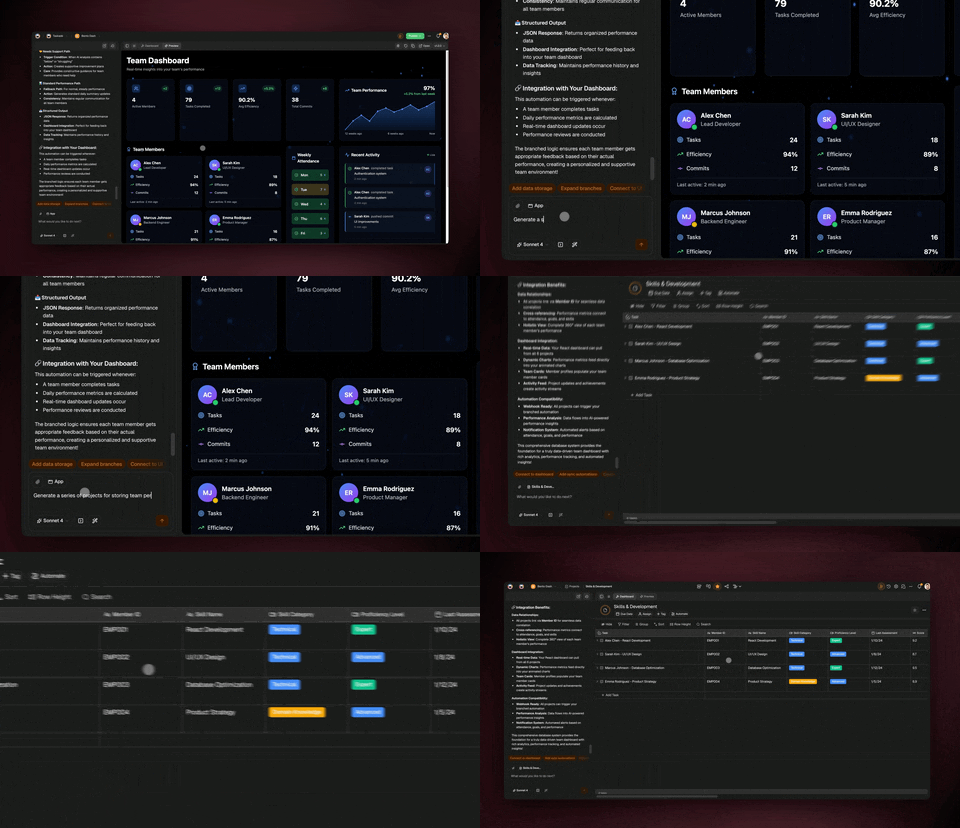
Karpathy's vibe coding concept is materializing in tools like Taskade Genesis, which lets users build live applications from natural-language prompts. No coding required. This trend democratizes software creation and puts AI app building in the hands of non-developers.
Parting Words
The AI influencers on this list are not just thought leaders. They are the architects of the technology that powers the tools you use every day. Following them gives you a strategic edge: early awareness of breakthroughs, deeper understanding of capabilities, and clearer vision for how AI will reshape your industry.
Stay curious, stay informed, and most importantly, start building. The concepts these leaders describe are not theoretical. You can apply them today.
Apply AI Influencer Insights With Taskade
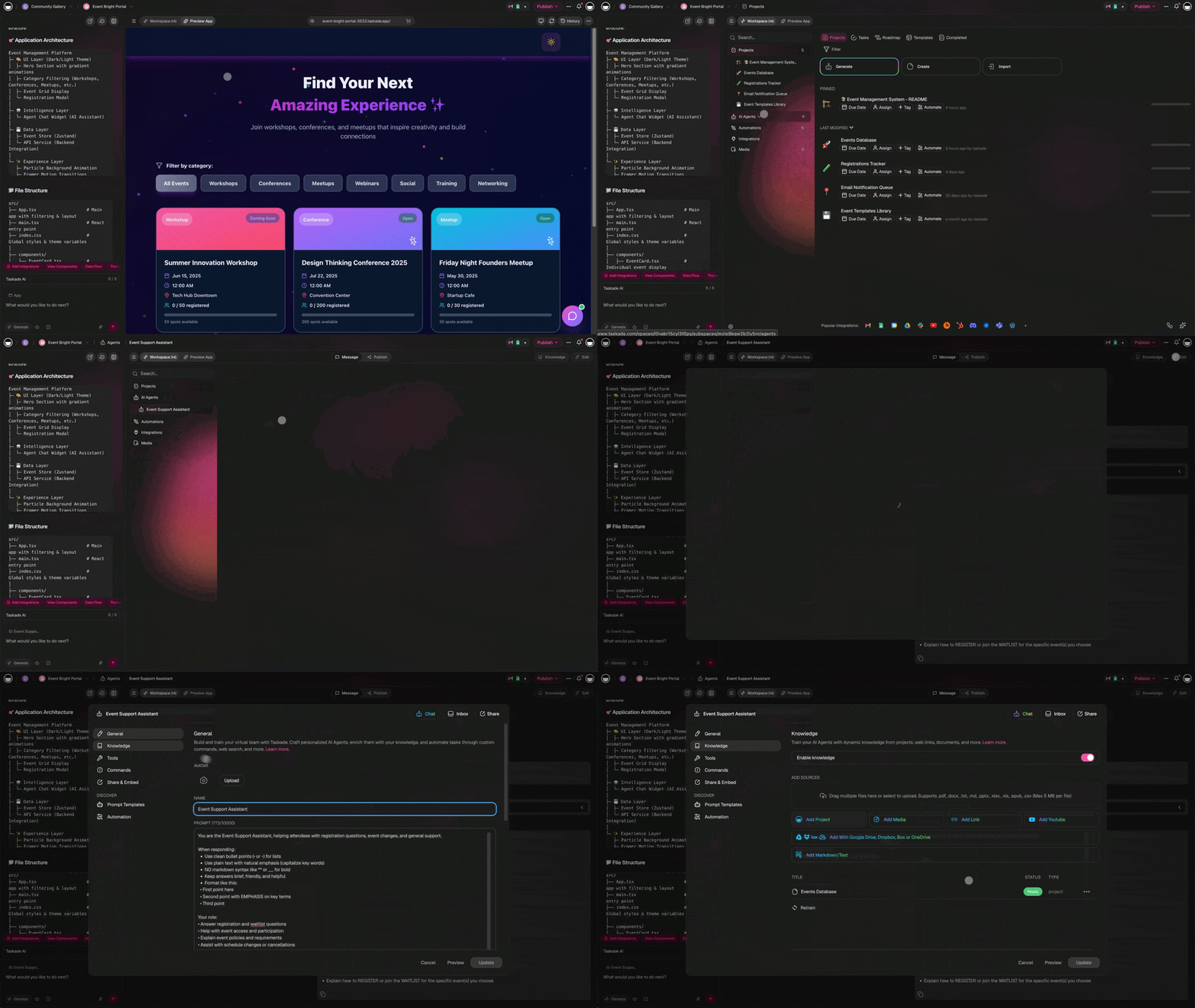
Taskade is an AI-native productivity platform powered by 11+ frontier models from OpenAI, Anthropic, and Google. Build custom AI agents, create apps from prompts with Genesis, and automate workflows across 100+ integrations.
| Feature | What It Does |
|---|---|
| Custom AI Agents | Build agents with 22+ tools, persistent memory, and custom knowledge |
| Genesis App Builder | Build live apps from natural-language prompts |
| Automation Flows | Multi-step workflows with 100+ integrations |
| 7 Project Views | List, Board, Calendar, Table, Mind Map, Gantt, Org Chart |
| Real-Time Collaboration | Chat, video, and AI-assisted teamwork |
Visit Taskade's pricing page for a breakdown of AI features and plans. Starting at $6/month with AI included in every plan.
Build your first AI agent with Taskade -->
Related Resources
- What Are AI Agents? -- Core agent concepts
- Agentic AI Systems: The Next Evolution of Work -- Agentic AI deep dive
- How to Build Your First AI Agent in 60 Seconds -- Practical agent guide
- Best Vibe Coding Tools -- AI coding tools compared
- 10 Best AI App Builders -- App builder roundup
- Single-Agent vs Multi-Agent AI Teams -- Architecture comparison
- AI Agent Builders: Empowering Automation -- Agent builder landscape
- Browse AI apps in the Taskade community -- Community gallery
Frequently Asked Questions
Who are the most influential people in AI in 2026?
The most influential people in AI in 2026 include Sam Altman (OpenAI CEO driving GPT models and ChatGPT), Dario Amodei (Anthropic CEO pioneering AI safety with Claude), Andrej Karpathy (former Tesla AI director who coined vibe coding and is an influential AI educator), Ilya Sutskever (co-founder of Safe Superintelligence Inc.), Demis Hassabis (Google DeepMind CEO and Nobel laureate for AlphaFold), Yann LeCun (Meta Chief AI Scientist and open-source AI advocate), and Fei-Fei Li (Stanford professor, ImageNet creator, founder of World Labs).
Why should you follow AI influencers?
Following AI influencers provides three strategic advantages. First, early signal detection because leaders announce breakthroughs and paradigm shifts weeks before mainstream media coverage. Second, technical understanding because educators like Andrej Karpathy explain complex AI concepts without requiring a PhD. Third, career guidance because understanding the direction from the people building AI helps you position your skills and business. X (Twitter) and YouTube are the primary channels where AI leaders share insights.
How do AI influencers shape the direction of AI technology?
AI influencers shape technology through three mechanisms. First, research direction because leaders at labs like OpenAI, Anthropic, DeepMind, and Meta decide which problems to prioritize. Second, public discourse because their statements on safety, regulation, and capabilities influence policymakers and investors. Third, open-source contributions because figures like Yann LeCun with LLaMA and Andrej Karpathy with educational content democratize AI knowledge for smaller companies and individual developers.
What AI trends are top influencers focused on in 2026?
Top AI influencers are focused on five major trends in 2026. Agentic AI is the shift from chatbots to autonomous agents that plan and execute tasks. AI safety and alignment ensures powerful models remain controllable. Multimodal AI processes text, images, video, and audio together. Open-source versus closed-source debates whether frontier models should be publicly available. AI-generated software through vibe coding and AI app builders lets non-developers create applications using tools like Taskade Genesis.
Who coined the term vibe coding?
Andrej Karpathy coined the term vibe coding in early 2025. He described it as a new way of programming where you give yourself over to the vibes, embrace exponentials, and forget that the code even exists. The concept describes AI-assisted software development where developers describe what they want in natural language and AI generates the code. Tools like Taskade Genesis embody this approach by letting users build complete apps from prompts.
What is Safe Superintelligence Inc and who founded it?
Safe Superintelligence Inc (SSI) was co-founded by Ilya Sutskever after his departure from OpenAI in 2024. The company focuses exclusively on building safe superintelligent AI. Sutskever was the co-founder and former chief scientist of OpenAI where he co-authored the original GPT research. SSI raised over $1 billion in 2024 and represents the safety-first approach to AI development contrasted with the rapid deployment strategies of OpenAI and Meta.
What role does Dario Amodei play in AI safety?
Dario Amodei is the CEO and co-founder of Anthropic, the company behind the Claude AI model family. He left OpenAI in 2021 to build an AI lab with safety as its core mission. Anthropic pioneered Constitutional AI, a technique for training models to be helpful, harmless, and honest. Amodei's essay Machines of Loving Grace outlined a vision for AI to accelerate progress in health, science, and governance while maintaining safety guardrails.
How can AI productivity tools help you apply insights from AI influencers?
AI productivity platforms like Taskade let you apply concepts from AI influencers directly. Custom AI agents with 22+ built-in tools implement the agentic AI vision that leaders like Sam Altman and Dario Amodei describe. Taskade Genesis app building from prompts is vibe coding in practice as described by Karpathy. Workflow automations with 100+ integrations demonstrate the autonomous execution that AI researchers are building toward. Start at $6 per month with AI included.