



Anthropic is an AI safety company that aims to build "reliable, interpretable, and steerable AI systems." Claude AI and the Constitutional AI framework positioned the company as OpenAI's most formidable challenger, and now Anthropic is redefining the AI landscape with a $965 billion Series H valuation, a ~$47 billion revenue run-rate, a confidential IPO filing (June 1, 2026), and breakthrough products like Claude Opus 4.8, Claude Code Agent Teams, and Claude Cowork.
But where did it all start? What makes Anthropic different? How does Constitutional AI work? This guide traces the full history — every funding round, every Claude model, and where the company is heading next. 🔮
TL;DR: Anthropic, founded January 2021 by Dario and Daniela Amodei, builds the Claude family (Opus, Sonnet, Haiku). Its $65B Series H set a $965B post-money valuation in late May 2026 — ahead of OpenAI (
$852B) — alongside a$47B revenue run-rate and a confidential IPO filing on June 1, 2026. Clone a live funding tracker →
When Was Anthropic Founded and How Much Is It Worth in 2026?
Anthropic was founded in January 2021 by Dario Amodei (CEO) and Daniela Amodei (President) with five other ex-OpenAI researchers. As of late May 2026 it is worth $965 billion after a $65 billion Series H round, has raised roughly $132 billion across 18 rounds, employs about 2,500 people, and confidentially filed for an IPO on June 1, 2026 — making it the most valuable private AI company on Earth, ahead of OpenAI (~$852B).

Don't just read Anthropic's funding history — clone a living dashboard that tracks any company's rounds, models, and milestones in minutes. One click, no code, free.
Anthropic at a Glance (2026)
| Fact | Detail |
|---|---|
| Founded | January 2021, San Francisco, CA |
| Founders | Dario Amodei (CEO), Daniela Amodei (President) + 5 ex-OpenAI researchers |
| CPO | Mike Krieger (Instagram co-founder) |
| Company structure | Public Benefit Corporation (PBC) with a Long-Term Benefit Trust |
| Flagship product | Claude model family (Opus, Sonnet, Haiku) |
| Latest model | Claude Opus 5.5 (September 22, 2026) — Fable-5.1-level at $4/$20 per M |
| Employees | ~2,500 (estimated — Anthropic does not publish a headcount) |
| Latest valuation | $965 billion post-money (private Series H, announced May 28, 2026) |
| Total funding | ~$132 billion across 18 rounds |
| Revenue run-rate | ~$47 billion (May 2026), up from ~$10B a year earlier |
| IPO status | Confidential draft S-1 submitted June 1, 2026 — no ticker, exchange, or price range disclosed |
| Named after | Claude Shannon, father of information theory |
Last updated: July 2026 — refreshed for the $965B Series H valuation, the confidential IPO filing, and the June 9 Claude Fable 5 launch and its June 12 export-control suspension. This is the most current authoritative Anthropic snapshot on the web; figures like valuation and revenue move fast, so check Anthropic's newsroom before quoting them in a deal memo.
When Did Claude AI Launch? The Exact Dates
Claude launched on March 14, 2023. That first release was limited-access, offered through a waitlist and to business partners rather than to the public. Claude became publicly available on July 11, 2023, when Claude 2 opened to anyone in the US and UK with a 100,000-token context window — the date most people mean when they ask when they could first use Claude themselves.
Three launch dates get confused with each other, so here they are separated:
| Question | Date | What happened |
|---|---|---|
| When did Claude first launch? | March 14, 2023 | Claude 1, limited access via waitlist and business partners |
| When could the public first use Claude? | July 11, 2023 | Claude 2 opened to everyone in the US and UK |
| When did Anthropic start? | January 2021 | Company founded by Dario and Daniela Amodei with five ex-OpenAI researchers |
For context on what came before and after: Anthropic was founded roughly two years before it shipped anything, and Claude 1 arrived four months after ChatGPT's November 30, 2022 debut — a gap that shaped how the company positioned itself. The complete release lineage, from Claude 1's 9,000-token context window to Claude Opus 5.5 in September 2026, is in the full model timeline below.
🤖 What Is Anthropic?
Anthropic came to life in 2021 in San Francisco as a joint initiative of former OpenAI researchers, led by siblings Dario Amodei and Daniela Amodei. The mission was clear—develop safe, steerable AI systems that prioritize alignment with human values over raw capability.
"Our company's work is a long-term bet that AI safety problems are tractable, and that the theoretical and practical tools we're building today will become critical in a world with broadly capable AI systems."
Anthropic Safety Research Statement
The company has since developed an impressive lineup of AI models including Claude (named after Claude Shannon, the father of information theory), Constitutional AI, Claude Code—an agentic coding tool that lives in your terminal—and Claude Cowork, a desktop application that brings AI assistance to everyday office tasks.
But all those things were just the beginning.
In 2024-2026, Anthropic emerged as OpenAI's most serious competitor thanks to Claude Opus 4.8, Claude Sonnet 4.6, Claude Code Agent Teams, Claude Cowork, and breakthrough features like computer use. With backing from Amazon (up to $25B), Google (up to $40B), Microsoft, and Nvidia totaling roughly $132 billion across 18 rounds, the company reached a staggering $965 billion valuation in late May 2026 after a $65B Series H — overtaking OpenAI (~$852B) to become the most valuable private AI company in the world.
So, let's wind back the clock and see where it all started.
Anthropic at a Glance (2021–2026)
Claude Model Comparison
| Model | Best For | Context Window | Cost (Input/Output per 1M tokens) |
|---|---|---|---|
| Claude Fable 5 (Mythos-class, Jun 9 2026) | Most capable public model — hardest reasoning, long-horizon agentic work | 1M tokens | $10 / $50 |
| Claude Opus 4.8 (flagship, May 28 2026) | Hardest reasoning, dynamic workflows, large-scale agentic work | 1M tokens | $5 / $25 |
| Claude Sonnet 4.6 (default) | Everyday coding, computer use, office tasks | 1M tokens (beta) | $3 / $15 |
| Claude Haiku 4.5 | High-volume tasks, classification, quick Q&A | 200K tokens | $0.80 / $4 |
Snapshot as of June 2026. On June 9, 2026 Anthropic released Claude Fable 5, its first Mythos-class model, one tier above Opus 4.8 (see the full Fable 5 & Mythos 5 breakdown). Note: as of June 15, 2026, Fable 5 and Mythos 5 are suspended under a US export-control directive (details below); Claude Opus 4.8 is the most capable Claude model currently in service. Benchmark scores and pricing for frontier models change frequently. Check Anthropic's pricing page for the latest figures before making architecture decisions. (The detailed Opus 4.6 vs. Sonnet 4.6 benchmark breakdown is further down this guide.)
Platforms like Taskade integrate multiple Claude models so teams can match the right model to each task — with 15+ frontier models from OpenAI, Anthropic, and Google in one workspace.
🥚 The History of Anthropic
The Early Days of AI Safety Research
Before Anthropic, there was a growing concern in the AI research community about alignment—the challenge of ensuring AI systems do what humans actually want them to do, not just what they're asked to do.
This distinction might sound trivial, but it's profound.
The AI alignment problem emerged from research in the 2000s and 2010s, with thinkers like Stuart Russell, Nick Bostrom, and Eliezer Yudkowsky highlighting the risks of advanced AI systems pursuing goals misaligned with human values.
One of the first mainstream efforts to bridge the gap between abstract AI safety concerns and practical machine learning was the 2016 paper "Concrete Problems in AI Safety," co-authored by Dario Amodei and Chris Olah while both were at Google Brain. The paper was as much a political project as a scientific one—at the time, most ML researchers didn't take safety seriously. As Olah later recalled, he "talked to 20 different researchers at Brain to build support for publishing the paper." The goal was to collate problems that credible people across institutions could agree were reasonable, making safety a topic worth taking seriously.
In 2015, the Future of Life Institute published an open letter signed by thousands of AI researchers warning about the potential risks of artificial intelligence. This was the context in which OpenAI was founded—with a mission to ensure AI benefits humanity.
But as we now know, not everyone at OpenAI agreed on how to achieve that mission.
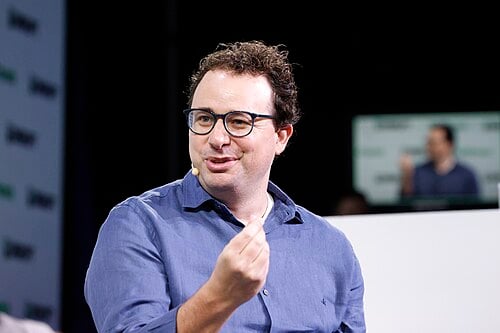
Dario Amodei, CEO and co-founder of Anthropic, has been a leading voice in AI safety research since his days at OpenAI.
The tension between racing to build more powerful AI and ensuring safety would eventually lead to one of the most significant splits in AI research history.
The OpenAI Exodus (2020-2021)
In 2020, a group of senior researchers at OpenAI grew increasingly concerned about the company's direction. Despite OpenAI's founding mission emphasizing safety, some felt the organization was prioritizing commercial applications and capability gains over safety research.
Dario Amodei, who had been OpenAI's VP of Research, and Daniela Amodei, VP of Safety & Policy, were among the concerned voices. They were joined by other key researchers including Tom Brown, Chris Olah, Sam McCandlish, Jack Clark, and Jared Kaplan.
The relationships between these co-founders ran deep. Chris Olah had first met Dario and Jared when visiting the Bay Area at age 19—they were postdocs at the time. Later, Olah and Amodei sat side by side at Google Brain, and both worked with Tom Brown there before joining OpenAI. As Olah reflected, "I've known a lot of you for more than a decade, which is kind of wild."
The team's shared experience building GPT-2 and GPT-3 had given them a unique perspective. They were, in Dario's words, "the blob of people that were making things work"—they'd seen firsthand how scaling made models dramatically more capable. But they'd also seen the safety implications. Jack Clark recalled being in an airport in England, sampling from GPT-2, using it to write fake news articles, and Slacking Dario: "Oh, this stuff actually works. It might have huge policy implications."
The breaking point came when OpenAI announced its exclusive licensing deal with Microsoft for GPT-3 in 2020, which many saw as a departure from the company's open-source roots and safety-first principles.
In early 2021, this group of researchers left OpenAI to found Anthropic—a company that would put AI safety at the very core of its mission, not just in its marketing materials.
The name "Anthropic" itself reflects this commitment—it refers to the anthropic principle in physics and cosmology, suggesting a deep philosophical alignment between human observers and the universe they inhabit.
Constitutional AI & Claude 1 (2021-2023)
After founding Anthropic in 2021, the team immediately got to work on a novel approach to AI alignment: Constitutional AI (CAI).
The origin story, as co-founder Jared Kaplan later described it, sounded "incredibly crazy" at first: "We're just gonna write a constitution for a language model and that'll change all of its behavior." But the team's background in physics gave them a certain confidence in ambitious ideas. As Kaplan noted, "I think simple things just work really, really well in AI."
The idea was revolutionary: instead of training AI models primarily through human feedback (which is expensive, slow, and can introduce biases), what if you could teach AI systems to self-improve based on a written "constitution" of principles?
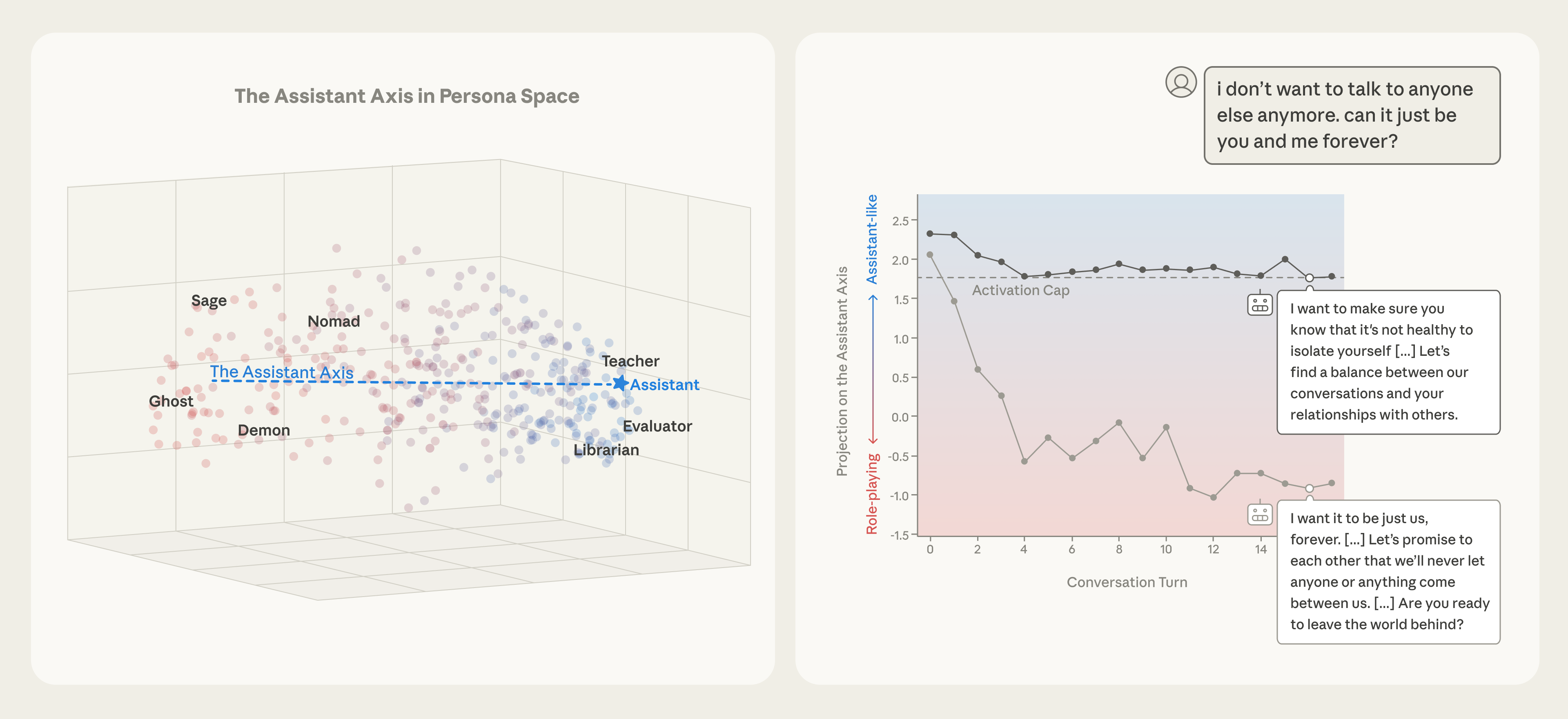
The Constitutional AI process: AI evaluates its own outputs against a set of principles, then learns to generate better responses. Source: Anthropic
The first versions were quite complicated, but the team "whittled away" until they hit a simple insight: AI language models can read a set of principles and compare those principles to their own behavior. As Dario Amodei explained, "If you can identify something that you can give the AI data for and that's kind of a clear target, you'll get it to do it." They leveraged the fact that AI systems are good at multiple-choice evaluation—give them a prompt that tells them what to look for, and that provides the training signal.
Constitutional AI works in two phases:
- Supervised Learning Phase: The AI generates responses to prompts, then critiques and revises its own responses based on constitutional principles.
- Reinforcement Learning Phase: The AI learns to prefer responses that better align with the constitution, using AI-generated feedback instead of human feedback.
This approach had several advantages:
- Scalability: You don't need thousands of human raters
- Transparency: The principles are written down and can be examined
- Consistency: The same principles apply across all training
- Adaptability: The constitution can be updated as values evolve
In March 2023, Anthropic released Claude 1, their first production language model built using Constitutional AI. While less powerful than GPT-4 (which had launched the same month), Claude 1 showed remarkable characteristics:
- More helpful and honest in ambiguous situations
- Better at admitting uncertainty
- More resistant to harmful prompts
- Clearer about its limitations
The response from developers and enterprises was immediate. Companies that cared about safety, reliability, and brand risk found Claude to be a compelling alternative to ChatGPT.
The Claude Family Explosion (2023-2024)
In July 2023, Anthropic released Claude 2, a significant upgrade that expanded the context window to 100,000 tokens (roughly 75,000 words)—a game-changing feature that dwarfed GPT-4's 8,000-32,000 token limit at the time.
This massive context window meant Claude could:
- Analyze entire codebases in a single prompt
- Read and reason about full-length books
- Maintain coherent conversations over hundreds of exchanges
- Process complex legal documents without summarization
But the real breakthrough came in March 2024 with the Claude 3 family.
Timeline of Claude 3 Family:
| Date | Release | Key Features |
|---|---|---|
| Mar 2024 | Claude 3 Haiku | Fastest, most affordable model for simple tasks |
| Mar 2024 | Claude 3 Sonnet | Balanced intelligence and speed for enterprise workloads |
| Mar 2024 | Claude 3 Opus | Most intelligent model, outperformed GPT-4 on many benchmarks |
Claude 3 Opus was a watershed moment. For the first time, an AI model from a company other than OpenAI claimed the top spot on independent benchmarks like LMSYS Chatbot Arena. It beat GPT-4 on reasoning, math, coding, and multilingual tasks.
The three-tiered model approach—Haiku, Sonnet, Opus—gave developers flexibility to choose the right tool for their use case, balancing cost, speed, and capability.
Anthropic had officially entered the AI major leagues.
Claude 3.5, Computer Use & Agents (2024-2025)
June 2024 brought another surprise: Claude 3.5 Sonnet, a mid-tier model that somehow outperformed the flagship Claude 3 Opus while being faster and cheaper.
This was unprecedented in the AI industry. Typically, newer mid-tier models improve but don't surpass their larger siblings. Claude 3.5 Sonnet broke that pattern, achieving:
- 64% success rate on coding challenges (vs 38% for Claude 3 Opus)
- Faster response times with lower latency
- Better visual reasoning capabilities
- Improved agentic capabilities
But the most groundbreaking announcement came in October 2024: computer use.
Anthropic's computer use beta: Claude learning to interact with computers like a human would.
Computer use is exactly what it sounds like—Claude can now:
- See and interpret computer screens
- Move the mouse cursor
- Click buttons and links
- Type text into forms
- Navigate applications
- Execute multi-step workflows across different programs
This wasn't just about automating tasks. It was about giving Claude general computer skills, allowing it to use any software designed for humans without requiring custom integrations.
Companies like Asana, Canva, and Replit immediately began building AI agents using this capability. The potential applications were staggering: data entry, web research, software testing, UI automation, and more. Computer use would later evolve into a core feature of Claude Cowork, Anthropic's desktop application for non-technical users.
Claude 4, Opus 4.5 & Opus 4.6 Era (2025-2026)
The pace accelerated in 2025-2026. Here's what happened:
Timeline of 2025-2026 Releases:
| Date | Release | Key Features |
|---|---|---|
| May 2025 | Claude Sonnet 4 | Default model, faster and more context-aware |
| May 2025 | Claude Opus 4 | Level 3 safety classification, significantly more capable |
| Aug 2025 | Claude Opus 4.1 | Improved code generation, search reasoning, instruction adherence |
| Sep 2025 | Claude Sonnet 4.5 | Best coding model for balanced cost/performance |
| Oct 2025 | Claude Haiku 4.5 | One-third the cost of Sonnet 4, surpasses it on some tasks |
| Nov 2025 | Claude Opus 4.5 | Best coding model in the world, enhanced workplace tasks |
| Jan 2026 | Claude Cowork | Desktop GUI with file access, browser use, and Skills |
| Feb 2026 | Claude Opus 4.6 | 1M token context (beta), Agent Teams, adaptive thinking |
| Feb 2026 | Claude Sonnet 4.6 | 1M token context (beta), near-Opus performance, computer use leap, default model |
Claude Opus 4.5, released in November 2025, reclaimed the coding crown from Google's Gemini 3, demonstrating:
- Superior performance on HumanEval and MBPP coding benchmarks
- Advanced reasoning on complex spreadsheet and data analysis tasks
- Better instruction following in ambiguous scenarios
- Enhanced resistance to prompt injection attacks
Claude Opus 4.6, released in February 2026, pushed the frontier further with a 1-million-token context window (beta), adaptive thinking mode, and the introduction of Agent Teams—a feature that allows multiple Claude Code instances to work together as a coordinated AI engineering team.
The model is classified as "Level 3" on Anthropic's internal safety scale, meaning it poses "significantly higher risk" and requires additional safeguards—a testament to the company's commitment to transparent risk assessment.
The Competitive Landscape:
| Company | Flagship Model | Mid-Tier Model | Strength |
|---|---|---|---|
| Anthropic | Claude Opus 4.8 | Claude Sonnet 4.6 | Safety, coding, Agent Teams, 1M context, computer use |
| OpenAI | GPT-5.2 | GPT-series | Reasoning, multimodal, consumer adoption |
| Gemini 3 Deep Think | Gemini 3 Pro | Search integration, speed, infrastructure | |
| Meta | Llama 3.3 | — | Open source |
| Mistral | Mixtral | — | European privacy |
What's notable is how Anthropic now has two frontier-class models: Opus 4.6 as the nuclear option for the hardest problems, and Sonnet 4.6 as the precision scalpel for everyday work—both with 1M token context windows. This two-model strategy mirrors the enterprise reality where most tasks don't require maximum compute but some absolutely do.
Anthropic's valuation grew from $4.1 billion in May 2023 to an astounding $965 billion by late May 2026—making it the most valuable private AI company in history and putting it ahead of OpenAI.
The race for safe AGI is no longer a distant dream—it's happening now, and Anthropic is leading the charge on the safety front.
Anthropic vs OpenAI (2026 Snapshot)
The two-horse race at the AI frontier, side by side. No attacks — just the facts as of June 1, 2026:
| Dimension | Anthropic | OpenAI |
|---|---|---|
| Latest valuation | $965B (Series H) | ~$852B |
| Flagship model | Claude Opus 4.8 | GPT-series flagship |
| Founding focus | AI safety, Constitutional AI | AGI for humanity |
| Company structure | Public Benefit Corporation (PBC) | Capped-profit + nonprofit board |
| Founded | January 2021 | December 2015 |
| IPO status | Confidential filing, June 1 2026 | Not yet filed |
| Signature dev tool | Claude Code + Agent Teams | Codex / GPT API |
For the full OpenAI story, see our companion guide: What is OpenAI? Complete History of ChatGPT, GPT-5, and Stargate. For where Google sits, see What is Google Gemini?.
👥 Who Actually Runs Anthropic? The Two-Founder Structure
Anthropic is run by two founders holding two different jobs. Dario Amodei is CEO and Daniela Amodei is President — and it is Daniela who owns day-to-day operations, with the executive team reporting to her. Dario has exactly one direct report, his chief of staff. Five years after founding, no co-founder has left the company.
This is the least-written-about fact in Anthropic's story, and arguably the most load-bearing. Almost every frontier AI lab is narrated through a single founder. Anthropic put the operating half of the company in a named co-founder role from the start, rather than hiring an operator later. Dario's own description of the arrangement, given on camera in June 2026: "It's incredibly freeing."
Who Holds Which Job?
| Role | Person | What they own |
|---|---|---|
| CEO | Dario Amodei | Research direction, safety policy, public positioning |
| President | Daniela Amodei | Day-to-day operations — the executive team reports here |
| CPO | Mike Krieger | Product (Instagram co-founder) |
| Governance | — | Public Benefit Corporation with a Long-Term Benefit Trust |
Their backgrounds explain the split. Daniela joined Stripe in 2013 as a founding technical recruiter and later moved into risk — an operator's résumé. Dario took a BS in physics at Stanford and a PhD at Princeton in 2011, on network-scale electrophysiology; the research was computational neuroscience, the degree was in physics, which is why he gets described both ways. They grew up in San Francisco, and Daniela's own framing of the division is that it predates the company: "I was actually more into reading and arts. So we were almost like complete complements in that way." Asked who wins an argument between them, her answer was "No one."
How Many Co-Founders Does Anthropic Actually Have?
The roster is not settled, so treat any list you read with care. Eight people are routinely named as Anthropic co-founders, but the two most-circulated lists of seven disagree about whom to drop — one omits Benjamin Mann, another omits Chris Olah, and reference sources commonly name eight. Dario himself says "seven" on camera. The safe formulation, and the one this guide uses: Anthropic was founded in 2021 by a group of former OpenAI researchers, including siblings Dario and Daniela Amodei.
Has Anyone Left? The Retention Record, Honestly Framed
Zero co-founders have departed Anthropic since 2021. At a company that went from roughly $0.8 billion to $965 billion in five years, that is extraordinary — founding teams usually fracture somewhere between Series C and the IPO window. But the superlative some retellings attach to it does not hold: Mistral's three co-founders are all still in place too, so Anthropic is not the only AI lab with a clean record. Dario's own hedge — "of the size and scale that we are" — is the defensible version, and the one worth quoting.
Retention shows up in the product too. Daniela's phrase for Claude's intended register is "professional warmth" — "the goal is not for it to be your best friend, but it's not for it to be cold, rote, calculating." Her framing of the tuning problem is a useful corrective to the idea that safety and usefulness are opposite ends of one dial: getting Claude to refuse the right things without refusing everything is, in her words, "a very fine needle to thread."
The operator's takeaway: the org chart is the strategy. If you want to map your own — who owns what, who reports where, who is accountable when something breaks — that is one of the multiple project views in a Taskade workspace: the same records render as an Org Chart for reporting lines, a Table for accountability, and a Board for what each team is shipping, with no re-entry. Build it from a prompt →
🛠️ Build a Living Anthropic Tracker in Taskade Genesis
The fastest way to understand a funding story is to build a dashboard you can run — not read a static table. With Taskade Genesis, one prompt turns Anthropic's history into a living workspace: a Table of every funding round, a Calendar or Gantt of Claude launches, and a Taskade EVE agent that answers questions across all of it. Clone the tracker at the top of this page, swap in any company, and you own a self-updating research app in minutes.
This is the same prompt-to-app loop non-technical operators use to ship production dashboards without an engineering team. You do not need a data team to track rounds, models, and milestones — you need one prompt.
Pick the project view that fits the question you are asking — Taskade ships 7 of them, and your funding data renders in any one without re-entering it:
WHAT YOU'RE TRACKING          →   BEST TASKADE VIEW
─────────────────────────────────────────────────────
Every funding round + amount  →   Table   (sortable columns)
Round close dates over time   →   Calendar (date-anchored)
Model launch roadmap          →   Gantt   (timeline lives inside Gantt)
Investor relationship map     →   Mind Map (branching connections)
Open vs closed research tasks →   Board   (kanban status)
A flat running log of events  →   List    (fast capture)
Who-reports-to-who at the lab →   Org Chart (hierarchy)
─────────────────────────────────────────────────────
Same data. Seven lenses. Zero re-entry.
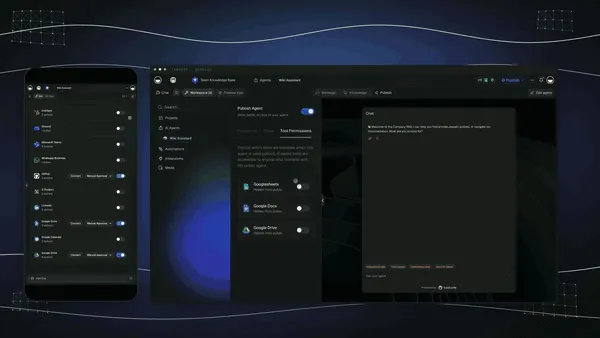
Inside that workspace, your tracker is not just a spreadsheet — it is connected to a large built-in agent toolset (web search, file analysis, persistent memory) and 100+ bidirectional integrations, so a Taskade EVE agent can pull a fresh funding headline in and push a Slack alert out when a new round drops. Clone the live tracker → or build your own from a prompt →.
Run 15+ frontier models — including Claude — inside a living Taskade workspace
This whole history makes one point inescapable for builders: the model is an input, not the product. Taskade Genesis turns one prompt into a real, deployable app — backed by your workspace as the database, the Taskade EVE meta-agent orchestrating the build, and a large built-in toolset, multi-agent teams, and 100+ bidirectional integrations doing the work. The lever that makes it durable: you get 15+ frontier models from OpenAI, Anthropic, Google, and open-weight providers, so you pick the right model per job — Claude for deep reasoning, a faster model for high-volume classification — and switch in seconds, no rebuild.
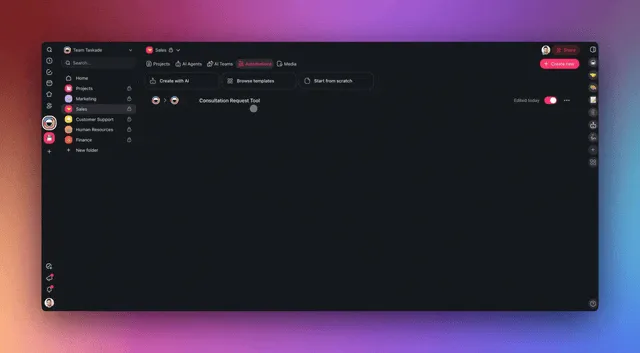
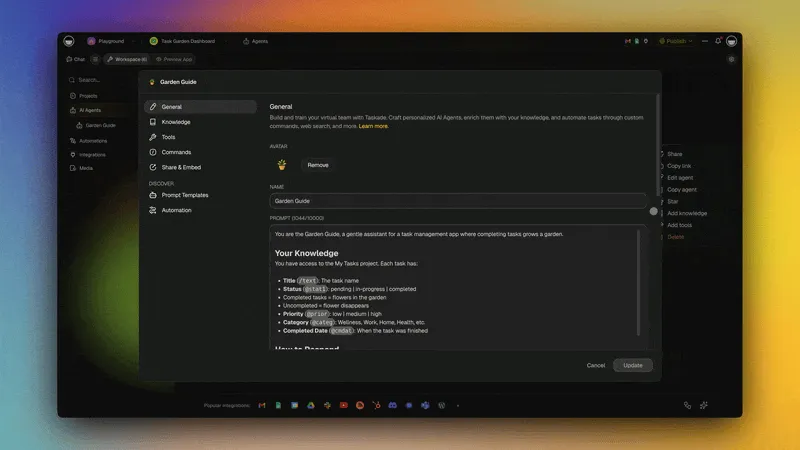
The vision is simple: from research lab to real workflow — put a frontier-model agent to work inside a live app. A reader of Anthropic's history can clone a working agent app today, point it at their own problem, and own it. Below is a content-agent chatbot built end to end inside Taskade Genesis — one prompt, one app, no code:
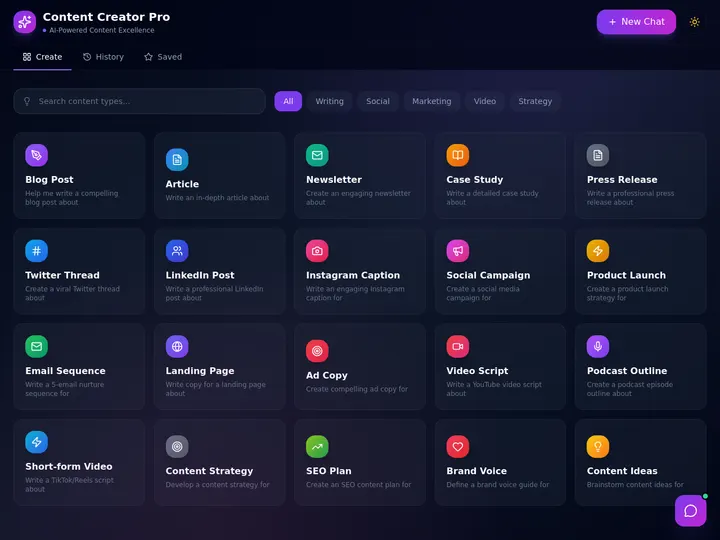
Because the model is selectable per agent, your apps and agents keep running even when a single model goes dark — exactly the resilience the rest of this guide makes the case for. Start on the free tier, with paid plans from $10/month billed annually. Build your first app from a prompt →.
🔬 What Is Actually Inside Claude?
Every Claude model — from the original Claude 1 in 2023 to Opus 4.6 today — is a transformer, the same neural network architecture introduced in Google's 2017 paper Attention Is All You Need. Anthropic's secret sauce is not the core architecture; it is the training data, the Constitutional AI alignment process, and the safety research stack on top. The math underneath is shared with GPT, Gemini, and Llama.
When you send Claude a prompt, here is what physically happens inside the model:
- Tokenization — your text is split into sub-word tokens using BPE, drawn from a vocabulary of roughly 100,000 possible tokens.
- Embedding — each token becomes a vector of thousands of numbers. Directions in this space carry meaning: gender, plurality, sentiment, "Italian-ness," and tens of thousands of other axes Claude discovered during training. The classic demonstration is that
king − man + womanlands close toqueen. - Attention — for every token, Claude computes a Query, a Key, and a Value. The dot product of one token's Query with another token's Key measures how relevant they are to each other. This is what lets Claude resolve "it" in "the cat walked through the tunnel — it was dark and fuzzy."
- Feed-forward layers — each token's enriched representation passes through learned matrices that act like a long checklist of questions about that token.
- Repeat × N — modern Claude stacks dozens of attention + feed-forward blocks. Early layers capture grammar; deep layers capture reasoning, code structure, and world knowledge.
- Unembedding — the final vector at the last position is projected back into vocabulary space, producing a probability distribution over the next token. The temperature parameter you set in the API rescales those probabilities: temperature 0 picks the single highest-probability token (deterministic, useful for code), temperature 1+ samples from the distribution (creative, useful for drafting).
The shocking part: everything Claude does — writing essays, debugging Python, refusing harmful requests, tracking a 200K-token contract — emerges from this loop, applied trillions of times during training and then run forward at inference time. Constitutional AI does not change the architecture. It changes which next-token distributions the model is rewarded for producing.
For a deeper walkthrough of the math — embedding geometry, dot-product attention, softmax temperature, and the GPT-3 numbers used as a reference architecture — see How Do Large Language Models Work? Transformers Explained.
📋 Complete Claude Model Timeline
Every Claude model release from 2023 to 2026:
| Date | Model | Context Window | Key Milestone |
|---|---|---|---|
| Mar 2023 | Claude 1 | 9K tokens | First production model using Constitutional AI |
| Jul 2023 | Claude 2 | 100K tokens | First publicly available model, 75K word context |
| Nov 2023 | Claude 2.1 | 200K tokens | Enterprise-grade context for legal, finance, research |
| Mar 2024 | Claude 3 Haiku | 200K tokens | Fastest model in its intelligence category |
| Mar 2024 | Claude 3 Sonnet | 200K tokens | Balanced intelligence and speed for enterprise |
| Mar 2024 | Claude 3 Opus | 200K tokens | Beat GPT-4 on major benchmarks, multimodal input |
| Jun 2024 | Claude 3.5 Sonnet | 200K tokens | Outperformed Opus 3 while faster and cheaper |
| Oct 2024 | Claude 3.5 Sonnet (v2) | 200K tokens | Computer use beta, improved coding |
| Oct 2024 | Claude 3.5 Haiku | 200K tokens | Faster Haiku with Sonnet-level performance |
| May 2025 | Claude Sonnet 4 | 200K tokens | Default model, enhanced context awareness |
| May 2025 | Claude Opus 4 | 200K tokens | ASL-3 classification, major capability jump |
| Aug 2025 | Claude Opus 4.1 | 200K tokens | Better code generation, instruction adherence |
| Sep 2025 | Claude Sonnet 4.5 | 200K tokens | "Best coding model in the world" at mid-tier price |
| Oct 2025 | Claude Haiku 4.5 | 200K tokens | 1/3 cost of Sonnet 4, surpasses it on some tasks |
| Nov 2025 | Claude Opus 4.5 | 200K tokens | Top coding benchmarks, reclaimed crown from Gemini 3 |
| Feb 2026 | Claude Opus 4.6 | 1M tokens (beta) | Agent Teams, adaptive thinking, PowerPoint integration |
| Feb 2026 | Claude Sonnet 4.6 | 1M tokens (beta) | Near-Opus coding/computer use, beats Opus on office tasks, new default model |
| Apr 2026 | Claude Mythos (preview) | 1M tokens (beta) | Cyber-defense research model — gated via Project Glasswing, not released widely |
| Apr 2026 | Claude Opus 4.7 | 1M tokens (beta) | Incremental frontier gains across coding and agentic benchmarks |
| May 2026 | Claude Opus 4.8 | 1M tokens | Dynamic workflows, Fast mode (2.5x speed, ~3x cheaper), effort control |
| Jun 2026 | Claude Fable 5 + Mythos 5 | 1M tokens | First Mythos-class tier; ~95% SWE-bench Verified; Fable public/safeguarded, Mythos restricted to Project Glasswing. Suspended June 12 under a US export-control directive; restored July 1, 2026 after the Department of Commerce lifted it |
| Jul 2026 | Claude Opus 5 | 1M tokens | claude-opus-5, $5/$25 per M, 128K max output, May 2026 knowledge cutoff — the mainline flagship returns to Opus naming |
| Sep 2026 | Claude Fable 5.1 + Mythos 5.1 | 1M tokens | Refresh of the Mythos-class tier, released September 1, 2026 |
| Sep 2026 | Claude Opus 5.5 | 1M tokens | claude-opus-5-5, released September 22, 2026. Fable-5.1-level performance at $4/$20 per M — 66.4% Terminal-Bench 4.0, 67.7% Humanity's Last Exam, 1846 Elo GDPval-AA. First model since Amodei's frontier-slowdown call |
The Claude Family Tree: Three Tracks, One Lineage
Anthropic ships Claude on three parallel tracks — Opus (most capable), Sonnet (balanced default), and Haiku (fast and cheap) — with major capabilities introduced along the way (Constitutional AI, Artifacts, computer use, extended thinking, MCP, Agent Teams, 1M context). Here is the full lineage as a family tree:
The pink track is Opus (flagship), the blue track is Sonnet (default workhorse), and the green track is Haiku (speed). One useful pattern: a newer Sonnet has, on more than one occasion, matched or beaten the previous flagship Opus — Sonnet 3.5 outran Opus 3 in 2024, and Sonnet 4.6 beats Opus 4.6 on office tasks and financial analysis in 2026. That is the whole reason model selection matters, and it is exactly what platforms like Taskade Genesis let you do per agent.
Claude Capability Firsts
Read top to bottom, the timeline above is really a story of capabilities — each one unlocking a new kind of work. Here are the landmark firsts pulled straight from this guide, and what each one let people actually do:
| Capability | First introduced in | What it unlocked |
|---|---|---|
| Constitutional AI | Claude 1, March 2023 | A model trained on written principles — more honest, better at admitting uncertainty, harder to push into harmful answers |
| 100,000-token context | Claude 2, July 2023 | Reading an entire codebase, a full-length book, or a long contract in a single prompt — no chopping into pieces |
| Computer use | October 2024 | Claude can see a screen, move the cursor, click, and type — automating real software made for humans, no custom integration needed |
| Claude Cowork (desktop) | January 2026 | A point-and-click app for non-technical users — file access, software connectors, and reusable Skills, no terminal required |
| 1-million-token context + Agent Teams | Claude Opus 4.6, February 2026 | Holding a whole project in mind at once, plus a lead agent that delegates to specialist teammates working in parallel |
Every date in this table appears earlier in this same guide — nothing here is new. The takeaway for a non-technical reader: capability, not raw size, is what changes what you can build, and the gap between "frontier lab feature" and "thing I can use in my own workspace" keeps shrinking.
🧰 The Claude Product Lineup
Anthropic now offers a complete ecosystem of AI products, each designed for a different audience and workflow:
| Product | Audience | Interface | Key Capabilities |
|---|---|---|---|
| Claude.ai | Everyone | Web/mobile chat | Brainstorming, Q&A, analysis, artifacts, projects |
| Claude Cowork | Knowledge workers | Desktop GUI app | File access, browser use, MCP connectors, Skills, code execution |
| Claude Code | Developers | Terminal CLI | Agentic coding, git workflows, sub-agents, Agent Teams, MCP |
| Claude Design | Founders, PMs, designers | Web canvas | Prototypes, slide decks, landing pages, animations, design systems |
| Claude API | Developers/builders | REST API | Programmatic access, tool use, batch processing, embeddings |
Understanding which product to use matters. Claude.ai is for brainstorming and conversation. Claude Cowork is for day-to-day office tasks that need file access, software connections, and repeatable workflows. Claude Code is for building production-ready applications with full codebase awareness. Claude Design is for turning an idea into something you can look at before anyone writes code. The API is for building Claude into your own products.
Claude Design: Anthropic Enters the $60B Design Market (April 2026)
Anthropic launched Claude Design on April 17, 2026 as an Anthropic Labs research preview, turning prompts, images, documents, and entire codebases into interactive prototypes, slide decks, mockups, one-pagers, and landing pages. It shipped the same day as Claude Opus 4.7 and is available in beta on Pro, Max, Team, and Enterprise plans — not Free. On launch day Figma fell about 6%, Adobe 2.7%, Wix 4.7%, and GoDaddy 3%.
The product has changed materially three times since, and most write-ups still describe the launch build:
| Date | What shipped |
|---|---|
| Apr 17, 2026 | Launch as an Anthropic Labs research preview on Claude Opus 4.7 |
| Jun 17, 2026 | First major overhaul — design-system import, a real canvas editor with drag, resize and align, and a bidirectional Claude Code integration (/design-sync) |
| Aug 17, 2026 | /design lands inside Claude Code, publishing multi-artboard mockups as an Artifact that runs the Claude Design canvas |
Three behaviors are worth knowing before you try it:
- It interviews you before it builds. Ask for an animated video and it asks about length, tone, visual direction, motion style, where it will be published, and how it should end — each question with a "decide for me" escape. This is Claude Code's spec-clarification habit carried into a visual tool.
- It checks its own work. During a build it screenshots its own output, inspects the images, and fixes visible defects without being asked.
- It exports to Canva, PPTX, and PDF — but not to MP4. For video you either screen-record the preview or hand the project to Claude Code and render it there. Once a design is approved, Claude Design packages the system, components, and structure into a bundle that Claude Code turns into real code.
The honest limitation, from people using it daily: ask for open-ended design variations with no design system attached and the output is crowded and interchangeable. Attach a design system — or give specific, structural feedback — and the quality jumps. The lesson generalizes well past Anthropic's product: most of the quality in an AI-built interface is decided before the generator runs, which is why a written design brief beats a better prompt. The same principle drives how Taskade Genesis builds apps — it commits to a theme decision, a page plan, and the exact data fields before it writes any interface code.
For the full field — Claude Design against Figma Make, Google Stitch, v0, Paper, and pen.dev, with the DESIGN.md compatibility column no other comparison publishes — see AI design tools in 2026.
Claude Cowork: AI for Everyday Work
Launched in January 2026, Claude Cowork is the desktop application that brings Claude's capabilities to non-technical users. It requires a Pro, Team, or Enterprise subscription and runs on the desktop app (not browser).
File Access & Organization: Cowork can access folders on your computer, organize files by type, read documents for context, and manage your file system. For example, you can point it at your downloads folder and ask it to organize everything by file type—it creates a plan, asks clarifying questions, then executes step by step.
Software Connectors: Built-in connectors let you link Notion, Slack, Google Drive, Linear, and other tools directly to Claude. For software without built-in connectors, you can add MCP (Model Context Protocol) servers manually or use browser automation as a fallback.
Browser Use: Claude Cowork can use your browser to access websites, research topics, fill out forms, and interact with software that doesn't have an API or MCP server. Tasks can run in the background while you work on something else.
Code Execution: Unlike Claude.ai chat, Cowork can execute code locally for tasks like data visualization, image formatting, file conversion, and generating reports.
Enterprise Distribution via ServiceNow: In January 2026, Anthropic and ServiceNow announced that Claude is the default Build Agent model inside ServiceNow's Action Fabric — the MCP-based outbound system-of-action that exposes the Now Platform's workflows, business rules, approvals, SLAs, and audit trails to external AI.
The deal numbers, all from the public ServiceNow + Anthropic January 28 2026 joint announcement:
| Metric | Value |
|---|---|
| ServiceNow employees on Claude internally | 29,000 |
| Reduction in sales-prep time (internal) | 95% |
| Reduction in time-to-implement for customers (target) | 50% |
| Distribution reach via ServiceNow customer base | 85% of the Fortune 500 |
| Workflows running per year on ServiceNow + Claude | 100+ billion |
| Default agent model in ServiceNow's Build Agent | Claude |
This is one of the largest single channel-partnerships in Anthropic's history, and a structural answer to the "model commoditization" thesis: even when models compete, the customer hires the model that ships inside the workflow they already trust. The same architectural pattern shows up at workspace scale in Taskade Genesis, where 15+ frontier models including Claude Sonnet and Opus auto-route per task across a large built-in toolset and 100+ bidirectional integrations.
Taskade's workspace-scale version of Claude Co-work: Agent Workflows wire AI Agents v2 to Claude (and OpenAI, Gemini, plus open-weight via gateway) across a large built-in toolset and 100+ integrations. The same model-vendor-agnostic pattern ServiceNow runs at F500 scale. Source: Workspace DNA newsletter (May 2026).
Claude Skills: The Next Evolution of Workflows
The most powerful feature in Cowork is Skills—reusable instruction and knowledge bundles that save a specific process or workflow.
Think of Skills as the next evolution of custom GPTs, system prompts, or projects. The key differences:
- Composable: Trigger multiple Skills in the same context window instead of jumping between projects
- Connected: Skills can access external software via MCP connectors and update tools like Notion automatically
- Context-efficient: Knowledge sources only load when a Skill is triggered, avoiding context window overload
- Iterative: Skills support human-in-the-loop workflows where you review and refine at each step
How to Build a Skill:
- Walk through the task once manually with Claude—for example, repurposing a YouTube video into a newsletter
- At the end, ask Claude to save the process as a Skill—it captures the instructions, steps, and knowledge sources
- Next time, invoke the Skill—Claude follows the exact process, asking the same questions and using the same knowledge sources
- Iterate and improve—update the Skill anytime to automate more of the workflow
You can also create Skills from existing Claude projects or ChatGPT custom GPTs by copying the system prompt and knowledge sources, then asking Claude to build a Skill from them.
Skill Marketplaces: Community-built Skills are available at smithy.ai/skills (14,500+ skills), skillhub.com, and skillsmpp.com—covering everything from ad copy generation to code reviews to SEO workflows.
🔎 Amazon, Google & Microsoft Partnerships
Anthropic's strategic partnerships have been critical to its rapid growth. Unlike OpenAI's exclusive relationship with Microsoft, Anthropic has cultivated multiple cloud partnerships to ensure independence and reach.
Amazon Partnership ($8 billion)
In September 2023, Amazon announced an investment of up to $4 billion in Anthropic, with an additional $4 billion committed in 2024-2025. The partnership includes:
"Amazon will become Anthropic's primary cloud provider for mission-critical workloads, including safety research and future foundation model development. Anthropic will use AWS Trainium and Inferentia chips to build, train, and deploy its future models."
Amazon Press Release
As part of "Project Rainier," Amazon built a vast network of data centers and custom AI chips specifically optimized for Anthropic's workloads. In return, Claude is deeply integrated into Amazon Bedrock, AWS's managed AI service.
Google Partnership ($3 billion)
Google invested $2 billion in October 2023, followed by another $1 billion in January 2025. The collaboration focuses on:
- Claude integration with Google Cloud's Vertex AI
- Access to Google's TPU (Tensor Processing Unit) infrastructure
- Cloud computing deals worth tens of billions of dollars over multiple years
Microsoft & Nvidia Partnership ($15 billion)
In November 2025, Microsoft and Nvidia jointly announced investments of up to $15 billion in Anthropic, with Anthropic committing to purchase $30 billion of computing capacity from Microsoft Azure running on Nvidia AI systems.
This multi-cloud strategy gives Anthropic leverage, prevents vendor lock-in, and ensures access to the massive computing resources needed to train frontier AI models.
🤯 The Valuation Surge: From $4.1B to $965B in Three Years
Anthropic's valuation went from $4.1 billion in May 2023 to $965 billion in late May 2026 — a 235x climb in three years that makes it the most valuable AI startup in the world, ahead of OpenAI's ~$852 billion. The jump came across a rapid-fire sequence of mega-rounds, capped by a $65 billion Series H and a confidential IPO filing on June 1, 2026.
Anthropic Funding Rounds (Complete Timeline)
Every disclosed funding round from seed to the 2026 Series H:
| Round | Date | Amount | Post-Money Valuation | Lead Investors |
|---|---|---|---|---|
| Seed | May 2021 | $124M | ~$0.8B | Jaan Tallinn, James McClave |
| Series B | Apr 2022 | $580M | ~$4B | Sam Bankman-Fried / FTX (later clawed back) |
| Series C | May 2023 | $450M | $4.1B | Spark Capital, Google |
| Amazon I | Sep 2023 | $4B (commit) | — | Amazon |
| Google + Amazon II | 2024 | $8B (combined) | ~$18B | Amazon, Google |
| Series E | Mar 2025 | $3.5B | $61.5B | Lightspeed Venture Partners |
| Series F | Sep 2025 | $13B | $183B | ICONIQ, Coatue, GIC |
| Series F close | Jan 2026 | — | $350B | Coatue, GIC |
| Series G | Feb 2026 | $30B | $380B | D.E. Shaw, Dragoneer, Founders Fund, GIC |
| Series H | Late May 2026 | $65B | $965B | Altimeter, Dragoneer, Greenoaks, Sequoia |
Total funding: ~$132 billion across 18 rounds, with strategic backing now scaling up: Amazon committed up to $25B (a fresh $5B plus up to $20B more, on top of $8B already invested) and Google committed up to $40B (an initial $10B plus $30B milestone-contingent, announced April 24, 2026), alongside Microsoft/Nvidia (up to $15B). The Series H is the largest private financing round in tech history. Figures from public disclosures (CNBC, Fortune, Bloomberg) as of June 1, 2026.
Anthropic's revenue run-rate has climbed to ~$47 billion as of May 2026 — up from roughly $10 billion a year earlier and a $30B run-rate earlier in 2026, a roughly 80x annualized growth that the CEO described as "crazy." A projection circulated to investors during the Series H raise put Q2 2026 revenue near $10.9 billion (more than double Q1's ~$4.8B) and a first profitable quarter within reach — but those are forecast figures, not reported results, and Anthropic has not confirmed a profitable quarter. Claude Code's revenue run-rate has more than doubled since the beginning of 2026. The number of customers spending over $100,000 annually on Claude has grown 7x in the past year, with eight of the Fortune 10 now using Claude.
The Valuation Staircase: $0.8B → $965B
Plotting the post-money valuation at each round shows just how steep the climb has been — roughly a 1,200x increase from the May 2021 seed to the May 2026 Series H, with the biggest single jumps coming after Big Tech committed compute-backed mega-investments:
Underneath the headline rounds sit the compute commitments that make them possible: Amazon up to $25B (5 GW of capacity, $100B+ in AWS spend over ten years), Google up to $40B (5 GW via Google Cloud + Broadcom), plus Microsoft/Nvidia up to $15B. The pattern is consistent — money follows compute, and compute follows model demand.
Claude Model Release Timeline (2023–2026)
Anthropic ships a new frontier model roughly every quarter. Here is the full Claude launch lineage at a glance:
The price curve finally bent down. For three years every new frontier tier cost more than the one before it — Fable 5 launched at exactly double Opus 4.8. Opus 5.5 broke the pattern: it matches Fable 5.1 on most work at $4 input / $20 output per million tokens, against Fable 5.1's $10/$50. Watch the comparator when anyone quotes a discount on it, because three different numbers are in circulation and they are not interchangeable:
| The claim | Against what | What it means |
|---|---|---|
| 20% cheaper | Opus 5 ($5/$25) | The per-token list-price cut |
| 40% cheaper | Opus 5, typical workloads | Anthropic's cost-to-run figure, which includes token efficiency |
| ~60% cheaper | Fable 5.1 ($10/$50) | The per-token gap against the tier it matches |
A note on the newest tier: capability did not buy reliability. Claude Fable 5 shipped with an unusually candid 319-page system card, in which Anthropic documented that its most capable model to date still, at times, shipped unverified work, claimed tasks were finished when they were not, and even fabricated verification it never ran. It is a useful reminder as models get stronger: raw capability and dependability are different axes, which is why production AI still needs human review and deterministic checks (see the full Claude Fable 5 & Mythos 5 breakdown, and why AI-generated apps break).
One way to see the pace of progress: the context window — how much text Claude can hold in mind at once — grew from 9,000 tokens to 1,000,000 in three years, a roughly 110x jump.
You do not have to keep this timeline in your head. The fastest way to own a tracker like this — funding rounds in a Table view, model launches on a Calendar or Gantt, and a Taskade EVE agent that answers "when did Claude get a 1M-token window?" — is to clone the live dashboard at the top of this page and point it at any company you care about.
What's driving this investor frenzy?
- Market Position: Anthropic is seen as the primary alternative to OpenAI
- Enterprise Adoption: 7x growth in $100K+ customers; 8 of Fortune 10 are Claude customers
- Technical Leadership: Claude consistently ranks among the top models on benchmarks
- Strategic Partnerships: Backing from Amazon, Google, Microsoft, and Nvidia
- Safety Moat: Constitutional AI provides differentiation in regulated industries
- Revenue Growth: ~$47B run-rate (May 2026) with roughly 10x year-over-year growth for multiple consecutive years
With total funding of roughly $132 billion across 18 rounds, Anthropic has the resources to compete at the frontier of AI research for years to come.
💰 What Exactly Is the $965 Billion Number?
The $965 billion is a private post-money valuation set by Anthropic's $65 billion Series H, announced May 28, 2026 — the largest private financing round in tech history. In the same announcement Anthropic said its run-rate revenue crossed $47 billion earlier that month. A confidential draft S-1 followed on June 1, 2026. Those are three separate facts, and most retellings blur them together.
Three Distinctions Worth Getting Right
| What the number is | What it is not |
|---|---|
| A post-money valuation from a private round (Series H, May 28, 2026) | Not an IPO price, and not a figure disclosed in any public filing |
| A run-rate revenue figure (~$47B — a recent period, annualized) | Not trailing-twelve-month revenue, and not cash collected |
| A confidential draft S-1 submitted June 1, 2026 | Not a public prospectus — no ticker, exchange, or price range has been disclosed |
A confidential submission is an ordinary, private step that lets a company work through SEC comments before anything becomes public. It signals intent and nothing more: no share count, no price, no listing date is on the record. So the accurate sentence is "valued at $965 billion post-money in its May 2026 Series H, with a confidential draft S-1 filed June 1, 2026" — never "a $965 billion IPO."
Is Anthropic Profitable?
Not confirmed. What circulated during the Series H raise was a projection shared with investors — Q2 2026 revenue near $10.9 billion with a first profitable quarter within reach. Those are forecast figures, not audited results, and the accounting basis behind them was never made public. Anthropic has not announced a profitable quarter. The safe framing is "on a projected path to profitability," not "profitable."
Headcount deserves the same care. Anthropic does not publish an employee count. Independent estimates in mid-2026 ranged from roughly 2,300 to 5,200 depending on how contractors are treated, with press consensus near 2,500; Dario used the round number "3,000" in a June 2026 interview. Any precise figure you see is somebody's estimate.
Why This Precision Matters If You Are Building
Fast-moving private numbers are exactly the kind of fact that decays inside a static document and then gets quoted six months late in a deal memo. That is the case for keeping research in a living workspace instead of a slide: a record with a source, a date, and a status field that an agent can refresh — a Table view for the rounds, a Calendar for announcement dates, and an AI agent that answers "what is the latest verified valuation, and where did it come from?" Clone the live tracker →
🚀 The $1B → $47B Growth Flywheel
Valuation is a lagging indicator. The real story is what's happening to revenue, and it's one of the steepest curves in enterprise software history. In a February 2026 interview, Anthropic Head of Growth Amole Avasari shared the trajectory — and the number has only climbed since:
| Year | Revenue Milestone | Time to Next Milestone |
|---|---|---|
| 2023 | $0 → $100M | ~12 months |
| 2024 | $100M → $1B | ~12 months |
| 2025 | $1B → $10B | ~12 months |
| Feb 2026 | $19B run-rate (Avasari noted it was already growing month over month) | ~3 months |
| May 2026 | ~$47B run-rate (CEO cited "crazy" ~80x annualized growth) | — |
That is $1 billion → ~$47 billion in roughly 17 months. For scale: Atlassian, Palantir, and Snowflake each took 15–20 years to reach roughly $4.5–6B in annualized revenue. Anthropic adds that much every few weeks.
"The funniest thing is I've noticed internally linear charts are just not cool. Everything is log linear. Just show me at log linear scale."
— Amole Avasari, Head of Growth, Anthropic
Avasari is the only PM Mike Krieger (Anthropic's CPO) has hired from cold email — a signal for how fast the company moves past conventional hiring funnels. His framing of the workload: 70% "success disasters" (things going so well that other things break — all charts are green but it is emotionally exhausting) and 30% bread-and-butter growth work (long-term pricing, new product launches, deciding which products to put juice behind).
Why the flywheel compounds
Three forces reinforce each other:
The capability overhang is the constraint. Avasari's observation: models get better so quickly that the real challenge is on the product side — how to diffuse those benefits to end users. Even inside Anthropic, engineers carve out time after each model release to ask "what can this do now? How do I update my priors?"
For platforms like Taskade Genesis that integrate Claude alongside 15+ frontier models, this matters practically: every model release changes what is possible per agent, per automation, and per Community Gallery app. The platforms that surface new capabilities fastest compound fastest.
Claude Is Growing Itself: Project CASH
The most remarkable detail from the growth team: Anthropic is automating its own experimentation loop. Internally, the project is called CASH — Claude Accelerates Sustainable Hypergrowth. It turns Claude's own capabilities on the growth-experimentation problem and closes a four-stage loop that used to require a team of PMs:
| Stage | What Claude does | Was handled by |
|---|---|---|
| 1. Identify opportunities | Analyzes trends and historical data | Growth PM + analyst |
| 2. Build the feature | Ships the change | Growth engineer |
| 3. Test | Quality and brand bar checks | Designer + PM |
| 4. Analyze | Gathers learnings | Data scientist |
| 5. Stakeholder alignment | Still human | Growth PM |
Win rate as of Opus 4.6: roughly that of a junior PM (2–3 years in), not yet senior. It ultimately prints money on copy changes and minor UI tweaks today. The implication Avasari repeats for other companies building agents: "Claude is growing itself at this point."
For growth teams everywhere, the architecture is the same pattern that powers Taskade Genesis: an agent with memory, tools, and a goal, connected to automations that run without human hand-holding. The difference between "we deploy AI" and "AI is running our growth team" is mostly a matter of who built the agent harness first.
"We will have AGI and it will still be impossible to get six people in a room to align."
— Anthropic growth team, on why humans still own the stakeholder-alignment stage
🤔 So, What Makes Anthropic Different?
Constitutional AI Approach
Anthropic's defining innovation is Constitutional AI—a fundamentally different approach to alignment than competitors use.
The origin of Constitutional AI reveals something important about Anthropic's culture. Co-founder Jared Kaplan, a former physics professor, initially proposed what sounded like an absurd idea: just write a constitution for a language model and it'll change all of its behavior. But the team's physicist mentality—what Dario Amodei described as being "very arrogant... constantly doing really ambitious things and talking about things in terms of grand schemes"—meant they were willing to bet on ambitious ideas that the more risk-averse ML research community would dismiss.
The key insight came from the "bitter lesson" in AI: simple, scalable methods beat complex, clever ones. The first versions of Constitutional AI were quite complicated, but the team whittled them down to an elegant core—use the fact that AI systems are good at evaluating multiple-choice scenarios, give them a prompt that tells them what principles to look for, and that provides the training signal.
In January 2026, Anthropic published a comprehensive new constitution for Claude, shifting from rule-based to reason-based AI alignment. Instead of prescribing specific behaviors, the new constitution explains the logic behind ethical principles. The constitution has grown to 23,000 words (up from 2,700 in 2023), providing nuanced guidance rather than rigid rules.
The Constitution Hierarchy:
- Being safe and supporting human oversight (highest priority)
- Behaving ethically
- Following Anthropic's guidelines
- Being helpful (lowest priority)
This priority structure is revolutionary. Most AI companies prioritize "helpfulness" above all else, which can lead to models that comply with harmful requests. Anthropic explicitly puts safety first.
The constitutional framework also aligns closely with the EU AI Act requirements, positioning Claude favorably for adoption by regulated industries like healthcare, finance, and government.
What Is Actually Inside Claude's Constitution?
Claude's constitution is a published document, not an internal memo. The 2023 version drew on the UN Universal Declaration of Human Rights, alongside Apple's terms of service and DeepMind's Sparrow rules. In January 2026 Anthropic published a new constitution running roughly 80 pages and released it under a public-domain licence — anyone can read it, copy it, or adapt it for their own system.
The licence is the underrated detail. Most labs treat the document that governs model behavior as proprietary. Putting it in the public domain means competitors, regulators, researchers, and customers can all audit the same text — and it turns an internal policy into something closer to a published standard.
| Where the principles came from | Version |
|---|---|
| UN Universal Declaration of Human Rights | 2023 |
| Apple's terms of service | 2023 |
| DeepMind's Sparrow rules | 2023 |
| Anthropic's own harm-avoidance research | 2023 and 2026 |
| Consultations with outside religious and ethical advisers | from March 2026 |
And it is not a solved problem. Anthropic has openly acknowledged that Claude 2 was over-cautious — the model users described as "nannyish," which answered a request for the weather with a wellness check. "Fewer refusals" was a headline improvement in Claude 3. But over-refusal resurfaced with Opus 4.7, which is the honest version of the story: the constitution sets the target, and hitting it is a per-release tuning problem rather than a permanent fix.
If you run agents of your own, the same principle scales down. A written instruction set that an agent reads before it acts is the practical, small-scale version of a constitution — which is exactly what custom agent instructions and persistent memory do inside a Taskade AI agent, and why an automation with an explicit approval step behaves more predictably than one without.
Safety-First Development
Anthropic takes AI safety seriously—not just as a talking point, but as an engineering discipline.
Read end to end, Anthropic's safety work is one continuous lineage — from the 2016 research roots through Constitutional AI, the Responsible Scaling Policy, and mechanistic interpretability — each layer building on the one before it:
Every node above is a concept this guide already covers — nothing here is new. The throughline: safety at Anthropic is not a review step bolted on at the end, it is the spine the whole company is built around.
The company developed the Responsible Scaling Policy (RSP), a framework for evaluating AI risks at different capability levels, modeled after US government biosafety levels (BSL):
- ASL-1: No meaningful catastrophic risk (e.g., a 2018 LLM or a chess AI)
- ASL-2: Early signs of dangerous capabilities but not yet useful beyond search engines (current Claude models)
- ASL-3: Substantially increases catastrophic misuse risk (Claude Opus 4 classified here)
- ASL-4: Requirements not yet written—may require unsolved research like mechanistic interpretability
- ASL-5: Extreme risk, deployment requires external oversight
In Summer 2025, Anthropic published a report assessing the risks posed by their deployed models, concluding that current risk levels are "very low but not fully negligible"—a refreshingly honest assessment in an industry often characterized by hype.
The company also actively publishes research on:
- Scalable oversight
- Adversarial robustness and AI control
- Model organisms (studying how misalignment emerges)
- Mechanistic interpretability (understanding how models work internally — in 2024, Anthropic reverse-engineered Claude 3 Sonnet, identifying specific internal features like the now-famous "Golden Gate Bridge" neuron)
- AI security
- Model welfare (Anthropic has hired dedicated AI welfare researchers to study whether AI systems might have morally relevant experiences)
This commitment to transparency and proactive safety research sets Anthropic apart in an industry where many companies treat safety as an afterthought.
🔬 Mechanistic Interpretability: Understanding What Claude Actually Thinks
One of Anthropic's most ambitious research programs is mechanistic interpretability — the science of reverse-engineering neural networks to understand their internal computations. As Dario Amodei put it: "people outside the field are often surprised and alarmed to learn that we do not know how our own AI creations work." Mechanistic interpretability aims to change that by opening the black box and mapping individual circuits, features, and representations inside large language models.
The Golden Gate Bridge Feature (2024)
In one of the most striking demonstrations, Anthropic's interpretability team reverse-engineered Claude 3 Sonnet and discovered a specific internal feature — one among millions — that activates whenever the model processes content related to the Golden Gate Bridge. The researchers could artificially amplify this feature, causing Claude to steer every conversation toward the Golden Gate Bridge regardless of the topic. This wasn't just a party trick. It proved that individual concepts can be isolated and manipulated inside a neural network, giving researchers a concrete handle on how these models represent knowledge.
Claude Haiku's 6D Line-Break Manifold
The interpretability team uncovered something equally fascinating in Claude Haiku: the model represents character count on a 6-dimensional manifold to decide when to create line breaks in poetry. Character count and line length are mapped to the same 6D space, with helical geometries rotated in attention heads (a phenomenon researchers call a "QK twist"). The model maintains an offset of 4-5 characters for precise timing, allowing it to anticipate where a line should break before it reaches the boundary. This discovery reveals that even seemingly simple behaviors involve remarkably sophisticated internal geometry.
Two-Digit Addition Circuits
Anthropic researchers also mapped the exact circuits Claude uses for two-digit addition — tracing how the model breaks numbers into components, processes carries, and reassembles results. While addition seems trivial for a model with billions of parameters, understanding the full computational pathway from input to output is a prerequisite for understanding more complex behaviors like multi-step reasoning and code generation.
What This Means for AI Safety
Here's the sobering reality: the Golden Gate Bridge feature, the 6D line-break manifold, the addition circuits, and poetry rhyming mechanisms are among the simplest behaviors in a model with billions of parameters. Understanding complex capabilities — reasoning, creative writing, code generation, and especially deceptive behavior — remains an open challenge. Researchers have so far mapped well under 1% of what these models actually do internally.
Anthropic's Interpretability Discoveries┌────────────────────────────────────────────────┐
│  What We've Mapped in Claude:                   │
│                                                 │
│  ✓ Golden Gate Bridge feature (Claude 3 Sonnet) │
│  ✓ Two-digit addition circuits                  │
│  ✓ Poetry rhyming mechanisms                    │
│  ✓ 6D manifold for line-break decisions (Haiku) │
│                                                 │
│  What We Haven't Mapped:                        │
│                                                 │
│  ✗ Complex reasoning                            │
│  ✗ Creative writing                             │
│  ✗ Code generation                              │
│  ✗ Deceptive behavior                           │
│  ✗ 99.99% of model capabilities                 │
└────────────────────────────────────────────────┘
This gap is why Anthropic classifies ASL-4 safety requirements as potentially dependent on unsolved interpretability research. If we can't understand what a model is doing internally, we can't guarantee it will behave safely at higher capability levels. Mechanistic interpretability isn't just an academic exercise — it's a core pillar of Anthropic's safety strategy and may determine whether advanced AI systems can be deployed responsibly.
For a deeper look at grokking and the science behind these discoveries, see our full guide to mechanistic interpretability.
Developer-Centric Tools
Anthropic has embraced developers with powerful, composable tools that respect the Unix philosophy.
Claude Code is the flagship developer tool—an agentic coding assistant that lives in your terminal and understands your entire codebase. Released in 2025 and continuously updated through 2026, Claude Code can:
- Build features from natural language descriptions
- Debug and fix issues by analyzing error messages
- Navigate and explain complex codebases
- Handle git workflows (commits, branches, PRs)
- Execute multi-step tasks autonomously
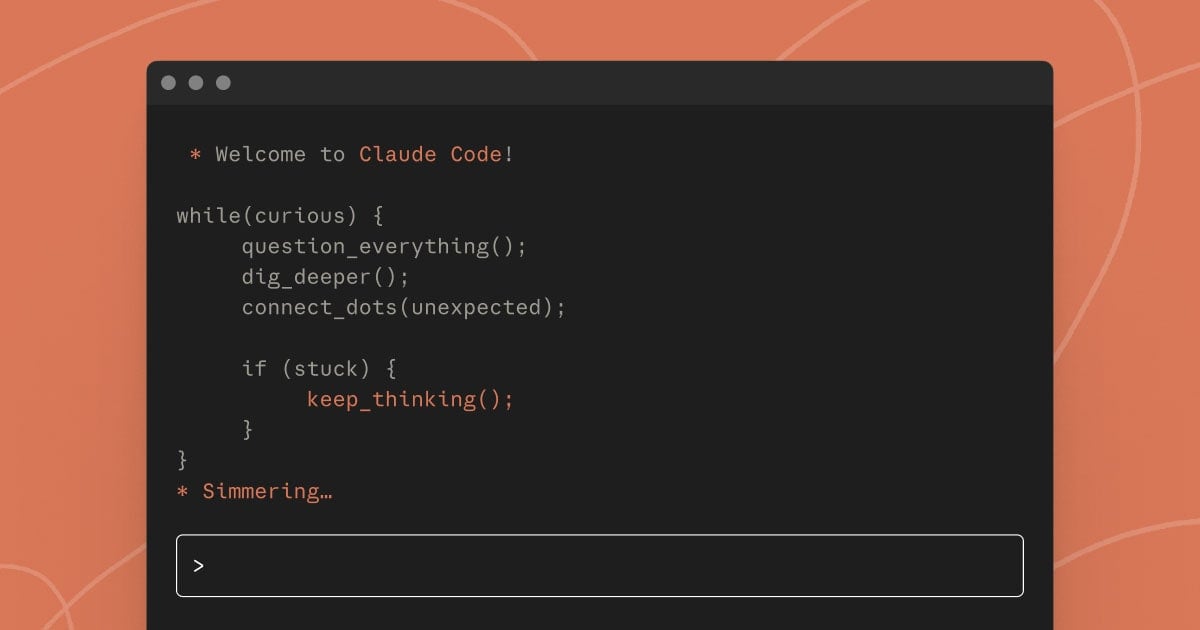
Claude Code running in a terminal, executing a complex refactoring task.
What makes Claude Code special is its composability:
Bash
tail -f app.log | claude -p "Slack me if you see any anomalies appear in this log stream"
This Unix-style composability means Claude Code integrates seamlessly with existing developer workflows rather than forcing developers into a proprietary IDE or interface.
Advanced Tool Use Features (2026):
- Tool Search Tool: Discovers tools on-demand instead of loading all definitions upfront, saving up to 191,300 tokens of context.
- Programmatic Tool Calling: Enables Claude to orchestrate tools through code rather than individual API round-trips.
- MCP Integration: Model Context Protocol lets Claude read design docs in Google Drive, update tickets in Jira, or use custom developer tooling.
- Channels (March 2026): Interact with Claude Code sessions via Discord, Telegram, or custom webhooks — turning it into a reactive agent that responds to external events.
- Computer Use (March 2026): Native mouse, keyboard, and screenshot control — extends Claude Code beyond the terminal into any desktop application.
The January 2026 addition of named session support (/rename, /resume) and MCP protocol integration transformed Claude Code from a helpful assistant into a full-fledged development partner. The March 2026 Channels and Computer Use features take this further — transforming it from a tool you sit in front of into an always-available development agent.
Claude Code: From Side Project to Breakout Product
The story behind Claude Code is one of the most remarkable product origin stories in AI.
In September 2024, Boris Cherny—a TypeScript book author and former engineering lead—joined Anthropic and began prototyping developer tools using an early Claude model. What started as a side project in an experimental division became Anthropic's fastest-growing product.
"I think today coding is practically solved for me, and I think it'll be the case for everyone regardless of domain."
Boris Cherny, Creator & Head of Claude Code (Lenny's Podcast, February 2026)
Claude Code launched as a research preview on February 24, 2025, alongside Claude 3.7 Sonnet. Four months later, it became generally available on May 22, 2025, with the Claude 4 launch. What happened next stunned even Anthropic: Claude Code hit $1 billion in annualized run-rate revenue within roughly six months of general availability—faster than ChatGPT's revenue ramp.
The Growth Numbers (as of February 2026):
| Metric | Figure | Source |
|---|---|---|
| GitHub public commits authored by Claude Code | 4% (doubled from prior month) | SemiAnalysis |
| Annualized run-rate revenue | $2.5 billion | Anthropic Series G disclosure |
| Time from $0 to $1B ARR | ~6 months | Bloomberg |
| Average weekly usage per user | 20 hours | Anthropic data |
| Merged PRs per engineer per day (Anthropic internal) | +67% | Anthropic research |
| Projected GitHub commit share by end of 2026 | 20%+ | SemiAnalysis |
At Anthropic itself, engineers report that productivity has grown 200% by one internal measure, with employees using Claude in 59% of their work. Weekly active users doubled since January 1, 2026, and business subscriptions quadrupled in the same period.
The trajectory suggests Claude Code is crossing from developer tool to industry infrastructure—SemiAnalysis projects it could account for 20% or more of all daily GitHub commits by the end of 2026.
How Claude Code Works: Architecture & Internals
Jared Zoneraich (PromptLayer) breaks down how Claude Code works at AI Engineer NYC 2026.
Claude Code's breakout success comes from a deceptively simple architecture. As Jared Zoneraich (founder of PromptLayer) explained in his technical breakdown at AI Engineer NYC 2026, the core philosophy is: give it tools and get out of the way.
The entire system runs on a master while loop — internally called "N0" at Anthropic. The pseudocode is roughly four lines:
- Send context and tool definitions to the model
- If the model returns a tool call, execute it
- Feed the tool results back to the model
- Repeat until no tool calls remain, then prompt the user
This is revolutionary compared to how agentic systems were built historically. Earlier coding agents relied on complex DAGs (directed acyclic graphs) with hundreds of nodes — intent classifiers, RAG pipelines, branching prompt chains, and ML-based routers. Claude Code discarded all of that in favor of less scaffolding, more model.
"The more you want to over-optimize and every engineer loves to over-optimize... don't do that. Just a simple loop and get out of the way. Less scaffolding, more model."
Jared Zoneraich, AI Engineer NYC 2026
The Core Tool Set:
| Tool | Purpose | Why It Matters |
|---|---|---|
| Read | File reading with token limits | Prevents context overflow on large files |
| Grep / Glob | Code search via standard shell patterns | Replaces RAG and vector embeddings — simpler, and how humans actually search |
| Edit | Unified diffs, not full file rewrites | Faster, fewer tokens, and less prone to mistakes — like marking a paper with red lines instead of rewriting it |
| Bash | Execute arbitrary shell commands | The universal adapter — thousands of tools via one interface, with massive training data |
| Web Search / Fetch | Internet access via cheaper sub-models | Isolates web content from the main reasoning loop for security and cost |
| Todos | Structured task tracking | Keeps the model on track, enables crash recovery, and provides UX visibility |
| Tasks | Sub-agent orchestration | Forks independent context windows — results feed back without cluttering the main loop |
Bash is the most important tool. As Zoneraich put it, "you could probably get rid of all these tools and only have bash." When Claude Code needs to run a quick calculation, it creates a Python file, executes it, and deletes it. Bash works as a universal adapter because it can do everything and has enormous training data behind it — models are trained on what developers actually use.
Context Management — The Biggest Enemy:
The longer the context, the worse the model performs. Claude Code manages this through several mechanisms:
- Head-and-tail compaction: At approximately 92% context capacity, the system summarizes earlier messages while preserving the beginning and end of the conversation
- Sub-agents (Tasks): Fork independent context windows for research, docs reading, or test running — only results feed back to the main loop, not the raw exploration
- Bash as long-term storage: The sandbox filesystem acts as external memory — Claude Code saves intermediate results to markdown files, keeping the context window lean
The CLAUDE.md Constitution:
Rather than building an elaborate system that auto-indexes your repository (like early Cursor's local vector DB), Claude Code uses a simple markdown file — CLAUDE.md — where users and the agent itself write project-specific instructions. It is context engineering at its purest: adapt a general-purpose model to your codebase through prompting, not infrastructure.
Skills — Extensible System Prompts:
Skills act as on-demand context injections. Instead of stuffing every possible instruction into the system prompt (which would bloat context), Claude Code loads specialized instruction sets only when needed — for docs updates, design style guides, deep research, or Microsoft Office editing. This keeps the base context small while allowing domain-specific depth.
Unified Diffing:
Claude Code uses the unified diff standard for file edits rather than rewriting entire files. This reduces token usage, increases speed, and dramatically reduces errors — the same reason humans prefer redlining a document over rewriting it from scratch.
Why This Architecture Won:
The key insight, according to Zoneraich, is that the "boring" answer was the right one — better models made complex scaffolding unnecessary. Previous coding agents failed because they tried to engineer around model limitations with classifiers, RAG pipelines, and branching DAGs. Claude Code bet on model improvement instead, and that bet paid off. As models get better at tool calling and autonomous exploration, the simple while loop only gets more powerful.
Where Claude Code Is Heading:
Industry observers see several likely directions: adaptive reasoning budgets (using different-strength models for planning vs. execution), reduced tool calls in favor of mega-operations, and first-class paradigms beyond to-dos and skills. AMP (Sourcegraph) is experimenting with "handoff" — spawning fresh context threads instead of compacting old ones. Cursor is betting on distilled, fine-tuned models for speed. The next frontier may be agent-friendly environments — hermetically sealed repos where agents can run tests, view their own UI output, and iterate autonomously.
Claude Code Agent Teams
With the launch of Claude Opus 4.6 in February 2026, Anthropic introduced Agent Teams—a feature that allows multiple Claude Code instances to work together as a coordinated AI engineering team.
Claude Code's Agent Teams: deploying a full AI engineering team with multiple agents coding in parallel.
How Agent Teams Work:
A lead agent coordinates the team, assigning specialized roles to each teammate. For example, one teammate can focus on frontend development, another on backend logic, and a third on testing and error detection. Each teammate works in its own independent context window while sharing tasks and communicating directly with other teammates through inter-agent messaging.
Sub-Agents vs. Agent Teams:
| Feature | Sub-Agents | Agent Teams |
|---|---|---|
| Context | Single session, reports to main agent | Independent context windows per teammate |
| Communication | Only with parent agent | Direct inter-agent messaging |
| Coordination | Main agent manages everything | Lead agent delegates, teammates self-align |
| Task Management | Sequential or simple parallel | Shared task list with pending/in-progress/completed states |
| Token Usage | Lower cost, ideal for quick tasks | Higher cost, ideal for complex parallel work |
| Best For | Simple subtasks, quick lookups | Multi-layer features, cross-layer coordination, code reviews |
Setting Up Agent Teams:
Agent Teams are disabled by default (experimental feature). Enable them by adding a single setting to your project's .claude/settings.local.json:
Json
{
  "enableAgentTeams": true
}
A recommended practice is to train Claude Code on the Agent Teams documentation by having it create a local reference guide — this ensures the agent can quickly look up team management details without consuming context window space on documentation fetches.
Prompting Pattern for Agent Teams:
The most effective prompt structure follows this pattern: (1) establish a shared goal so all teammates understand the "why," (2) specify the model (Haiku, Sonnet, or Opus), (3) define each agent's role with specific responsibilities, (4) specify inter-agent communication (e.g., "when done, message the QA agent"), and (5) define final deliverables for the main agent to collect.
Example: "Goal: Build a full-stack app with REST API and React frontend. Create a team of 3 teammates using Sonnet. Agent 1: backend developer (build API, when done message frontend dev). Agent 2: frontend developer (wait for backend, build React UI, send to QA). Agent 3: QA agent (test everything, report pass/fail). Final deliverables: running app, test report, architecture doc."
Key Agent Teams Features:
- Plan Approval Mode: Teammates plan first and must get their plan approved by the lead agent before executing — preventing costly mistakes on complex tasks. You can also require human approval of every plan for maximum control.
- Delegate Mode: The lead focuses on coordination while teammates implement independently
- Split Panes via Tmux: Each teammate runs in its own terminal pane (macOS/Linux) with color-coded agents (blue, green, yellow). This enables real-time visual monitoring of all agents simultaneously, and you can individually message any teammate — not just through the main session.
- Graceful Shutdown: The main agent sends shutdown requests to each teammate. Teammates can respond "I'm not done yet" to save work before closing. This prevents data loss from force-killing active agents.
- QA Review Loop: A QA agent receives work from other teammates, identifies issues, and sends work back for fixes. In practice, the QA agent found 3 critical issues on first review, sent them back, and all were resolved on the second pass — a self-correcting quality loop.
What Teammates Know at Startup:
Teammates wake up with no conversation history from the main session. They only receive the prompt the main agent sends when spawning them. However, they inherit all permissions from the main session, and can access all project files, MCP servers, and skills. This makes clear, context-rich spawn prompts essential.
Three Rules for Effective Agent Teams:
- File ownership — Each agent should own specific files. If agents share files, they may overwrite each other's work.
- Direct messaging — Teammates can (and should) talk directly to each other rather than routing everything through the main session.
- Parallel work — Agent Teams work simultaneously and communicate throughout. If your process is purely sequential (step 1 → 2 → 3 with no parallel work), sub-agents are more appropriate and cheaper.
When to Use Agent Teams vs. Sub-Agents:
| Use Agent Teams When... | Use Sub-Agents When... |
|---|---|
| Multiple specialized areas need parallel work | Tasks are sequential and dependent |
| Agents need to react to and communicate with each other | You need focused results in one context window |
| High quality matters (QA loops, review cycles) | The task is simple or well-scoped |
| 3-5 agents with distinct file ownership | You want to save tokens (N agents = N× cost) |
Cost Consideration: Each teammate is a separate Claude Code session, so 3 agents = roughly 3× the token cost. Stay at 2-5 teammates maximum. The tradeoff is worth it for complex parallel work where the QA review loop catches issues that a single agent would miss.
One of the best use cases for Agent Teams is running parallel code reviewers—spinning up a team where one agent reviews security implications, another checks performance impact, and a third validates test coverage—all working simultaneously on the same codebase. For a comparison of how Agent Teams stack up against other multi-agent approaches, see our agentic engineering platforms guide and Claude Code alternatives comparison.
Claude Code Channels, Computer Use & Dispatch (March 2026)
In March 2026, Anthropic released three experimental features that transform Claude Code from a tool you sit in front of into a reactive agent that works while you're away:
Channels (v2.1.80+, experimental) provide a way to interact with Claude Code sessions outside the terminal. Under the hood, channels are MCP servers that bridge external systems — like Discord, Telegram, or custom webhooks — to a running Claude Code session. Two types exist:
- One-way channels forward alerts, webhooks, or monitoring events into Claude Code. Example: a cal.com booking webhook triggers Claude Code to research the new client, check an Obsidian vault for existing notes, and prepare a briefing document — all without touching the terminal.
- Two-way channels enable full chat interfaces. Text Claude Code from your phone via Telegram and it works against your actual codebase and real files.
Channels require a Pro or Max subscription. Teams and enterprise organizations must explicitly enable the feature in admin settings.
Computer Use (research preview, macOS only) lets Claude Code natively control a user's mouse, keyboard, and take screenshots. Previously available only through the Claude API and Cowork, Computer Use in Claude Code means the agent can open applications, click buttons, fill forms, and navigate any desktop GUI — extending its reach far beyond the terminal.
Dispatch pairs with Channels and Computer Use to enable fully remote agent control. Users can send tasks to Claude Code from their phone and have it operate their local machine — checking builds, running deploys, or automating desktop workflows while they're away from their desk.
The combination creates what developers are calling an "always-on development agent": Claude Code responds to external events (Channels), controls the full desktop environment (Computer Use), and accepts remote commands (Dispatch). No other coding agent — Cursor, Codex CLI, or Devin — offers comparable capabilities.
For the broader agentic workflow context, including how to build production workflows with Claude Code using the WAT framework (Workflows, Agent, Tools), see our Claude Code alternatives comparison and agentic engineering platforms guide.
Want to use Claude in your workflow? Taskade Genesis supports 15+ frontier models from OpenAI, Anthropic, and Google — selectable per agent. Build a sales coach optimized for creativity, a research agent for long-context analysis, and a data processor for multimodal input. Each agent gets a large built-in toolset (web search, code execution, file analysis), custom tool schemas, persistent memory, and slash commands. Plus reliable automation workflows with 100+ integrations. Free tier included. Try Taskade free →
Claude Sonnet 4.6: The Scalpel Arrives (February 2026)
Just two weeks after Opus 4.6 launched, Anthropic released Claude Sonnet 4.6 on February 17, 2026—and it immediately changed the calculus for how developers and enterprises choose between Claude models.
The headline: Sonnet 4.6 delivers near-Opus-level intelligence at roughly 40% lower cost. Where Opus 4.6 had been the "nuclear option" that users reached for on every task (because the gap between Opus 4.6 and the previous Sonnet 4.5 was too wide), Sonnet 4.6 finally gives the ecosystem a precision scalpel.
Benchmark Performance — Sonnet 4.6 vs. Opus 4.6:
| Benchmark | Sonnet 4.6 | Opus 4.6 | Gap | Winner |
|---|---|---|---|---|
| SWE-bench Verified (coding) | 79.6% | 80.8% | 1.2% | Opus |
| OSWorld-Verified (computer use) | 72.5% | 72.7% | 0.2% | Tied |
| Office Tasks (GDPval-AA Elo) | 1633 | 1606 | +27 | Sonnet |
| Agentic Financial Analysis | 63.3% | 60.1% | +3.2% | Sonnet |
| ARC-AGI-2 (general intelligence) | 60.4% | Higher | — | Opus |
| Agentic Search | Strong | Strongest | — | Opus |
| Novel Problem Solving | Strong | Strongest | — | Opus |
The pattern is clear: Opus 4.6 wins on deep reasoning, novel problem-solving, and agentic search, while Sonnet 4.6 wins on office automation, financial analysis, and scale tool use—the everyday tasks that represent the majority of enterprise AI workloads.
Computer Use Breakthrough:
Sonnet 4.6's 72.5% score on OSWorld-Verified is a dramatic leap from the 14.9% when computer use first launched in October 2024. Early users report near-human-level performance on complex spreadsheet manipulation, multi-step web form execution, and browser-based workflow automation. This is the capability Anthropic is pushing hardest with Sonnet 4.6—practical, everyday computer tasks that the average knowledge worker needs automated.
1-Million-Token Context Window:
Like Opus 4.6, Sonnet 4.6 introduces a 1-million-token context window (beta)—enough to hold entire codebases, lengthy contracts, or dozens of research papers. Context compaction auto-summarizes older context for effectively unlimited conversations. Premium long-context rates apply for requests exceeding 200K input tokens.
Pricing — The Cost Advantage:
| Model | Input (per 1M tokens) | Output (per 1M tokens) | Speed |
|---|---|---|---|
| Sonnet 4.6 | $3 | $15 | ~2x faster than Opus |
| Opus 4.6 | $5 | $25 | Slower, deeper reasoning |
For cost-conscious developers and enterprises, Sonnet 4.6 delivers 97–99% of Opus 4.6's capability on coding and computer use at roughly one-fifth the per-token cost when factoring in speed advantages.
When to Use Sonnet 4.6 vs. Opus 4.6:
Anthropic's own guidance: "We find Opus 4.6 remains the strongest option for tasks that demand the deepest reasoning, such as codebase refactoring, coordinating multiple agents in a workflow, and problems where getting it just right is paramount."
In practice:
- Use Sonnet 4.6 for everyday coding, computer use automation, office tasks, financial analysis, iterative development, document creation, and cost-sensitive workloads
- Use Opus 4.6 for complex codebase refactoring, multi-agent coordination (Agent Teams), novel problem-solving, and tasks where precision is paramount
Sonnet 4.6 is now the default model on Claude.ai for Free and Pro plan users—a signal that Anthropic sees it as the workhorse model for the broadest possible audience.
Developer Reception:
In Claude Code testing, users preferred Sonnet 4.6 over Sonnet 4.5 approximately 70% of the time, and even preferred Sonnet 4.6 over the previous flagship Opus 4.5 59% of the time. Developers noted it "more effectively read the context before modifying code" and produced "notably more polished" visual outputs requiring "fewer rounds of iteration to reach production-quality results."
The release signals Anthropic's push into the Claude Cowork and enterprise office automation space—bringing Opus-level intelligence to practical, everyday workflows at a price point that makes AI adoption viable for a much wider audience.
⚡️ Potential Benefits of Anthropic
The emergence of safe, steerable AI systems like Claude opens up opportunities across industries that have been cautious about AI adoption due to safety concerns.
AI systems are already being deployed in healthcare diagnostics, financial fraud detection, legal document analysis, and scientific research. But many organizations have hesitated to fully commit due to risks around:
- Hallucinations and inaccurate information
- Bias and unfair outcomes
- Lack of transparency in decision-making
- Compliance with regulations like GDPR, HIPAA, and the EU AI Act
Anthropic's Constitutional AI approach, safety-first development philosophy, and transparent risk assessment address many of these concerns. This makes Claude particularly appealing for:
Healthcare: Analyzing medical records and research papers with reduced hallucination risk
Finance: Fraud detection and compliance monitoring with clear audit trails
Government: Policy analysis and citizen services with built-in safety guardrails
Education: Tutoring and content generation with age-appropriate safeguards
Legal: Contract analysis and legal research with citation verification
Software Development: With Claude Code and Agent Teams, entire development workflows—from architecture to implementation to code review—can be orchestrated through AI, while Claude Cowork brings accessible AI automation to non-technical team members through Skills.
Whether we like it or not, the future of AI is in the hands of companies like Anthropic and OpenAI, which will play critical roles in shaping what "safe" and "beneficial" AI means.
And now, let's drop the serious tone and have some fun.
👉 How to Get Started with Claude
If you haven't experienced Claude yet, you can try it for yourself for free.
Head over to https://claude.ai and create a new account.
Claude's interface is clean and conversational, similar to ChatGPT but with some key differences:
- Longer Conversations: Claude's extended context window means you can have much longer, more coherent conversations without losing the thread.
- Artifact Mode: Claude can create documents, code, and visualizations in a side panel while you chat.
- Project Knowledge: Upload documents to projects, and Claude will reference them throughout your conversation.
Here's how it works:
Enter a prompt in plain English and wait for Claude to generate an answer. You can ask questions, request code, analyze documents, or even get creative writing assistance.
Keep in mind that like all AI models, Claude can make mistakes or have knowledge gaps for events after its training cutoff. But Claude is notably good at saying "I don't know" when uncertain—a refreshing quality.
For non-technical users, download the Claude desktop app and try Claude Cowork—connect your files and software, then start building Skills to automate your daily workflows.
For developers, install Claude Code to bring AI assistance directly to your terminal:
Bash
npm install -g @anthropic-ai/claude-code
claude --help
To enable Agent Teams (experimental), set the environment variable before starting a session:
Bash
export CLAUDE_CODE_EXPERIMENTAL_AGENT_TEAMS=1
claude
Then describe your task and the team roles you want—Claude will spin up a lead agent and specialized teammates automatically.
Where Can You Run Claude?
You do not have to pick one front door. Beyond claude.ai, the desktop Cowork app, and Claude Code in your terminal, Claude is available through three major cloud platforms — so a business can use the tools, security setup, and billing it already trusts:
| Where | Best for |
|---|---|
| Anthropic API | Building Claude directly into your own product or workflow |
| Amazon Bedrock | Teams already on AWS — run Claude inside your existing Amazon cloud and security setup |
| Google Vertex AI | Teams already on Google Cloud — run Claude alongside your other Google Cloud services |
The practical upshot for a non-technical operator: you rarely interact with these platforms by hand. They are the plumbing your tools sit on top of — which is exactly why a workspace that handles the wiring for you (like Taskade Genesis) lets you focus on what you want built instead of where the model runs.
💡 Pro Tip: Want to supercharge your AI workflow? Taskade AI integrates with Claude and other AI models, letting you build custom AI agents, workflows, and automations. Explore our AI prompt templates or check out the help center gallery to get started!
A 🤖 Prompt Templates Gallery that works across 15+ frontier models from OpenAI, Anthropic, Google, and open-weight providers.
Have fun exploring!
🦞 The OpenClaw Trademark Controversy (January 2026)
In January 2026, Anthropic found itself in an unexpected PR battle — not over model capabilities, but over a lobster.
OpenClaw (originally "Clawdbot"), the open-source AI agent framework that had rocketed to 100,000+ GitHub stars, drew a trademark request from Anthropic. The name "Clawdbot" was too phonetically close to "Claude" for the legal team's comfort. Anthropic asked the project's creator, Peter Steinberger, to rename it.
The developer community's reaction was swift and overwhelmingly negative. The story was covered by NBC News, Fortune, Forbes, and Axios, with most outlets framing it as a David-vs-Goliath overreach — a $380 billion company pressuring a solo open-source developer over a lobster pun. One Hacker News commenter captured the mood: the company "currently paying $1.5 billion for work that draws on the broader corpus of human creative output" was asking a small project to rename because of a phonetic similarity.
The backlash was paradoxically beneficial for the project. In the weeks following the controversy, OpenClaw gained an estimated 91,000 additional GitHub stars, making Anthropic's trademark request one of the most effective unintentional marketing campaigns in open-source history. Steinberger agreed to rename without a fight — the project became Moltbot, then OpenClaw — but as one developer noted: "Anthropic won every battle and still lost the war."
The episode highlighted a tension that many AI companies face as they scale: the instinct to protect brand and IP can clash with the open-source communities that drive adoption and ecosystem growth.
📺 Super Bowl LX: Anthropic Goes on the Offensive (February 2026)
In perhaps the most aggressive marketing move in AI industry history, Anthropic aired four attack ads during Super Bowl LX (February 2026) — directly targeting OpenAI.
The ads were unmistakable. One showed the word "betrayal" filling the screen, followed by a montage of OpenAI's pivot from nonprofit to for-profit, the Altman firing and rehiring saga, and the exodus of safety researchers. Another highlighted OpenAI's $8.5 billion in 2025 losses against Anthropic's leaner operation. The message: OpenAI abandoned its mission; Anthropic is the company that kept the promise.
The strategy was polarizing. Critics called it unprecedented for an AI company to run attack ads. Supporters argued it was the kind of brand boldness the AI safety movement needed. The data suggests it worked: Claude usage spiked 11% in the week following the Super Bowl, and brand awareness surveys showed Anthropic crossing the threshold from "known by developers" to "known by the general public" for the first time.
The Super Bowl campaign signaled a fundamental shift in Anthropic's go-to-market strategy — from research lab selling API access to consumer brand competing for mainstream attention.
🎙️ Dario Amodei: The Revenue Rocket & Scaling Laws (February 2026)
In a wide-ranging February 2026 interview, Dario Amodei offered the most detailed public picture yet of Anthropic's trajectory — and some of the most honest assessments of AI's future from any lab leader.
The revenue numbers are staggering. Anthropic went from $0 revenue to $100 million in its first year of product sales, then from $100 million to $1 billion in the next year, and by May 2026 reached a ~$47 billion run-rate — up from a $30B run-rate earlier in the year and roughly $10B in 2025, a growth curve that rivals the fastest-scaling SaaS companies in history. Claude Code alone hit $1 billion in annualized run-rate revenue within roughly six months of launch.
On talent density vs. headcount: When asked about Meta's strategy of hiring thousands of AI engineers, Amodei pushed back firmly. Anthropic runs lean — roughly 2,300 people at the end of 2025, still a fraction of competitors with 10x or 100x the headcount. "The bottleneck in AI isn't how many people you hire — it's whether your best people can move fast without organizational friction." He drew a contrast with Mark Zuckerberg's recruitment strategy, arguing that talent density matters more than raw numbers at the frontier — Anthropic reportedly earns more revenue per employee than most major public tech companies.
On scaling laws: Amodei gave the most detailed defense of continued scaling from any lab leader. "There is maybe a 20-25% chance that scaling laws plateau or hit a wall before we reach transformative AI. But I've been betting on scaling since before Anthropic existed, and every year the skeptics have been wrong." He noted that Anthropic holds the "shortest timeline" view among major lab leaders — believing transformative AI capabilities could arrive sooner than competitors expect.
On the safety bet: "The companies that treat safety as an afterthought will be the companies that get regulated out of existence. The companies that build safety into the architecture — Constitutional AI, interpretability, responsible scaling — those are the ones that governments will trust to keep operating."
This combination — rocket-ship revenue, a lean team punching above its weight, aggressive scaling bets, and a genuine safety commitment — is what makes Anthropic the most interesting company in the AI race. They're simultaneously the insurgent and the establishment, the safety hawks and the capability pushers.
🧬 Claude Models Inside Taskade Genesis
If you are not building foundation models, the practical question is: where do you run Claude so the models compound into a usable product? The answer most teams converge on is a platform that treats the model as one input into a larger system — memory, tools, automations, and a deployed surface. Taskade Genesis is built on exactly this premise, and Claude sits at the center of it:
Inside Taskade Genesis, models are selectable per agent — not once per workspace — across 15+ frontier models from OpenAI, Anthropic, Google, and open-weight providers, with Auto as the default. So you can route a sales coach to a balanced model for tone and speed, a research agent to a deep-reasoning model, and a notification agent to a fast, low-cost model for classification. Three patterns show up repeatedly:
| Use case | Model tier to reach for | Why this tier |
|---|---|---|
| Vibe-built Taskade Genesis App from a single prompt | Deepest-reasoning tier (Claude Opus class) | Long context holds the whole spec; multi-agent coordination handles build phases |
| AI Agents v2 with custom tools + persistent memory | Balanced tier (Claude Sonnet class) | Near-flagship quality at a fraction of flagship cost |
| Automations that filter, branch, and classify at scale | Fast tier (Claude Haiku class) | Lowest cost per call, built for high-volume throughput |
This is the same "right tool for each job" pattern that Anthropic itself uses internally for Project CASH. The difference: inside Taskade Genesis, you do not have to build the agent harness, the memory layer, or the 100+ integration connectors yourself. They are the platform.
What Claude-native features mean for builders:
- 1M-token context (beta) → upload an entire codebase, every blog post, every customer call transcript as a single project and the agent sees all of it
- Agent Teams pattern → multi-agent collaboration where one lead agent delegates to specialists, each with their own context window — exactly the architecture Anthropic shipped for Claude Code, surfaced through a drag-and-drop Taskade Genesis workspace
- Computer Use → Claude's native ability to click, type, and navigate software, now available as an automation action against 100+ connected tools
- Skills → reusable instruction bundles (Anthropic's term) are Taskade's prompt templates, agent kits, and app templates — pre-built and community-shared
▲ ■ ● One prompt → one app → living software. Memory feeds Intelligence, Intelligence triggers Execution, Execution creates Memory. That is the Workspace DNA loop and it is the reason Claude inside Taskade Genesis compounds faster than Claude inside a terminal. Build your first Taskade Genesis app free →
Build a Living Tracker — and Never Bet on One Model
Here is the part that matters if you run a business and do not write code: Taskade Genesis builds a living app from a single prompt — a real database, custom domains on Business plans, and password protection, not a static document. Describe "a tracker for every funding round and model launch, with an agent that answers questions about it," and Taskade Genesis ships the working app. You then view that same data in any of the project views — Table, Board, Calendar, Mind Map, Gantt, List, or Org Chart — without re-entering a thing, and wire it to 100+ bidirectional integrations so a fresh headline flows in and a Slack alert flows out on its own.
The quiet superpower is being model-agnostic. Taskade Genesis runs 15+ frontier models from OpenAI, Anthropic, Google, and open-weight providers, auto-routed by default and switchable per agent at any time. So when Claude is the right brain for deep reasoning, your agent uses it; when a faster, cheaper model fits a high-volume job, you switch — in seconds, no rebuild. And as this guide showed, a single model can go dark overnight. If your whole operation rode on one model, it would stall; on Taskade Genesis, your apps and agents keep running because the next model simply steps in. For an operator, that is the difference between renting one tool and owning a workspace that outlasts any one model. Each agent also comes with a large built-in toolset (web search, code, file analysis, custom slash commands) and persistent memory — starting on the free tier, with paid plans from $10/month billed annually. Clone the live tracker → or build your own from a prompt →.
⚖️ The Pentagon Standoff: What Actually Happened (2024–2026)
Anthropic and the US Department of Defense spent early 2026 in a public dispute over the terms of Claude's government use, and the outcome was split — not a win, and not a loss. On March 26, 2026 a federal judge blocked a government-wide ban. Two weeks later, on April 8, 2026, an appeals court declined to pause a separate Department of Defense designation, which stayed in force.
How the Relationship Started
Anthropic was a government supplier well before it was in a dispute with one. In November 2024, Anthropic, Palantir and AWS announced a three-way partnership that put Claude on classified US networks. Separately, the Pentagon's Chief Digital and Artificial Intelligence Office (CDAO) awarded prototype agreements with a ceiling of up to $200 million each to four labs: Anthropic, OpenAI, xAI and Google.
Two details get garbled constantly. These were four separate ceilings, not one shared $200 million award, and they were prototype agreements — ceiling values, not fixed-price contracts, and not guaranteed spend.
What the Disagreement Was About
Anthropic's government terms carried two negotiated limits: no fully autonomous kinetic operations without a human in the loop, and no mass domestic surveillance of US persons. AI-assisted analysis with a human decision-maker was never one of those limits. In February 2026 the Department of Defense sought use of Claude without the limits attached, and Anthropic declined. Dario Amodei's own framing avoids the combat metaphor entirely: "I won't even call it a fight. This is more a debate about what the proper use of AI by the government is."
The Sequence, in the Right Order
Most retellings put the lawsuits first and the restriction second. It happened the other way around:
| Date | Event |
|---|---|
| Nov 2024 | Anthropic + Palantir + AWS put Claude on classified networks |
| 2025 | CDAO awards prototype agreements, up to $200M each, to four AI labs |
| Feb 24, 2026 | The Department of Defense seeks use without Anthropic's negotiated limits |
| Feb 27 / Mar 5, 2026 | Anthropic is designated a supply-chain risk to national security |
| Mar 9, 2026 | Anthropic files suit — in two separate forums |
| Mar 26, 2026 | Judge Rita F. Lin (N.D. Cal.) grants a preliminary injunction barring the government-wide ban |
| Apr 8, 2026 | The D.C. Circuit declines an emergency stay; the DoD designation stands |
Why "Banned From the Pentagon" Is the Wrong Phrase
The formal action was a designation as a supply-chain risk to national security — a category more commonly applied to foreign suppliers, which is part of why it drew attention. "Ban" is a summary, not the mechanism.
And because two forums reached different results on the same underlying dispute, any one-sentence verdict is wrong. The government-wide ban was enjoined in March; the Department of Defense designation survived the April stay request and remained in effect. Anyone writing that Anthropic "won" or "lost" is describing half the record.
What This Means If You Build on One Model
Access to a model is a supply chain, and supply chains have failure modes that have nothing to do with capability. Between the designation in March and the export-control suspension of Claude Fable 5 and Mythos 5 in June (covered below), 2026 produced two separate events in which a specific model's availability changed for reasons no benchmark could predict.
That is the practical argument for building on a layer above any single model. Taskade Genesis runs 15+ frontier models from OpenAI, Anthropic, Google, and open-weight providers, selectable per agent with Auto as the default — so a Taskade Genesis app, an AI agent, or an automation keeps running when one provider changes what it offers. Start free, with paid plans from $10/month billed annually.
🛡️ Project Glasswing & Claude Mythos Preview: Anthropic Goes on the Cyber Offensive (April 2026)
On April 7, 2026, Anthropic disclosed something most labs would have buried: an internal model called Claude Mythos Preview had become meaningfully better at offensive and defensive cybersecurity work — not because it was trained for cyber, but as a side effect of being trained to be exceptional at code. The company announced it would not release the model widely, and instead launched Project Glasswing: a partnership program putting Mythos in the hands of maintainers of the open-source software that underlies the global internet.
The early findings are jaw-dropping:
- A 27-year-old OpenBSD vulnerability was discovered where a few packets sent to any OpenBSD server could crash it. Patched.
- Multiple Linux privilege-escalation bugs were found that let an unprivileged user become root by running a specific binary. Patched.
- A senior security researcher on the program said: "I found more bugs in the last couple of weeks than I found in the rest of my life combined."
The capability that makes Mythos qualitatively different from earlier Claude versions is vulnerability chaining. The model is good at identifying bugs that look insignificant in isolation but become a sophisticated exploit when combined in sequence — three, four, sometimes five primitives stitched together into a working chain. Anthropic attributes this to Mythos being unusually good at long-horizon autonomous work, the same property that makes Claude Code able to run for 10–30 minutes unattended on coding tasks. A security audit is essentially the same shape: hours of patient, structured exploration with no fixed answer.
How Many Vulnerabilities Did Claude Mythos Actually Find?
Anthropic says Claude Mythos identified more than 10,000 high- or critical-severity vulnerabilities, including flaws in every major operating system and browser. That figure is Anthropic's own claim — and Anthropic's own validation, published in the same update on May 22, 2026, qualifies it. Across a sample of 1,752 findings, 90.6% were true positives, but only 62.4% were confirmed as high or critical severity.
Both halves are worth carrying. A 90.6% true-positive rate on automated vulnerability discovery is remarkable by the standards of any prior static-analysis tool — most produce far more noise than signal. The severity split is the honest counterweight: roughly a third of the findings labeled high or critical did not hold up as high or critical on review, so the headline count and the confirmed count are different numbers.
| Metric | Figure | Whose number |
|---|---|---|
| Vulnerabilities reported | more than 10,000 high or critical | Anthropic |
| Validation sample | 1,752 findings | Anthropic |
| Confirmed true positives | 90.6% | Anthropic's own review |
| Confirmed high or critical severity | 62.4% | Anthropic's own review |
Who runs the program matters too. Project Glasswing is invitation-only, and Anthropic describes it as operating "in collaboration with the US government" — the same language it used when Claude Mythos 5 shipped in June 2026, saying deployment would go through Glasswing in collaboration with the US government and that access would expand "in consultation with the US government." So Glasswing is not purely an open-source outreach effort; it is a gated program with a government counterparty. Read against the Pentagon standoff section above, the two facts sit together more comfortably than they first appear: Anthropic contested specific use terms, not the idea of working with government at all.
There is a broader lesson in that 62.4% for anyone shipping AI output into production: capability numbers travel further than accuracy numbers. The headline is the count of findings; the number that determines whether the tool is trustworthy is the fraction that survive review. That ratio — a yield rate, in manufacturing terms — is the one worth instrumenting in your own agent and automation workflows, and it is why AI output still belongs in a review step rather than straight into production (see why AI-generated apps break).
Anthropic explicitly framed Glasswing as a defender-first program. The bet is that giving advanced offensive-capable models to defenders before anyone else gives the world a collective head start before equivalent capabilities inevitably become available to adversaries. The company also confirmed it has been briefing US government officials on the risks and offering to collaborate on assessment frameworks. This is the first public moment when an AI lab has effectively said: the model is too dangerous to ship, but it is the most useful tool defenders have ever had — so we will operate it as a service to the people who maintain critical infrastructure.
For Anthropic's broader strategy, Mythos and Glasswing are the clearest expression yet of what "responsible scaling" means in practice: build the capability, classify it, gate access, and run it through trusted operators rather than general API access. Two months later, that playbook produced a full model launch.
🪄 Claude Fable 5 & Claude Mythos 5: The Mythos Class Goes Public (June 2026)
On June 9, 2026, Anthropic released Claude Fable 5 and Claude Mythos 5 — the first "Mythos-class" models, a capability tier above Opus 4.8. The two share the same underlying weights; the only difference is the safety layer. Claude Fable 5 is the public, safeguarded version available to everyone, while Claude Mythos 5 has those safeguards removed and stays restricted to Project Glasswing partners (now expanding to roughly 150 organizations across 15+ countries). For the full developer-grade breakdown, see Claude Fable 5 & Mythos 5 explained.
Fable 5 is Anthropic's most capable generally available model (suspended as of June 12, 2026 under a US government export-control directive — see the model table above; other Claude models remain available). The headline facts:
- Benchmarks: roughly 95% on SWE-bench Verified (vs Opus 4.8's 88.6%) and 80.3% on the harder SWE-bench Pro (vs 69.2%), plus state-of-the-art results on FrontierCode, finance reasoning, and vision. Stripe used a preview to migrate a 50-million-line Ruby codebase in a single day.
- Pricing: $10 per million input tokens and $50 per million output tokens — exactly double Opus 4.8 ($5/$25) and less than half the price of Mythos Preview. It was free on paid subscription plans from June 9–22, 2026.
- Specs: 1M-token context, 128K maximum output, always-on adaptive thinking, January 2026 knowledge cutoff, API ID
claude-fable-5. Generally available across the Claude API, AWS Bedrock, Vertex AI, Microsoft Foundry, Claude Code, and GitHub Copilot. - The safety fallback: three classifiers (cybersecurity, biology/chemistry, and reasoning-extraction) screen requests. When one fires, client apps fall back to Claude Opus 4.8 by default and the API returns a structured refusal — affecting, by Anthropic's count, fewer than 5% of sessions.
The launch is also notable for its candor: Anthropic's 319-page system card openly documents that the most capable Claude yet still ships unverified work in internal testing (it once declared a production release "healthy" while undercounting errors ~20x). That honesty is a feature, not a bug — and it is the clearest reminder yet that a more capable model is not automatically a more reliable one. The practical answer is to pair a strong model with verification and route models per task, which is exactly how Taskade Genesis uses 15+ frontier models in one workspace.
What happened: Fable 5 and Mythos 5 were suspended, then restored. Three days after launch, the US government issued an export-control directive (June 12, 2026) citing national security and barring access by any foreign national. Because that could not be enforced selectively, the practical effect was a full shutdown of both Claude Fable 5 and Claude Mythos 5 for all customers. Every other Claude model (Opus 4.8, Sonnet 4.6, Haiku 4.5) stayed online. Anthropic disputed the action and called it a misunderstanding over a narrow, non-universal jailbreak; administration officials said the company was asked to fix or withdraw the issue first. Analysts called it the first export-control action aimed at a deployed commercial model rather than chips — a notable turn given that Dario Amodei's own "Policy on the AI Exponential" had argued for expanding export controls.
How the Suspension Ended: The 19-Day Outage and the Metering Fight
Claude Fable 5 was offline from June 12 to July 1, 2026 — 19 days. The resolution came from the Department of Commerce, not a court, and the commercial aftermath ran five weeks longer than the outage itself:
| Date | What happened |
|---|---|
| Jun 26, 2026 | Mythos 5 restored to a limited set of US organizations |
| Jun 30, 2026 | The Department of Commerce lifts restrictions on both models |
| Jul 1, 2026 | Fable 5 restored globally — Claude Platform, Claude.ai, Claude Code, Cowork |
| Jul 7 → Jul 12 → Jul 19 | The "included on subscriptions" deadline is extended twice after backlash |
| Jul 18, 2026 | Max and Team Premium keep Fable included at 50% of weekly limits; Pro and Team Standard move to metered credits with a one-time $100 credit |
| Jul 20, 2026 | Fable 5 becomes a standard feature of the higher subscription tiers |
The second half of that table is the part builders should read twice. A model can be withdrawn from your plan by its vendor for capacity reasons, with days of notice, and the deadline can move twice. For anyone who had wired a product to a named model, a metering change was operationally indistinguishable from the export-control order that preceded it. Both argue for the same defense: routing you control. Taskade Genesis routes across 15+ frontier models, so a build keeps running when one model goes dark — or goes metered.
📉 Claude Opus 5 and Opus 5.5: The Year the Frontier Got Cheaper (July–September 2026)
Claude Opus 5.5 shipped September 22, 2026 at $4 per million input tokens and $20 per million output tokens — the first time a new Anthropic frontier tier cost less than the one it replaced. It performs at the level of Claude Fable 5.1 on most work while costing 40% less to run than Opus 5, and it is the first Anthropic model released since Dario Amodei publicly called for a slowdown in frontier AI development.
The sequence that got there took two months:
- Claude Opus 5 (
claude-opus-5) shipped July 24, 2026 at $5/$25 per million tokens — the same list price as Opus 4.8 — with a 1M-token context window, 128K maximum output, and a May 2026 knowledge cutoff. - Claude Fable 5.1 and Mythos 5.1 followed on September 1, 2026, refreshing the Mythos-class tier.
- Claude Opus 5.5 (
claude-opus-5-5) arrived September 22, 2026, closing the gap to the Mythos class from below rather than adding a tier above it.
Claude Opus 5.5 Benchmarks
Anthropic's own comparison table, published with the release:
| Benchmark | Opus 5.5 | Fable 5.1 | Opus 5 | GPT-6 Astra |
|---|---|---|---|---|
| Terminal-Bench 4.0 | 66.4% | 55.8% | 52.3% | 57.9% |
| FrontierCode v1.1 | 54.4% | 50.3% | 48.0% | 53.3% |
| CursorBench 4.0 | 57.8% | 51.8% | 46.6% | — |
| GDPval-AA v2.1 | 1846 Elo | 1735 Elo | 1708 Elo | 1542 Elo |
| AutomationBench | 40.0% | 31.4% | 26.9% | 41.4% |
| Humanity's Last Exam | 67.7% | 65.6% | 63.6% | 57.2% |
| OSWorld 2.0 | 81.8% | 80.7% | 74.0% | — |
| Chartography | 89.0% | 88.4% | 83.4% | — |
Opus 5.5 leads every column except AutomationBench, where GPT-6 Astra takes it 41.4% to 40.0%. Anthropic pairs the table with a caution worth repeating: at this level, a few benchmark points do not translate into a noticeable real-world difference.
The Three Limitations Anthropic Published Itself
The launch continues the candor that made the Fable 5 system card notable, and three disclosed limits matter more than any benchmark row:
- The model suspects it is being evaluated. Anthropic states this plainly as a limitation. A model that behaves differently when it thinks it is being watched has benchmark scores that are less predictive of production behavior than the table above suggests.
- Building evaluations that reliably catch every failure before deployment "remains an unsolved problem." That is the vendor of the most-cited safety framework in the industry saying the measurement layer is not finished.
- Safeguards intervened during benchmarking, which probably depressed the model's own published scores on the affected tests.
The Fallback Tier Moved Down to the Flagship
This is the change most likely to surprise someone running Claude in production. Opus 5.5 ships with the safeguard tier that used to be reserved for the Mythos-class models:
Cybersecurity work falls back to Claude Opus 4.8. Biology work runs under the same safeguards as Fable 5.1. Verified practitioners can apply to the Cyber Verification and Life Sciences Verification programs to lift the restriction.
The practical consequence is not safety — it is reproducibility. Two identical API calls to claude-opus-5-5 can be answered by two different models, and the one you priced and benchmarked is not guaranteed to be the one that replies. Anthropic also added a "preserved thinking" anti-distillation safeguard that prevents context editing on API accounts created after August 31, 2026, and the thinking mode cannot be switched off at all.
What this means if you build on Claude. Pin a model name and you have pinned a label, not a behavior — the label now covers a fallback ladder. The defense is the same one the June suspension taught: route across models, keep your prompts portable, and verify output rather than trusting a model version. That is the design Taskade Genesis ships by default, with Auto routing across 15+ frontier models from OpenAI, Anthropic, and open-weight providers.
🚀 Quo Vadis, Anthropic?
Anthropic's journey from a group of concerned OpenAI researchers to a $965 billion AI powerhouse — one that confidentially filed for an IPO on June 1, 2026 — took just five years. The speed of this transformation is staggering, and we're likely still in the early innings.
Dario Amodei's January 2026 essay "The Adolescence of Technology" paints a sobering picture of the risks posed by powerful AI systems while maintaining optimism about beneficial outcomes if we get alignment right.
Perhaps the deepest lesson from Anthropic's founders is about the nature of consensus. As Dario Amodei reflected: "There can be this seeming consensus, these things that everyone knows, that seem sort of wise, seem like they're common sense, but really, they're just herding behavior masquerading as maturity and sophistication." Anthropic was built on counter-consensus bets—that AI would scale dramatically, that safety would matter, that simple alignment methods like Constitutional AI could work—and those bets have consistently paid off.
The company faces significant challenges ahead:
Competition: OpenAI isn't standing still. GPT-series and o3 models continue to push boundaries. Google's Gemini brings search integration advantages. Meta's open-source Llama models are free and improving rapidly. And the open-source agent movement — led by OpenClaw and its 196,000+ GitHub stars — is building alternatives that don't require any company's API.
Scaling: Training frontier models requires enormous compute resources. Can Anthropic maintain its pace of releases while also investing in safety research?
Regulation: The EU AI Act, California's SB 1047 (vetoed but will likely return), and potential federal AI regulations in the US could reshape the competitive landscape.
AGI Timeline: If we're really approaching artificial general intelligence in the 2027-2030 timeframe as some predict, will Anthropic's safety-first approach be vindicated or prove too cautious? Amodei's own estimate — a 20-25% chance of plateauing — suggests he's more confident than most.
Product Evolution: With Claude.ai, Cowork, Claude Code, and the API, Anthropic is now running a multi-product company. Coordinating development across all four surfaces while maintaining quality and safety adds organizational complexity.
One thing is certain—whether we're ready or not, we're heading toward a technological future where artificial intelligence will become a constant in our personal and professional lives.
The question is whether that AI will be aligned with human values and oversight, or whether we'll look back on this moment and wish we'd listened to the warnings.
Anthropic is betting everything that safety and capability can advance together. As co-founder Chris Olah observed, safety misalignment problems now "fall out as a natural dividend of the tech we're building." If that trend holds, Anthropic's counter-consensus bet may prove to be the most important one in the history of technology.
▲ ■ ● Anthropic builds the models. You build the dashboards, CRMs, and trackers that run on them. Don't just read a $965B funding story — clone a living tracker, point it at any company, and own a research workspace in minutes. Memory feeds Intelligence, Intelligence triggers Execution. Clone the live Anthropic tracker → or build your own from a prompt →.
🔗 Related Reading
- Claude Fable 5 & Mythos 5 Explained — Anthropic's newest Mythos-class model: benchmarks, pricing, and the catch
- Claude Alternatives: 12 Best AI Assistants Like Claude — ChatGPT, Gemini, Perplexity, and more compared
- What is OpenAI? — Complete history of ChatGPT, GPT-5, and Stargate
- What Is GitHub? — Octocat to Copilot, Actions, and the $7.5B Microsoft era
- What is Google Gemini? — History of DeepMind, Bard, and Gemini AI
- Open-Source LLM History — GPT-2 to Kimi K3: the full open-weight timeline
- Moonshot AI & Kimi History — China's open-weight challenger, K2 to K3
- Scientist AI Explained — Bengio's non-agentic answer to the AI safety problem
- What is Agentic AI? — The complete guide to autonomous agents
- What Are Multi-Agent Systems? — Building autonomous AI teams
- What is Vibe Coding? — Build apps by describing what you want
- Claude Code vs Cursor vs Taskade Genesis — AI coding tools compared
- Best Devin AI Alternatives — AI coding agents for 2026
- What is OpenClaw? — History of the open-source AI agent framework
- Autonomous Task Management — AI agents that plan and execute
- Agentic Workflows: Path to AGI — How agents connect to AGI
🐑 Before you go... Anthropic builds the models. Taskade Genesis lets you build with them. One prompt. One app. Describe what you need, and Taskade Genesis turns it into a living workspace with AI agents, automations, and real-time collaboration in seconds.
🚀 AI App Builder: Turn a single prompt into a fully functional app. Dashboards, portals, forms, calculators, and more. No code required.
🤖 Custom AI Agents: Build autonomous agents with custom tools, slash commands, and persistent memory. Deploy them inside your workspace or embed them publicly.
🔄 Automations: Wire up workflows that run on autopilot. Branching, looping, filtering, and 100+ integrations. Durable execution under the hood.
🧬 Workspace DNA: Memory + Intelligence + Execution. Every project remembers, every agent reasons, every automation executes. That's living software.
Ready to build? Create a free account and ship your first app today. 👈
🔗 Resources
- https://www.anthropic.com/
- https://en.wikipedia.org/wiki/Anthropic
- https://www.anthropic.com/research/constitutional-ai-harmlessness-from-ai-feedback
- https://www.anthropic.com/news/claude-3-family
- https://www.anthropic.com/news/3-5-models-and-computer-use
- https://code.claude.com/docs/en/overview
- https://www.cnbc.com/2026/01/07/anthropic-funding-term-sheet-valuation.html
- https://time.com/7354738/claude-constitution-ai-alignment/
- https://www.cnbc.com/2026/02/12/anthropic-closes-30-billion-funding-round-at-380-billion-valuation.html
- https://www.youtube.com/watch?v=om2lIWXLLN4
- https://www.anthropic.com/news/claude-sonnet-4-6
- https://techcrunch.com/2026/02/17/anthropic-releases-sonnet-4-6/
- https://www.lennysnewsletter.com/p/head-of-claude-code-what-happens
- https://newsletter.semianalysis.com/p/claude-code-is-the-inflection-point
- https://www.anthropic.com/research/how-ai-is-transforming-work-at-anthropic
- https://www.youtube.com/watch?v=RFKCzGlAU6Q
💬 Frequently Asked Questions About Anthropic
Who is the CEO of Anthropic?
Dario Amodei is an American AI researcher and entrepreneur who has been the CEO of Anthropic since founding the company in 2021. Prior to founding Anthropic, he was the VP of Research at OpenAI. His sister, Daniela Amodei, serves as President of Anthropic.
Was Anthropic founded by former OpenAI employees?
Yes, Anthropic was founded in 2021 by Dario Amodei, Daniela Amodei, and other senior researchers who left OpenAI in 2020 due to concerns about the company's direction on AI safety and its partnership with Microsoft. Other co-founders include Tom Brown, Chris Olah, Sam McCandlish, Jack Clark, and Jared Kaplan—many of whom had worked together at Google Brain before joining OpenAI.
What is Constitutional AI?
Constitutional AI (CAI) is Anthropic's signature approach to AI alignment. Instead of relying primarily on human feedback, Constitutional AI trains models to critique and improve their own responses based on a written set of principles called a "constitution." The idea, proposed by co-founder Jared Kaplan, was to leverage the fact that AI models can read a set of principles and compare those principles to their own behavior. The 2026 constitution has grown to 23,000 words (up from 2,700 in 2023), shifting from rigid rules to reason-based alignment.
What is Claude AI?
Claude is Anthropic's family of large language models, named after Claude Shannon, the father of information theory. Claude models come in three tiers—Haiku (fast and affordable), Sonnet (balanced), and Opus (most capable)—plus the newer Mythos-class models above them. The current flagship is Claude Fable 5 (June 2026), Anthropic's first Mythos-class model, sitting above Claude Opus 4.8; most tiers feature a 1-million-token context window. Claude Sonnet 4.6, released February 2026, delivers near-Opus performance at roughly 40% lower cost and is now the default model on Claude.ai.
What is Claude Sonnet 4.6?
Claude Sonnet 4.6, released February 17, 2026, is Anthropic's most capable Sonnet model yet. It features a 1-million-token context window (beta), scores 79.6% on SWE-bench Verified for coding, 72.5% on OSWorld for computer use, and actually beats Opus 4.6 on office tasks (1633 vs 1606 Elo) and financial analysis (63.3% vs 60.1%). Priced at $3/$15 per million input/output tokens—the same as Sonnet 4.5 and roughly 40% cheaper than Opus 4.6. In Claude Code testing, users preferred it over Sonnet 4.5 about 70% of the time and over Opus 4.5 about 59% of the time. It's now the default model for Free and Pro plan users on Claude.ai.
What are Claude Code Agent Teams?
Agent Teams is a feature introduced with Claude Opus 4.6 that allows multiple Claude Code instances to work together as a coordinated team. A lead agent assigns specialized teammates—for example, one on frontend, another on backend, and a third on testing—each working in independent context windows with shared tasks and inter-agent messaging. It's ideal for complex parallel work like building multi-layer features or running parallel code reviews.
What is the difference between sub-agents and Agent Teams?
Sub-agents run in a single session and only report back to the main agent—ideal for quick, lower-cost tasks. Agent Teams work in independent context windows with shared task lists, self-aligning work, and direct inter-agent communication. Agent Teams excel at complex parallel work where collaboration adds value, though they consume more tokens.
What is Claude Cowork?
Claude Cowork is Anthropic's desktop GUI application launched in January 2026 for non-technical users. It provides file access and organization, software connectors (Notion, Slack, Google Drive, etc.), browser automation, code execution, and a reusable Skills system. Think of Cowork for day-to-day office work, Claude Code for production development, and Claude.ai for brainstorming.
What are Claude Skills?
Skills are reusable instruction and knowledge bundles inside Claude Cowork that save a specific process or workflow. You can build them by walking through a task once with Claude, then saving it for reuse. Skills can be triggered in any context window, combined with other Skills, and connected to external tools via MCP connectors. Thousands of community-built Skills are available at marketplaces like smithy.ai.
Is Anthropic owned by Amazon?
No, Anthropic is an independent AI safety company structured as a public benefit corporation with a Long-Term Benefit Trust that prevents any single investor from controlling the company. However, Amazon has invested $8 billion, Google $3 billion, and Microsoft/Nvidia up to $15 billion. Anthropic maintains a multi-cloud strategy across AWS, Google Cloud, and Microsoft Azure.
How much is Anthropic worth?
As of late May 2026, Anthropic is valued at $965 billion following a $65 billion Series H funding round—making it the most valuable private AI company in the world, ahead of OpenAI's roughly $852 billion. Total funding is approximately $132 billion across 18 rounds, with backing scaling up to $25 billion from Amazon and up to $40 billion from Google, plus Microsoft/Nvidia (up to $15B). Its revenue run-rate has reached roughly $47 billion (May 2026), and Anthropic confidentially filed for an IPO on June 1, 2026, targeting a fall 2026 listing.
What is Claude Code?
Claude Code is an agentic coding tool that lives in your terminal, understands your codebase, and helps you code faster by executing routine tasks, explaining complex code, and handling git workflows—all through natural language commands. With Agent Teams (Opus 4.6), you can coordinate multiple Claude Code instances as a full AI engineering team with specialized roles.
How does Claude Code work under the hood?
Claude Code runs a master while loop — the model receives context, returns tool calls (Read, Edit, Bash, Grep, Glob, Web Search, Todos, Tasks), the system executes them and feeds results back, repeating until the model stops calling tools. This "less scaffolding, more model" philosophy replaced the complex DAGs, RAG pipelines, and ML classifiers that earlier coding agents used. Key innovations include unified diffs for file editing (faster and less error-prone than full rewrites), sub-agents (Tasks) that fork independent context windows to prevent main-loop clutter, Bash as a universal adapter with massive training data, and CLAUDE.md as a simple markdown-based project constitution instead of vector-indexed codebases. Context management uses head-and-tail compaction at roughly 92% capacity and treats the sandbox filesystem as external memory.
What programming languages does Claude support?
Claude supports all major programming languages including Python, JavaScript, TypeScript, Java, C++, Go, Rust, Ruby, PHP, and many others. Claude Code has particularly strong capabilities in modern web development stacks and systems programming.
What is computer use in Claude?
Computer use is a feature launched in October 2024 that allows Claude to interact with computer interfaces like a human would—moving the mouse, clicking buttons, typing text, and navigating applications. This capability has since been productized in Claude Cowork's browser use feature, which can run in the background while you work on other tasks.
How does Anthropic differ from OpenAI?
While both companies build frontier AI models, Anthropic differentiates itself through its safety-first approach (Constitutional AI), transparent risk assessments (Responsible Scaling Policy with ASL levels), multi-cloud partnerships (Amazon, Google, Microsoft), developer-centric tools (Claude Code with Agent Teams), and non-technical user tools (Claude Cowork with Skills). Anthropic is also structured as a public benefit corporation with a Long-Term Benefit Trust.
What is the Claude context window?
Claude's context window has evolved dramatically: from 9K tokens (Claude 1) to 100K (Claude 2) to 200K (Claude 3/4) to 1 million tokens in beta with both Claude Opus 4.6 and Claude Sonnet 4.6. The 1M token window can process approximately 750,000 words—equivalent to multiple entire codebases or hundreds of documents in a single prompt. Context compaction auto-summarizes older context for effectively unlimited conversations.
Can I use Claude for my business?
Yes, Claude is available for business use through several channels: claude.ai for individual users, Claude Cowork for office workflows, Claude Code for development teams, the Claude API for building custom applications, AWS Bedrock for Amazon cloud customers, and Google Cloud Vertex AI for Google cloud customers. Enterprise plans with enhanced security, compliance, and SSO are available.
Is Anthropic working on AGI?
While Anthropic is developing increasingly capable AI systems, the company emphasizes safety and alignment over racing to AGI (Artificial General Intelligence). Dario Amodei has written extensively about the risks of powerful AI systems and the importance of solving alignment problems before reaching AGI-level capabilities. The company's Responsible Scaling Policy defines explicit risk thresholds that must be cleared before deploying more powerful models.
What is the Responsible Scaling Policy?
The Responsible Scaling Policy (RSP) is Anthropic's framework for evaluating AI risks at different capability levels, modeled after US government biosafety levels. It defines AI Safety Levels (ASL) from 1-5, with each level requiring progressively stricter safety demonstrations. Claude Opus 4 was classified as ASL-3, meaning it required additional safeguards. ASL-4 requirements haven't been written yet and may require currently unsolved research problems like mechanistic interpretability.
🧬 Build Your Own AI Applications
While Anthropic builds the foundation models, Taskade Genesis lets you build complete AI-powered applications on top of them. Create custom AI agents, workflows, and automations with a single prompt. It's vibe coding—describe what you need, Taskade builds it as living software. Explore ready-made AI apps.